
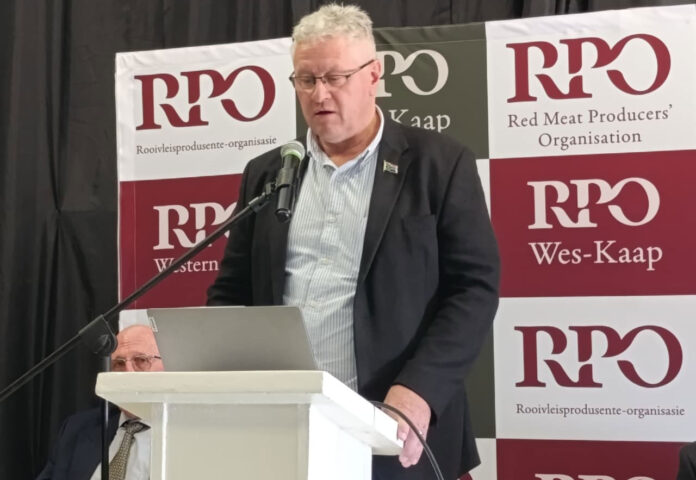
This was according to Dan Kriek, general manager of the National Wool Growers’ Association (NWGA), who spoke during the recent joint annual general meetings (AGM) of the Western Cape NWGA and the Red Meat Producers’ Organisation at Nampo Cape in Bredasdorp.
Giving feedback on his recent trip to the International Wool Textile Organisation (IWTO) Congress held in Dalang, China, Kriek said the visit had left him feeling positive about the future of wool, despite continued uncertainty on global markets.
China’s appetite for wool grows
The congress in Dalang gave delegates a first-hand view of the scale and sophistication of China’s knitwear industry, he said. The town, home to more than 30 000 knitwear-related businesses, employs about 200 000 people, with around one in every five jerseys from around the world being produced there.
Annual transactions across Dalang’s full knitwear industrial chain exceed RMB72 billion (around R172 billion), including more than RMB40 billion (R96 billion) in yarn transactions alone. The town is working towards developing an industrial cluster worth more than RMB100 billion (R240 billion).
Kriek said the technology used in China’s textile sector was equally impressive. Advances in machinery and artificial intelligence were dramatically shortening production processes, with a wool garment being able to move from design to finished product in about two hours.
China’s interest in wool was growing strongly, he added, with wool sales up 100% in the country.
“That is a very strong demand,” he said, describing the trend as a positive signal for the global wool industry.
China was also investing heavily in developing its own brands, while innovation was broadening wool’s use in areas such as sportswear and lifestyle clothing.
Wellness opens another opportunity
Kriek said changing consumer priorities could provide further opportunities for wool.
According to information presented at the congress, the global wellness economy had doubled since 2013, now spanned 11 sectors and was growing faster than global GDP. It was already larger than sectors such as sport, tourism, the green economy and information technology.
“This matters to wool, because wellness is increasingly influencing how consumers evaluate the products they buy, their surroundings and their daily routines,” he said.
Wool’s natural attributes could therefore become increasingly valuable as consumers seek products that fit into healthier and more environmentally conscious lifestyles.
Wool market turns after difficult years
Improving demand comes as wool prices recover following several difficult years. South Africa’s Wool Market Indicator increased by 54% over the 2025/26 season across 33 catalogue sales.
The international market is also up. The price of 19-micron wool in 2025 was more than 39% higher than in late 2024, while the price of 28-micron crossbred wool has risen by more than 75%.
Crossbred wool prices began recovering in 2024, followed by a strong improvement in Merino prices in 2025.
Tightening supply was significant in the fibre’s turnaround, with global clean wool production being 7% lower than in 2023, and global sheep numbers declining by around 2%. Production among major Southern Hemisphere exporters had contracted even more sharply.
Kriek said Australia and New Zealand were experiencing substantial declines in sheep numbers and wool production, while South Africa had held up better comparatively.
South African production was nevertheless also under pressure, declining from about 50,6 million kilograms in 2020/21 to 43,6 million kilograms in 2025/26, a drop of around 14% over six seasons.
Australia provided an indication of how constrained future supply could become. Its wool production had declined by about 22% over the past decade from 325 million kilograms to 255 million kilograms. Kriek added that the country appeared to be heading towards substantially lower production.
Natural fibre production was therefore constrained, while volumes of competing fibres such as polyester and cellulosic continued to increase.
Certification set to become more important
Kriek warned that the better market outlook did not lessen the importance of sustainability and certification.
On the contrary, he expected certification requirements to become more demanding, with producers increasingly required to provide scientific evidence to substantiate claims that their production systems were environmentally sustainable or regenerative.
The IWTO was working to strengthen the scientific evidence supporting wool’s environmental credentials through initiatives including its Green Book.
Kriek said this was particularly important as the industry challenged environmental assessment methods that could result in synthetic fibres such as nylon and polyester being rated more favourably than wool.
Against this backdrop, he pointed to Australia as an example of how wool producers were already building a stronger evidence base around sustainability through nature-positive farming practices.
According to his presentation, 89% of Australian wool growers used multiple practices to encourage soil health, while 73% of sheep producers undertook activities to maintain, measure or enhance biodiversity. Almost half generated and used renewable energy.
Research was also being conducted there into methane mitigation, with trials involving feed additives achieving reductions in methane emissions from grazing sheep up to 50%.
Kriek said South Africa was well positioned in an increasingly demanding market because of the quality of its wool, established classing standards and level of certification.
“Our quality is still our competitive advantage,” he said.
He also highlighted the inclusive nature of the local industry. About 15% of South Africa’s wool was produced by small-scale and communal farmers, with the NWGA working in partnership with government to support these producers. Kriek said this was a characteristic that distinguished the South African wool industry nationally.
Uncertainty still clouds outlook
Despite the more positive market signals, Kriek cautioned that producers still faced considerable uncertainty.
Conflict in the Middle East and uncertainty surrounding US tariffs were among the geopolitical factors clouding demand prospects for 2026/27.
El Niño added another layer of uncertainty for producers, reinforcing the need to remain adaptable and diversified rather than relying too heavily on predictions about the season.
Against this backdrop, Kriek urged wool growers to concentrate on the factors they could control, particularly maintaining quality and strengthening the resilience of their businesses.