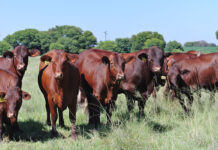
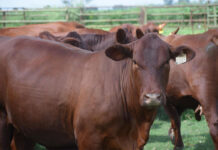
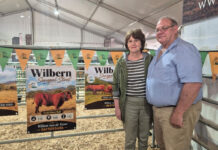
He runs the Northfield Nguni Stud on his 700ha farm in Palmietloop, near Mokopane in Limpopo. He also operates a veterinary practice in Bela-Bela.
Bester believes the Nguni’s greatest strength lies in the fact that its resilience was shaped long before modern breeding programmes existed.
“The three As are adaptability, adaptability, and adaptability,” highlights Bester.
Built by natural selection
According to Bester, the Nguni story as an indigenous breed stretches back thousands of years.
“They started adapting 8 000 years ago when they started moving down Africa.”
Along the way, cattle encountered droughts, predators, diseases, and harsh environmental conditions that shaped the breed over generations.
“They got corridor disease, they got foot-and-mouth, they got everything. The animals that adapted and survived all of that are the animals we’ve got today,” explains Bester.
For him, this history remains one of the breed’s greatest advantages.
“Only the toughest cattle reached Southern Africa.”
He argues that adaptability is not something that can simply be bred into cattle over a few generations.
“I can’t breed adaptability. It’s something we’ve already got,” notes Bester.
In his view, the challenge for breeders is not to create adaptability but to preserve the characteristics that have allowed the breed to thrive under African conditions for centuries.
Fertility and longevity
While adaptability lies at the heart of the breed’s appeal, Bester believes fertility remains one of the Nguni’s most valuable production traits.
“You’ve got to have an animal that gives you a calf every year,” Bester points out.
He sees a strong link between fertility and adaptability.
“Fertile animals are usually the animals that are adaptable.”
According to Bester, one of the practical benefits of that combination is longevity.
“A proper Nguni will give you at least 14 to 16 productive years,” says Bester.
He points to cows in his own herd that remain productive long after many commercial beef cows would normally be culled. His oldest cow is currently 21 years old and still in calf.
For producers farming under extensive conditions, he believes longevity reduces replacement pressure and contributes significantly to overall efficiency.
Looking beyond calving percentages
Bester believes many cattle producers focus heavily on conception rates, calving percentages, and weaning figures, but overlook another important aspect of profitability, namely erosion.
“You’ve got good fertility, good calving rates, and even good weaning rates, but erosion is the calves that never make it to adulthood,” explains Bester.
He says disease pressure, environmental stress, and poor adaptation can quietly erode profitability, even when basic production figures appear satisfactory.
For that reason, he regards adaptability as more than a biological trait. He believes it has a direct impact on the economics of beef production.

Lessons from veterinary practice
Bester’s views are shaped not only by more than three decades of breeding Nguni cattle but also by his experience as a veterinarian working across multiple breeds and production systems.
Over the years he experimented with other breeds and crossbreeding systems, believing there might be opportunities to improve production.
However, the results often came at a cost, notes Bester, especially the more the crossbreeds moved away from the Nguni genetics further down the line.
“I thought, yes sir, let’s go this way, let’s go that way, but my management costs just skyrocketed,” says Bester.
He warns that additional management requirements, health challenges, and production losses frequently offset any perceived advantages.
“As soon as I lose the footprint of the Nguni, my management becomes a big headache.”
Bester says one of the Nguni breed’s greatest strengths lies in its ability to perform with relatively low levels of intervention under extensive conditions.
Adaptability and disease resilience
Bester believes the Nguni’s adaptation to African conditions may also contribute to how the breed responds to disease challenges.
Drawing on his veterinary experience, he says indigenous breeds often react differently to production pressures than many European-origin breeds.
“European breeds are more susceptible to foot-and-mouth disease (FMD),” Bester pointed out.
While he stresses that Nguni cattle are not immune to FMD, he believes they generally cope well under local conditions, which hardly affected his stud.
“They do get FMD, but they usually just become lame. Disease resilience forms part of a broader package of traits that includes hardiness, fertility, longevity, and adaptability,” says Bester.
A breed for the future
Looking ahead, Bester believes climate change, rising input costs, and increasing pressure on grazing resources will place even greater emphasis on efficient, adaptable cattle.
“Cow efficiency will become one of the most important traits,” Bester points out.
He believes indigenous breeds will play an increasingly important role in South African beef production over the coming decades due to their natural adaptability.
“Thirty years from now, we’re going to have more indigenous cattle in South Africa,” says Bester.