
The engagement, held at the Karkloof Country Club near Howick, KZN, after Steenhuisen’s visit to Colbourne Dairy Farm, laid bare the mounting economic losses, emotional strain, and deepening mistrust between producers and government.
“You should have acted sooner. We warned that [FMD] was spreading, and now we are paying the price,” Peter Griffin, a dairy farmer in Mooi River and chairperson of the district’s Disease and Biosecurity Committee, told Steenhuisen.
“Government failed us. If decisive action had been taken at the start, we would not be sitting with this scale of infection.”
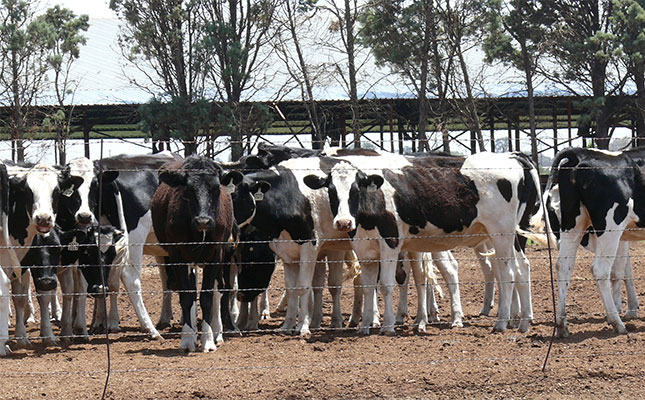
The confrontation unfolded in a province that houses an estimated 300 000 dairy cattle and produces nearly 30% of South Africa’s milk. For many farmers present, the crisis has already moved beyond containment to survival.
Vaccine rollout under scrutiny
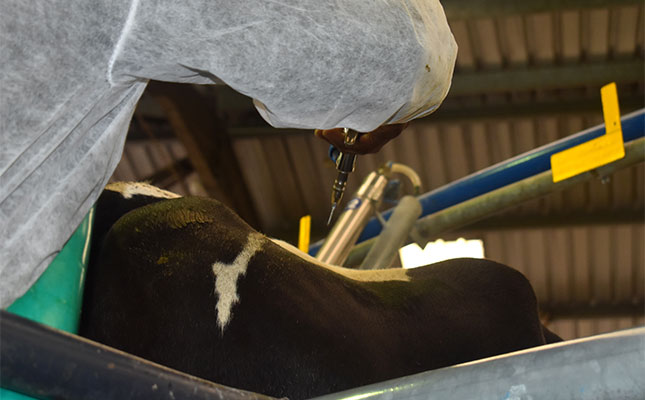
Farmer’s Weekly was also present when, earlier that day, Steenhuisen officially launched the province’s vaccination drive, with 850 dairy cattle inoculated with the Biogénesis Bagó vaccine from Argentina. The doses formed part of emergency shipments secured to curb viral spread.
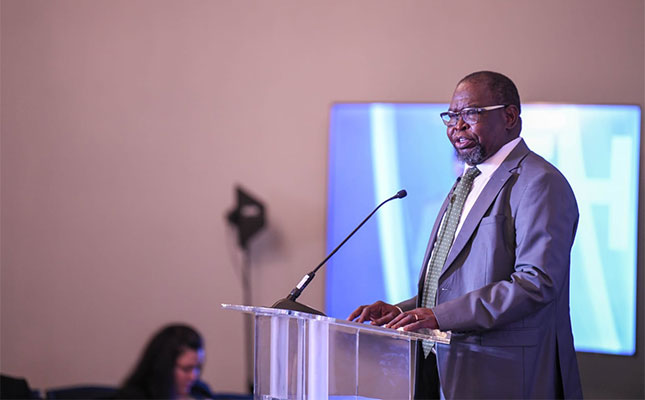
Addressing farmers, Steenhuisen called for unity. “Achieving an FMD-free status with vaccination is a collective effort that requires total cooperation between farmers and the state,” he said.
He confirmed that 1,5 million doses of the Turkish Dollvet vaccine were due to arrive, with five million additional Biogénesis Bagó doses expected on 15 March. A further six million doses are scheduled two weeks later, bringing the total to 13,5 million doses by the end of March.
“We are laser-focused on suppressing viral circulation. By leveraging agents like Dunevax, we are proving that the [Agriculture] Department is willing to work with any partner who can help us protect our national herd.
“We are focused on action and results, and we will continue to deal decisively with every outbreak until South Africa is FMD-free,” Steenhuisen added.
Government aims to vaccinate 80% of the national herd by December and regain FMD-free-with-vaccination status from the World Organisation for Animal Health to restore export markets.
Speaking at the event, Dipepeneneng Serage, deputy director-general of agricultural production, biosecurity and natural resources at the Department of Agriculture (DoA), said dairy cattle – estimated at 1,5 million nationally – will be prioritised, with the DoA aiming to vaccinate all dairy animals by the end of April.
But for many milk producers, the assurances came too late. Dave Moberly, a dairy farmer from Creighton near uMzimkhulu, described the outbreak as ‘horrific’. Of his 1 200 cows, 800 were infected and 500 severely affected.
After hearing of an outbreak nearby, he attempted to secure vaccines, only to learn that state stocks were unavailable. He sourced the Botswana vaccine privately, but the process required authorisation from Pretoria and the Allerton Provincial Veterinary Laboratory in Pietermaritzburg.
The result was a 10-day delay, followed by a further four-day wait after officials “forgot to get the vaccine”.
“Had we injected two weeks before when we were asking [for the vaccine], we wouldn’t have been infected,” he told Farmer’s Weekly.
Moberly’s milk production plummeted from 21 000ℓ/day to 11 500ℓ/day, translating into losses of roughly R1,5 million per month in milk income alone. Veterinary costs have already exceeded R500 000 above normal expenditure.
“It just costs us, and it makes me angry. All this should never have happened. If we just had a state that was a little bit more on the ball, we’d have been okay,” he added.
‘It’s the fear of the unknown’
Debbie Stratford of Stratford Dairy in Mooi River, which milks about 3 500 cows across four farms and employs 100 staff, said three of their farms have been affected.
“This virus does not only affect the animals, but the people are emotionally affected as well. Everyone has been scared of what’s coming, and it’s affected our interpersonal relationships. People are highly strung and emotional. It’s terrible,” she explained to Farmer’s Weekly.
Stratford said she had already written to Steenhuisen in August 2024 warning that the outbreak was approaching.
“We needed help, and we haven’t received the help on time,” she said.
“It’s the anticipation and fear of the unknown. Normally, we know how to fix problems. We know how to budget for issues… but we haven’t known how to deal with this.”
Mooi River farmer Rob Strachan questioned the long-term sustainability of the response.
“Where were you and your officials in December? A lot of us were under serious strain. What guarantee do we have that our cattle will receive booster shots in time, and what is the long-term plan?” he asked Steenhuisen.
“I have children who are interested in farming, but they don’t see a future in it if this isn’t handled properly.”
The concerns of most of the farmers present centred on the availability of booster shots – critical to maintaining immunity – and whether procurement and logistics systems would once again delay delivery.
Race against the virus
Veterinarians warn that once FMD enters a herd, it spreads rapidly. Dr Gareth Myles of the Howick Veterinary Clinic described the disease as ‘incredibly aggressive’, estimating that between 30 000 and 40 000 dairy cows in his practice area alone are at risk.
“We’ve got biosecurity and vaccination – our only two tools to combat this disease – and biosecurity only goes so far,” he told Farmer’s Weekly.