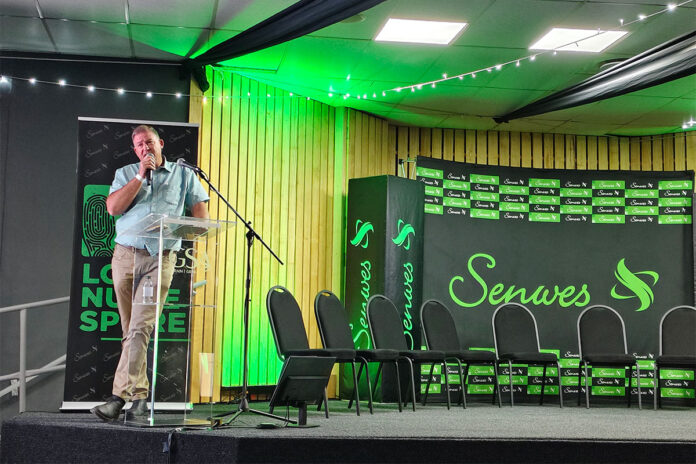
This was one of the central messages to emerge from the Road to Recovery event held at Nampo Alfa in Bothaville, Free State, on 2 October.
Kobus Bester, chairperson of the Stud Breeders Federation and initiator of the event, said the livestock industry was fortunate to have dedicated people working to address its problems. However, they were often too few, operated in silos, and eventually “ran into walls”.
At the same time, systems and structures had already been developed to address some of the industry’s challenges, yet these were not always being effectively implemented.
Bester questioned why this was the case, suggesting that in some instances political or, as he described them, “sinister” reasons stood in the way of implementation.
For Bester, the answer lay in combining efforts and uniting across organisations, regions, and livestock species, rather than allowing different parts of the industry to continue trying to solve problems independently.
He urged role players to look beyond individual organisations and interests and measure what they said and did against whether it contributed towards creating a future in which every link in the value chain could be profitable, sustainable, and prosperous.
Problems identified years ago
Bester’s concerns were echoed by Gerhard van der Burgh, senior analyst at the Bureau for Food and Agricultural Policy (BFAP) and managing director of the Integrated Value Information System (IVIS), which showed that many of the shortcomings raised during Road to Recovery had already been identified when the industry’s long-term strategy was developed. (Read a shortened version here: Red Meat Industry Strategy 2030 Shortened_Final)
Van der Burgh said the red meat industry was therefore not without a roadmap.
Work on what became the Red Meat Strategy 2030 started in 2021, building on the Agriculture and Agro-processing Master Plan and earlier efforts to establish a structure capable of taking the industry forward.
The strategy identified four focus areas: animal and public health, inclusive growth, market access, and competitiveness. It also identified constraints that could prevent progress, including the lack of a unified industry voice, inadequate funding, insufficient delivery capacity, shortcomings in state veterinary capacity, and the implementation of traceability.
Van der Burgh said the lack of a unified voice remained particularly problematic.
If 20 different individuals and organisations approached government independently, he asked, who was government supposed to listen to?
He likened it to a classroom in which everybody shouted at the same time. Ultimately, somebody had to put up their hand and articulate what the industry collectively wanted.
Who will ‘move the ship’?
However, speaking with one voice and agreeing on priorities would achieve little without the capacity to implement them.
This could range from delivering services on farms and implementing vaccination programmes to developing traceability systems or travelling to export markets to negotiate access.
That, Van der Burgh stressed, was the difference between discussion and delivery.
The 2022 strategy had already proposed a structure separating three important functions: aligning the broader sector, directing primary-industry priorities, and delivering services.
Under this model, the Meat and Livestock Value Chain Round Table would address sector-wide issues, while the Red Meat Primary Cluster (RMPC) would facilitate and direct priorities, build cohesion, and help prevent duplication.
Red Meat Industry Services (RMIS), in turn, would be responsible for implementation and service delivery in areas such as traceability, research, and animal health.
Van der Burgh illustrated the challenge with the image of several relatively small vessels trying to move a much larger ship – the R44 billion red meat industry in 2024.
Moving that ship required more than structures on paper, he said. It needed budget, people, mandate and authority, together with clear accountability for delivery.
However, agreements around roles, accountability, and the avoidance of duplication still needed to be settled.
Levy well below sector average
Funding was another major constraint. Figures presented by Van der Burgh showed that the red meat industry’s reported statutory levy income amounted to R51,2 million in 2024.
This was slightly below the R51,5 million generated by the considerably smaller pork industry, while citrus generated R274,2 million, soybeans R169,3 million, and deciduous fruit R160,1 million.
More important than the absolute figures, however, was the levy intensity. The historical aggregate red meat levy equated to only 0,09% of first-point-of-sale value, compared with an average of 0,50% across levied South African agricultural sectors.
In other words, the red meat rate amounted to only about 18% of the agricultural-sector average.
Van der Burgh said this was insufficient to support the broad range of functions required to grow the industry, including animal health and biosecurity, inclusive growth, market access, competitiveness, sustainability, and research.
He illustrated what stronger funding could look like by using 0,36% of first-point-of-sale value as a possible step up from the historical 0,09%. Yet, even at this level, the levy would remain 28% below the 0,50% agricultural-sector average.
Increasing contributions, however, remained contentious. When the industry was consulted in 2021, there had already been considerable resistance to asking farmers, feedlots, and abattoirs to pay more.
The question was therefore not simply whether the levy should increase, but what the sector wanted to achieve, what services and capacity were required to get there, and how these should be funded.
Traceability and veterinary shortages
The funding question was closely linked to traceability. A system capable of linking animals to their owners and farms, and tracking them through subsequent processes in the value chain, could enable different approaches to collecting industry funding.
Its importance, however, extended well beyond levies. Traceability was also a critical enabler for animal-disease management, compartmentalisation, trade, and exports.
State veterinary capacity represented another major constraint.
Van der Burgh’s figures showed that national and provincial agricultural budgets together amounted to about R28,9 billion, while provincial veterinary services received about R1,46 billion in 2024.
Against an estimated R2,8 billion required under the veterinary strategy, this left a funding shortfall of more than R1,4 billion.
By comparison, about R5,1 billion was budgeted for agricultural producer support and development. Van der Burgh therefore questioned whether the veterinary-services problem should simply be viewed as government not having sufficient funds.
Agricultural organisations, he argued, should also engage with how existing
Inadequate veterinary capacity affected far more than the number of veterinarians available in the field. It also affected laboratories, critical veterinary posts, export-related services, and veterinary health certification, as well as the country’s capacity to deal with diseases that posed risks to both animals and people.

Cost of failing to deliver
The consequences of these unresolved structural, funding, and animal-health constraints were increasingly evident in the industry’s performance.
When the Red Meat Strategy 2030 was developed, different scenarios were modelled for the industry’s future, including a ‘low-road’ scenario.
Four years later, Van der Burgh said the industry’s gross production value was hovering around the trajectory projected under that scenario.
“We are hovering right on the red line,” he said, adding that exports were among the major factors contributing to this outcome.
The impact of foot-and-mouth disease (FMD) illustrated the potential cost of remaining on this trajectory.
Updated BFAP modelling presented by Van der Burgh put the total gross production value impact between 2025 and 2035 at R21,1 billion compared with the pre-FMD baseline.
The pressure was also visible in exports. Beef exports from January to April amounted to about 7 700t, compared with 14 100t over the corresponding period in 2025.
Export recovery therefore remained critical, particularly as domestic consumers were under considerable financial pressure and could not necessarily absorb red meat at the value it could command internationally.
However, increasing exports required a substantially lower-risk operating environment.
Van der Burgh highlighted effective traceability and compartmentalisation, secure animal health, certainty around export protocols, trade and supply assurance, and quality assurance as important prerequisites.
Without these, businesses faced considerable risk when investing in export capacity.
Abattoirs wanting to enter export markets could have to spend tens of millions of rand on infrastructure, chillers, certification, and audits. Van der Burgh said such investments were difficult to justify if an animal-disease outbreak or uncertainty around export protocols could abruptly close a market and leave the business carrying the cost.
Far-reaching benefits
The scale of the challenges – and the potential benefits of addressing them – extended far beyond formal commercial agriculture.
Figures presented by Van der Burgh showed that more than 553 000 households responsible for 50 or fewer cattle accounted for about 5,3 million cattle, or 41% of the national herd.
In the goat sector, almost 483 000 such households accounted for about 6,03 million goats, or 86% of the national herd.
Many of these livestock owners were concentrated in areas with high levels of poverty, where cattle and goats represented important household assets and sources of economic security.
Improving animal-health services, traceability, and market access would therefore not only strengthen the commercial livestock industry, but could also benefit hundreds of thousands of smaller livestock-owning households by protecting the value of their animals and improving their ability to participate in the wider livestock economy.
Time for the 2026 report card
The fact that the industry was tracking close to the low-road scenario gave added urgency to the mid-term review envisaged when the strategy was developed.
Rather than simply revisiting the document, Van der Burgh said the industry now had an opportunity to measure actual performance against the priorities set several years earlier and determine where implementation had fallen short.
“A strategy is only as good as its updating,” he said, stressing that it needed to remain a living document.
The review therefore needed to establish what had actually been implemented, what remained relevant, what had changed, who was responsible for the next actions, and whether sufficient funding and capacity were available to deliver them.
From strategy to disciplined delivery
Ultimately, Van der Burgh’s presentation returned to the same issue Bester had raised at the start of Road to Recovery: how to turn plans and structures into action.
Quoting the management maxim “culture eats strategy for breakfast”, Van der Burgh questioned why the industry had seen so little change over many years despite repeated strategies and initiatives.
He added another: “Structure eats culture for dinner.”
Changing the industry’s trajectory, he said, required four elements: a shared direction, a credible driver, a fit-for-purpose structure, and disciplined delivery.
Disciplined delivery, in turn, meant funding agreed actions, monitoring progress and impact, identifying bottlenecks, and adapting where necessary.
Accountability was particularly important. In business, failure to perform carried consequences. The industry therefore also needed to ask what happened when service organisations, individuals, or government failed to fulfil the responsibilities expected of them.
For both Bester and Van der Burgh, the fundamental issue was therefore not whether the industry had a plan. It was whether its role players could unite behind that plan, adequately fund the structures responsible for carrying it out, and hold those structures accountable for delivery.