

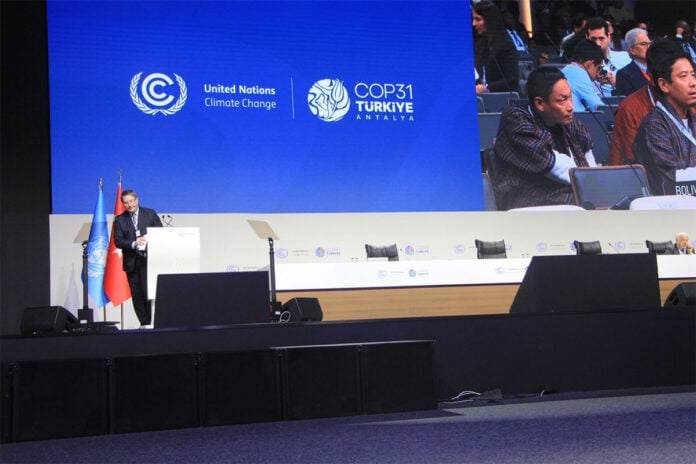
The 31st Conference of the Parties to the United Nations Framework Convention on Climate Change (COP31), held in Antalya, Türkiye, from 9 November, draws to a close today. Negotiations have focused on turning international climate commitments into practical action.
For South Africa, improving agricultural resilience and securing funding to implement climate adaptation projects remain key priorities, according to the Department of Forestry, Fisheries and the Environment (DFFE).
Climate finance is a priority
Climate finance has remained a major sticking point, particularly over how much funding developed countries should provide and how easily developing countries can access it.
Speaking to the media, Deputy Director-General for Climate Change and Air Quality Management Maesela Kekana said South Africa already had ambitious climate plans.
“South Africa is not short of plans. What is lacking is implementation, and why implementation is lacking is because of funding,” he said.
Kekana added that developing countries could not be expected to meet their climate commitments without the necessary financial support.
“The issue of action goes with support,” he said, adding that developing countries had ambitious measures they needed to implement.
“We need to see enhanced funding or increased finance, either for adaptation, but also for mitigation and loss and damage. Then you’ll see action.”
Kekana said South Africa already had a pipeline of projects that could be implemented if the necessary funding became available.
“We need the developed countries to follow through with their commitment and obligation, which is funding.”
He added that the scale of international climate funding remained far below what developing countries required.
“We are getting millions in this system, but actually we need trillions for the Global South.”
He said adaptation funding was particularly important for countries such as South Africa, which needed substantial investment to strengthen their economies against climate-related disasters.
Impact on agriculture
Delivering South Africa’s national statement on behalf of President Cyril Ramaphosa on 17 November, Minister of Forestry, Fisheries and the Environment David Maynier said the country would need more than R250 billion in investment and climate finance to fully implement its climate adaptation measures between 2026 and 2035.
He said the funding would support the country’s efforts to prepare for and respond to climate change across several sectors, including agriculture, as farmers faced increasing pressure from unpredictable rainfall, prolonged droughts, floods, and rising temperatures.
Maynier said the country was implementing its Climate Change Act and National Climate Change Adaptation Strategy, while individual sectors were developing their own plans to reduce climate risks.
“There has been progress in implementation, but significant gaps remain,” he said.
“South Africa is already experiencing the effects of climate change, including heatwaves affecting agricultural systems, severe droughts reducing water availability, and heavy rainfall damaging infrastructure. Our agricultural communities, particularly vulnerable smallholder farmers, continue to face significant risks from prolonged drought and other climate-related disasters.”
Maynier said adaptation remained a national priority, with South Africa calling for a clear plan to triple international adaptation finance by 2035 and mechanisms to monitor whether this funding was being delivered.
“The widening adaptation gap is of concern to us,” he told delegates, reiterating the country’s call for greater and more reliable financial support.
He also called for sufficient and predictable contributions to international climate funds to ensure that developing countries could implement their adaptation plans.
Agriculture on the negotiating agenda
South Africa has also been actively involved in COP31 negotiations on reducing greenhouse gas (GHG) emissions and securing support for developing countries to meet their climate commitments.
Kekana co-facilitated discussions alongside Dr Ursula Fuentes Hutfilter, head of the Division for Climate Foreign Policy at Germany’s Federal Ministry for the Environment, Climate Action, Nature Conservation and Nuclear Safety.
The talks focused on the future of the Sharm el-Sheikh Mitigation Ambition and Implementation Work Programme, including how it could be improved and extended beyond 2026, and how developing countries could access the finance and technical support needed to reduce emissions.
Another important issue at COP31 was the future of the Sharm el-Sheikh Joint Work on Implementation of Climate Action on Agriculture and Food Security (SJWA), which aims to strengthen international action on climate change in relation to agriculture and food security.
However, countries failed to reach an agreement on the future of the SJWA during the first week of COP31. On 14 November, negotiators agreed to continue discussions in June 2027 and report back at COP32 in November next year.
Energy transition and jobs
Beyond agriculture, South Africa is also negotiating for a fair energy transition that takes account of its dependence on coal and the need to protect jobs.
In his statement, Maynier confirmed that the country had submitted updated emission reduction targets under the Paris Agreement.
He said the country aimed to reduce annual GHG emissions to between 320 million and 380 million tons of carbon dioxide equivalent by 2035, compared with its 2030 target range of 350 million to 420 million tons.
However, he emphasised that developing countries needed investment and technical assistance to meet their targets, rather than additional commitments without financial support.
South Africa is calling on developed nations to support a renewed international programme that attracts investment into projects aimed at reducing GHG emissions. It is also pushing for the implementation of a Just Transition Mechanism to facilitate international cooperation, technical assistance, skills development, and access to funding for developing countries.
“Just transition cannot be reduced to energy transition or emissions reductions only. It must also address economic diversification, industrialisation, employment, and decent work, skills, social protection, technology, trade, value chains, resilience, and sustainable development,” Maynier said.
He also raised concerns about climate-related trade measures, including the Carbon Border Adjustment Mechanism, warning that such measures could restrict access to international markets and place additional pressure on developing economies.
South Africa has also called for more funding to help countries recover from climate-related disasters, including through the international Fund for Responding to Loss and Damage.
Maynier said developed countries needed to honour their financial commitments, particularly as poorer nations were increasingly experiencing severe weather events.
He added that his department had submitted a US$20 million funding proposal to the Green Climate Fund on behalf of South African National Parks for restoration work in Kruger National Park and the surrounding conservation landscapes following severe flooding earlier this year, but the proposal has yet to be approved.
Talks enter final stages
With COP31 concluding today, ministers are attempting to resolve outstanding disagreements over finance, climate adaptation, and energy.
Maynier said the outcome would be crucial in determining whether international climate commitments translated into accessible funding and practical support for agriculture, rural communities, and the wider economy.
“South Africa stands ready to work with all nations to turn commitment into action and ambition into results,” he added.