

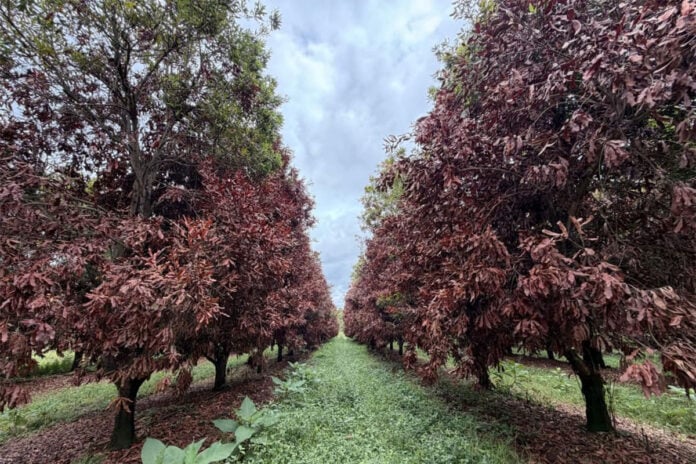
Org Lindeque, chairperson of Barberton Agri Boerevereniging (Barberton Agri), told Farmer’s Weekly that macadamia farmers faced the same level of threat that livestock farmers did with foot-and-mouth-disease (FMD).
“The coccid is destroying our orchards and threatening our livelihoods. We desperately need help, and we need it now, not in a few months,” he said.
Barberton Agri has been pushing for greater intervention to combat MFC (Acanthococcus ironsidei) since the spread of the pest had not slowed down from the time it was first detected in2017.
“More needs to be done, and it should’ve been done a long time ago already,” Lindeque said.
Barberton Agri wrote to Minister of Agriculture Willie Aucamp earlier this year requesting a site visit so that decision-makers could see the damage first-hand. The Department of Agriculture (DoA) subsequently visited affected farms in November, along with representatives from Macadamias South Africa (SAMAC), Biosyntrix, and Agricultural Innovation for Tropical and Sub-tropical Africa (AITSA). Delegates saw extensive damage across three farms.
AITSA reported that at Vosmac farm, delegates viewed severe infestations that had caused leaf necrosis and canopy dieback affecting more than 80% of some trees. At Barberton Valley Plantations, large sections of trees had lost bearing wood and nut set, with even the relatively hardy Beaumont cultivar showing severe infestation. A third farm demonstrated the cumulative damage caused by several seasons of infestation.
MFC was first recorded in the Barberton Valley in April 2017, when severe infestations were found across approximately 16ha of mature macadamia orchards. Nearly a decade later, the problem has spread across most of Mpumalanga. As of this November, the pest was also confirmed in Ohrigstad, Limpopo.
In total, it is estimated that 34 000ha of macadamias are infected, representing nearly half of the orchards in South Africa.
Limited progress in research-based solutions
The spread of MFC was exacerbated by a lack of biosecurity measures and adequate research on pest control.
In an anonymous letter sent to SAMAC on 5 November, members requested a special general meeting. Among the issues placed on the proposed agenda was the request for an MFC action plan.
In a written response, SAMAC stated that the organisation had invested more than R6,3 million in MFC research up to 2026 and had communicated research findings, technical guidance, and biosecurity protocols to growers through newsletters, publications, and regional study groups.
SAMAC had also engaged the DoA on the pest’s regulatory status, surveillance, quarantine measures, and control options since at least 2022, including through the national MFC Steering Committee. The organisation was also funding research into chemical and biological controls, supporting applications for additional product registrations and coordinating research priorities.
However, an industry stakeholder, who spoke to Farmer’s Weekly on condition of anonymity, said the R6,3 million had done little to address the spread or containment of MFC.
“It’s the elephant in the room. Millions were spent funding research that doesn’t have any practical application for farmers. We don’t even have basic research on the biology of MFC, which is critically needed information to guide pesticide programmes. To fix the problem, you must understand the problem.”
They added that research was conducted in a laboratory in Pretoria, rather than having a research station in the Lowveld, where the infestation was prevalent.
The stakeholder also noted that few biosecurity measures were currently in place on farms.
“Seeing vehicles sprayed before entering farms, and foot baths between orchards, is very rare. MFC spreads through infected trees from nurseries, via wind, birds, machinery, and on people’s clothes. The spread is drastically sped up though human intervention, so it is critical that biosecurity measures are followed,” they said.
Crippling an already fragile industry
The financial implications are particularly concerning. AITSA noted that production costs were estimated at between R85 000 and R110 000/ha, while macadamia prices had fallen to approximately US$2,20/kg (around R37,96/kg) dry nut-in-shell. At an illustrative exchange rate of R16,50/US$, growers would need yields of approximately 2,4t to 3t/ha just to break even. In severely affected orchards, achieving these yields would no longer be possible.
Lindeque noted that pesticide costs amounted to around R60 000 to R70 000/ha on a farm where MFC was not present. When MFC control was added, the costs jumped to R100 000/ha.
Projections done by AITSA showed that as much as 45% of Mpumalanga’s macadamia area, approximately 14 600ha, could become seriously affected under a severe-spread scenario.
Based on this scenario, yield losses on affected orchards could reach 70%, while approximately 5 950 jobs across farming and processing could be at risk. If each farmworker supported four dependants, as many as 24 000 people in rural communities could be affected.
An urgent, coordinated response is needed
The AITSA statement warned that MFC could not be addressed through isolated farm-level interventions.
“The pest was introduced without its natural enemies, allowing populations to increase rapidly. Infested trees also become vulnerable to secondary problems, including Botryosphaeria dieback and bark and ambrosia beetles, further compromising tree health,” it said.
Although biological control options showed promise, including predatory beetles already observed in the Barberton Valley, AITSA said research and field testing were still needed. Growers also required access to effective chemical and biological control agents, faster registration of suitable products, and practical financial support to keep affected farms operational.
For now, farmers have been advised to use synthetic chemicals to control high levels of infestation. Where the pest numbers were still relatively low, biological control using Rhyzobius should be used.
Following the November farm visits, government convened a stakeholder meeting to discuss an action plan and possible solutions. A national and provincial government-led steering committee was identified as a key mechanism to coordinate research, registrations, grower support, and orchard rehabilitation.