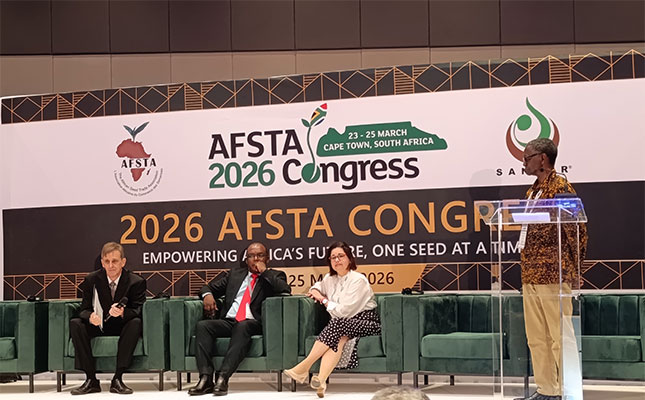
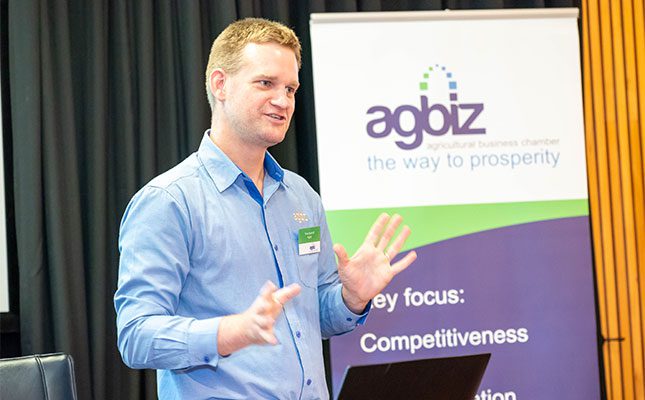
Speaking at the event, Agbiz CEO Theo Boshoff highlighted several policy developments achieved this year and offered a forward-looking view of the challenges and opportunities for 2026.
On logistics, he outlined the long regulatory and legal process that culminated in the Durban High Court clearing the joint venture between Transnet and International Container Terminal Services Inc (ICTSI) to proceed. The partnership will operate under a 51% (Transnet) and 49% (ICTSI) shareholding split.
“For the industry, it doesn’t really matter who the private-sector partner is. Our concern has always been that the state and Transnet should not backtrack on the principle of private-sector participation and that the process must move forward,” Boshoff told the media.
The deal will be formalised at a signing ceremony in December, after which Transnet and ICTSI will establish a special purpose vehicle (SPV) to run Pier 2 at the Durban Container Terminal.
“It is extremely positive that this deal is finally going ahead,” he added.
Upgrades at Cape Town Container Terminal
Boshoff also reported on improvements at the Cape Town Container Terminal (CTCT), where new equipment was introduced in September 2025. In what he described as a ‘miniature public–private partnership’, exporters, producer organisations, the Western Cape government, and value chain partners jointly funded the installation of two generators.
The R1,4 million investment was essential to maintain reefer container capacity and improve operational efficiency. The upgraded equipment now enables the terminal to handle 4 644 containers per day; volumes that would otherwise have been redirected to other ports. This led to major efficiency gains and cost savings for the industry.
“Contracts are now being signed to repeat this partnership at CTCT, and we hope to institutionalise it next year,” he said.
With significant technology upgrades under way at the Durban and Cape Town ports, Boshoff said he believes the industry is turning a corner. Export volumes have already increased, and with the stone fruit and table grape peak season in full swing, attention is firmly on Cape Town’s performance.
Road and rail: slow progress and critical milestones
However, rail transport remains a concern. “Unfortunately, we haven’t seen similar improvements in rail. Volumes continue to decline, but through constitutional reforms we have at least reached some critical milestones,” Boshoff said.
A key development was the publication of network statements – the terms and conditions governing third-party access to the rail network – which effectively levelled the playing field between private operators and Transnet Freight Rail.
Looking ahead, Boshoff highlighted the branch line concession programme that Transnet intends to roll out for roughly 7 300km of branch lines (94 lines) across rural and agricultural regions. These concessions are designed to attract private investment to revitalise critical rail corridors. The formal procurement process, including requests for proposals, is expected at the end of 2025.
Shift to road continues
In a second presentation on South Africa’s logistics landscape, Agbiz researcher Diaan Venter shared insights into the long-term shift from rail to road.
A notable trend, he said, is the increasing ratio of trailers to trucks. Logistics companies are buying more trailers per truck to maximise distribution efficiency, an area where rail simply cannot compete due to its inability to service last-mile destinations.
Venter presented data showing extreme pressure on the road network and the underutilisation of rail:
- Interlink trucks cause 125 000 times more road wear than passenger vehicles.
- Rail freight is 11% to 44% cheaper than road freight, yet it remains underused.
- The external costs of road freight are 11 times higher than rail.
With 76% of national roads exceeding their 20-year design life, and provincial roads in even worse condition, the maintenance backlog is estimated at R78 billion. Heavy vehicles alone cause R67 billion in damage per year, while passenger vehicle taxes cross-subsidise approximately 30% of freight costs.

“Volatile fuel prices and energy insecurity add further pressure to road-based freight models,” Venter noted.
The cost of fully revitalising the rail network is estimated at R200 billion, including R75 billion for new locomotives and rolling stock. Although rail becomes increasingly cost-effective over longer distances and higher-density loads, road transport continues to dominate due to its flexibility, entrenched systems, and service gaps in the rail network.
Two very different road networks
Venter also highlighted the stark divide between South Africa’s two parallel road systems:
- SANRAL-managed roads (22 000km): 92% rated in ‘fair’ condition
- Provincial and rural roads (around 750 000km): more than 60% rated ‘poor’ or ‘very poor’
“For agriculture, the major concern is reliable access to mills, silos, and production nodes,” he concluded.