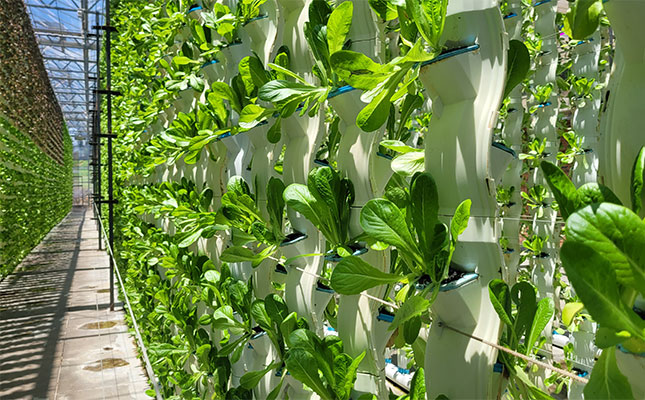
The promise of growing fresh produce indoors, close to consumers, attracted billions of rands in investment over the past decade. Vertical farming was widely pitched as a solution to climate risk, food miles, and urban food security, but rapid expansion, coupled with high operating costs, soon exposed the fragility of many business models.
In March 2025, US-based vertical farming company Plenty filed for bankruptcy after raising nearly US$1 billion (around R16,4 billion) in funding since 2014. The company cited unsustainably high costs and thin profit margins as the main reasons for its collapse, a pattern that has been repeated across the industry.
Francois van der Merwe, CEO of Clean Air Nurseries Agri Global (CAN-Agri), told Farmer’s Weekly that the concept of vertical farming made for a “great sales pitch”.
“It’s easy to see why it attracted so much investment, but looking at how most vertical farms are run – using expensive LED lighting and highly skilled labour – it’s also easy to see why the industry saw such a spectacular decline,” he explained.
According to him, a boom-and-bust cycle is typical of emerging industries and does not signal the end of vertical farming. “The next generation needs to learn from the [industry’s] mistakes, and that means fundamentally addressing high production costs.”
A valuable concept
South Africa’s relative lack of vertical farms is due to its favourable climate, which means food can be produced outdoors or in greenhouses, using free sunshine year-round.
Van der Merwe therefore stated that it is difficult to make a business case for vertical farming in the country, since the capital investment is not justified by the prices paid for the produce.
“But it is a viable option for countries that can’t produce outdoors all year. The disruptions we’ve seen over the last few decades – from 9/11 to COVID-19 – have made countries think differently about their food sources. There is a drive to become more self-sufficient and less dependent on imports,” he added.
A Mordor Intelligence report on the global vertical farming market shows that despite a slew of bankruptcies, investment in the industry continues, with growth expected at a compound annual growth rate (CAGR) of 19,66% between 2026 and 2031, reaching US$18,4 billion (R302 trillion).
The US accounted for 41% of revenue share in 2025, while Asia-Pacific is projected to grow at a CAGR of 18% to 2031. Mordor Intelligence expects Asia-Pacific to outpace every other region, although the US remains the revenue anchor, as controlled environment pilots and agritech grants cushion cash flows.
Lettuce and leafy greens are forecast to maintain the largest share of the vertical farming market, which stood at 35% in 2025. Their short 21-day growth cycles and strong retail partnerships contribute to high utilisation of their production lines. However, the report noted that expanding beyond speciality and foodservice channels remains a significant challenge.
Tomatoes and peppers face slower growth due to competition from greenhouse producers in Mexico, Canada, and the Netherlands, where access to free sunlight provides a cost advantage.
The boom-and-bust cycle has heralded a new era where investors are more focused on proven success and adequate margins. This has forced greater innovation and collaboration in the industry to reduce costs.
For example, the report notes that operators are experimenting with berry production and co-locating with data centres to capture free heat. Component vendors are capturing value through high-efficacy horticultural LEDs, and retailers are locking in multi-year offtake contracts to protect against open-field supply shocks.
While the first wave of vertical farming was driven by hype and abundant capital, the next phase is being shaped by pragmatism, with survivors focusing on redesigning systems around energy efficiency, tighter crop selection, and secure market access rather than scale alone.
As food security concerns intensify and climate volatility grows, vertical farming is unlikely to disappear. Instead, it is being forced to mature, shedding the hype in favour of models that can withstand economic pressure and deliver consistent returns.