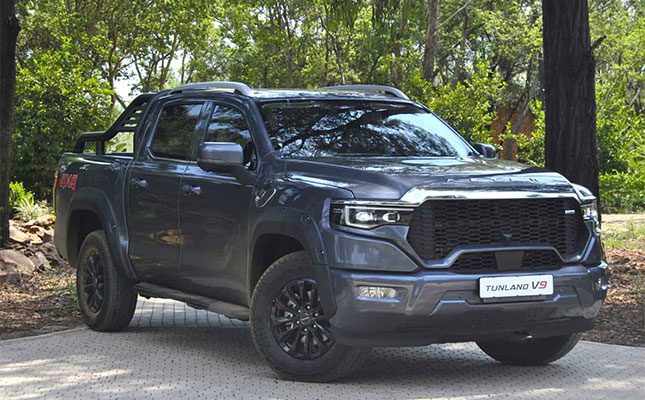
Foton’s unveiling of its V-Series represents a considerable step up from the likes of the Ford Ranger, Toyota Hilux, Isuzu D-Max, Volkswagen Amarok, and GWM P500. The V-Series comprises the V7 and V9, known locally as the Tunland V7 and Tunland V9.
Unique in design and segment focus, the Ford F-150-inspired V7 is positioned as the more rugged, off-road-oriented offering, while the V9, styled to resemble the South American Ram Rampage, is more comfort- and on-road-focused.
Although based on the same platform, the differences aren’t limited to the exterior, as the V7 utilises hydraulic power steering and a leaf spring design for the rear suspension.
For the V9, the rear suspension is a multi-link arrangement, and the power-assisted steering uses an electric rack.
SA’s longest bakkie
Foton claims both the V7 and V9 have a tow rating of 3 500kg, ground clearance of 240mm, wading depth of 700mm, and payload of 1 050kg.
Somewhat bizarrely, both have the same dimensions, unlike in Australia and China. This translates to an overall length of 5 617mm – the longest of any bakkie in South Africa – a wheelbase of 3 110mm, a height of 1 955mm, and a width of 2 090mm.
Only offered as a double cab, the line-up spans a total of four models, with each one making use of an upgraded version of the 2ℓ turbo-diesel engine used in the Tunland G7. Co-developed by long-time partner Cummins under the Aucan banner, the unit produces the same 120kW as the G7, but with torque increased from 390Nm to 450Nm.
Pedigree components
Adding to this is a 48-volt mild-hybrid system similar to the Toyota Hilux 48V, the ZF-sourced eight-speed automatic gearbox and a BorgWarner part-time four-wheel drive system complemented by front and rear Eaton locking differentials on all-paw gripping models.
In terms of specifications, both the V7 and V9 ranges start with the VLX grade, which only comes with two-wheel drive in the case of the latter. They also include 18” alloy wheels, side steps, folding electric mirrors, auto on/off LED headlights, roof rails, LED daytime running lights, integrated tailgate step, imitation leather upholstery, heated electric front seats, keyless entry, push-button start, wireless smartphone charger, 12,3” digital instrument cluster, and 14,5” infotainment system.
And, as with most Chinese vehicles, rear space isn’t lacking in either the V7 or V9.
Safe as houses
On the safety and driver-assistance side, all VLX variants feature cruise control, six airbags, front and rear parking sensors, a 360° camera system, blind spot monitoring, lane change assist, and driver attention alert.
The LTD or Limited V9 boasts adaptive cruise control, a panoramic sunroof, ventilated front seats, lane keep assist, automatic emergency braking, traffic jam assist, lane centring assist, and traffic sign recognition.
Starting and ending on the outskirts of Silver Lakes in Pretoria, Gauteng, the media launch route of less than 30km provided little opportunity to really get to grips with the V7 and V9. Initial impressions include a premium, spacious interior; impressive rear head- and legroom; the welcome retention of physical buttons on the centre console, steering wheel, and below the infotainment system; and satisfactory noise intrusion prevention.
What’s the verdict?
Included on the route was a section of badly rutted gravel, which felt more comfortable and better dampened in the V9 than in the V7. Although quieter and more refined than the G7, the added torque and mild-hybrid system haven’t had a dramatic effect on performance or improved power delivery.
While, admittedly, the models tested had covered less than 1 500km, they could have done with at least 10kW to 20kW more. The eight-speed box performed adequately but arguably not to its full potential, as was expected.
Vehicle pricing
Tunland V7 2.0D VLX AT: R689 900
Tunland V7 2.0D VLX 4×4 AT: R765 900
Tunland V9 2.0D VLX AT: R725 900
Tunland V9 2.0D LTD 4×4 AT: R799 900
Pricing includes a five-year/200 000km warranty and five-year/75 000km service plan.