
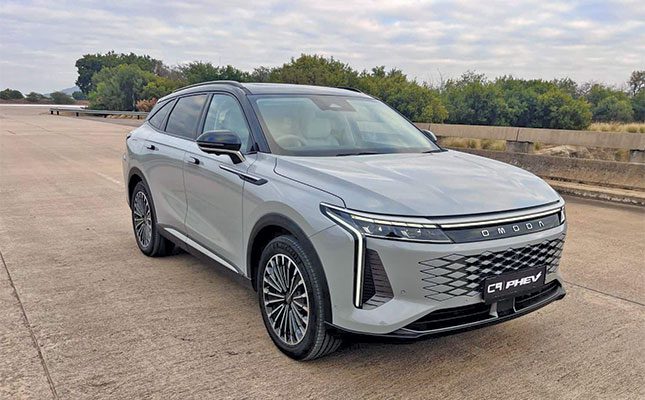
This SUV is always seen on display at high-end celeb activations, with the most recent being the prestigious Durban July.
PHEV stands for plug-in hybrid electric vehicle and this means that the 1,5ℓ turbo petrol engine gets a proper shot of electricity.
Making only 105kW and 215Nm, the petrol engine would not even be a threat to the VW Golf 8.5 1.4 TSI. But add a 34,5kWh battery into the mix that drives four electric motors, one at each wheel, and you have a 440kW/915Nm Golf GTI killer.
The battery adds 335kW of power and 700Nm of torque. The extra urge is driven down to all four wheels via a three-speed DHT auto box.
Stomping on the accelerator of the Omoda C9 PHEV produced a tested 0 to 100km/h time of 5,16s, which is fractionally slower than the claimed 4,9s, but it’s way quicker than the 5,88s posted by the VW Golf 8 GTI.
Inconsistenty issues
Is there a downside? The short answer is yes. There is a delay from when you hit the accelerator to when the C9 figures it all out and lets the car go. This everybody will live with, though, because after that it bolts.
What concerned me was that the runs were not consistent. Sometimes the petrol engine would kick in earlier and then later, and this meant you could get a fast Omoda C9 on one run, and a not so fast one the next. I even had it on one occasion where something glitched and the car limped to about 120km/h and wouldn’t go any faster.
What didn’t glitch was the fuel consumption. Omoda claims an overall figure of 1,4ℓ/100km and a range of 150km on the battery alone to give a combined number of over 1 100km.
The C9 PHEV offers 70kW fast-charging capability at public charging stations. This takes the car from 30% to 80% in around 25 minutes. Or you can use the Omoda-installed wall charger at your home and recharge the battery in 5,5 hours when it is parked in your garage doing nothing.
Excellent fuel economy
In my world, I could get away with using battery power most of the time. So, my cost to run the C9 PHEV was minimal and even below 1,4ℓ/100km. The only caveat is that although the car indicated that I had 150km of battery range when fully charged as claimed, this figure was never realised. The best I could get was around 100km.
This said, at the end of my week with the car, I ended up averaging an impressive 6,8ℓ/100km, including the drive out to Gerotek and all the flat-out runs done there.
Talking of drive, there was one thing that really irritated me – the brakes. The pedal feel is so electronically manipulated. No matter the setting chosen, the brakes were far too sensitive, especially at low speed.
And not once, but almost every time I applied the brakes, the passengers in my car landed up pinned against the seatbelts. Maybe over time as an owner one might figure the brakes out, but I couldn’t in the short time I had the car.
What’s the verdict?
The Omoda C9 PHEV offers all sorts of luxury and tech and every driver assistance feature is offered too. That is if you can get over the frustration of operating most of the controls on the big centre digital screen and ignore the odd system failure warnings that pop up on the dash. The car is a great place to spend a lot of time.
Pricing for the new Omoda C9 PHEV is R999 000, better priced than anything in its segment.