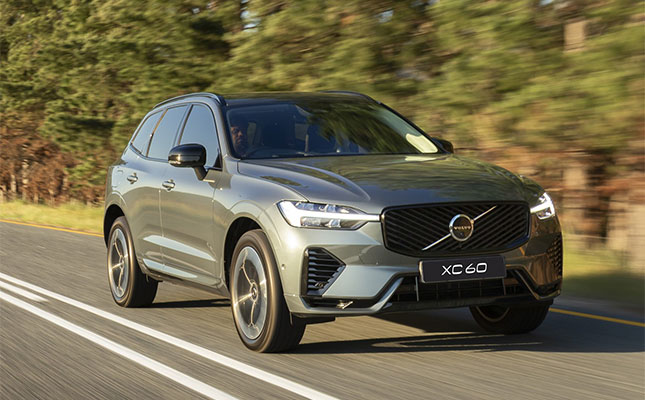
First, a quick overview of some of the updates, because you’d need to be a Volvo XC60 aficionado to notice them right away. The XC60 now features a reworked air intake, darker tail-lights, standard-fit LED headlights, a new wheel design, and an updated Volvo Iron Mark badge that aligns it with the recently refreshed XC90.
On the inside, you get a new 11,2” Google-powered infotainment system with the Snapdragon Cockpit Platform, a premium audio system, and upgraded materials with refreshed decorative inlays.
Also on the menu is an improved wireless phone charger, plus extra storage, including redesigned cup holders. That’s right, someone actually went ahead and redesigned the cup holders.
Plenty of punch
But for this review, we’ve focused on the X60’s performance, especially in potent T8 format, and its competitors.
The XC60 T8 is a plug-in hybrid electric vehicle (PHEV) that offers a combined 340kW of power and 709Nm of torque from its 2ℓ turbocharged petrol engine and electric motor.
Now, when pitched against its most direct premium rival on the technical side – the new R1 310 000 BMW X3 30e M Sport PHEV – you might think the R1 500 700 asking price for the Volvo XC60 T8 is over the top. But the X3 30e only offers 220kW/450Nm and is comprehensively outgunned by the XC60 T8 in terms of performance.
The Volvo XC60 T8 gets to 100km/h in just 4,8 seconds, while the BMW X3 30e gets there in 6,3 seconds. Top speed is a socially responsible whitewash in favour of the BMW, because all Volvos are limited to 180km/h. BMW, on the other hand, lets you decide your own risk, with the X3 30e hitting 247km/h.
Who is XC60 up against?
For the sake of performance comparisons (and to be fair to the Volvo XC60 T8), closer rivals would be the R1 545 447 BMW X3 M50, which produces 293kW/580Nm. And even the R1 902 263 Mercedes-AMG GLC43 could sneak in here with 310kW/500Nm.
The BMW X3 M50 gets to 100km/h in 4,6 seconds and hits an electronically limited top speed of 250km/h, while the AMG GLC 43 does 100km/h in 4,8 seconds and has the same top speed limit. I guess this is the kind of performance you’re thinking about if you’re eyeing a BMW or AMG, rather than a Volvo XC60 T8, but fuel economy is a whole different story.
Speaking of which, both the Volvo (19kWh) and the BMW (18kWh) have small lithium batteries, and both only allow ‘slow’ AC charging at a rate of 3,7kWh. This translates into a real-world electric-only drive of around 60km each.
For what it is worth, China, with its battery technology, is streets ahead of both, offering convenient high-speed DC charging and a far superior electric-only range.
Charging at home – as a typical PHEV owner would – let us get well below the 5ℓ/100km mark, which is when the PHEV part of the Volvo XC60 T8 really makes sense.
What’s the verdict?
Thanks to air suspension and laminated windows, the XC60 T8 rides incredibly smoothly – by far the best among the premium offerings. When it comes to digitalisation, though, the interior is starting to show its age and can’t compete with the large LCD clusters of the BMW and Mercedes-Benz. Even so, it’s easy to see why the XC60 remains the go-to choice for Volvo buyers.
Vehicle fast facts
Price: R1 500 700
Engine: 2ℓ turbo-petrol and electric
Transmission: eight-speed automatic
Power: 340kW
Torque: 709Nm
Fuel consumption (tested): 5ℓ/100km
Licensing mass: 2 158kg
Towing capacity: 2 250kg