
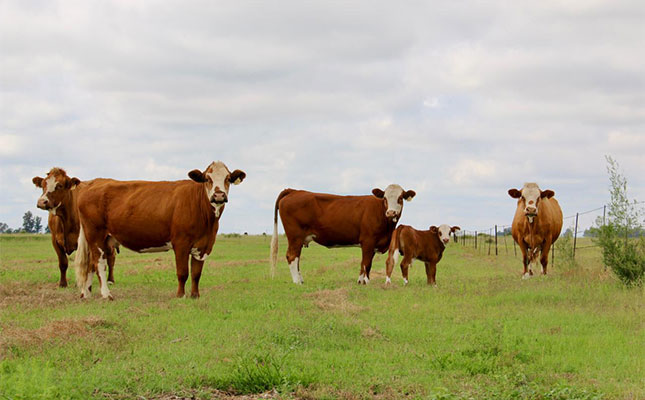
Located at Losdorings between Wesselsbron and Bothaville in the heart of South Africa’s maize triangle, Fardi Simmentalers is a young but ambitious stud focused on breeding productive, adaptable cattle for commercial beef producers. The operation runs a herd of 350 commercial cattle alongside 30 stud female animals in production, with a breeding philosophy centred on fertility, functionality and profitability.
For stud owner Hennie Steyn, the journey with Simmentaler cattle began long before the establishment of the stud.
“My love for Simmentalers started when I was a child; I always knew them as ‘spectacle cattle’,” he says.
“In 2013 I bought my first 3-in-1 from Oom Paul Maas of Nawina Simmentalers. From there my appreciation for the breed only grew, especially because of their versatility, adaptability and reproduction.”
Today, those traits remain central to the breeding philosophy at Fardi Simmentalers.
“Our vision is to breed animals that can produce optimally under real farming conditions, with a strong focus on functional efficiency, fertility and profitability for the producer,” says Steyn.
A versatile breed
According to Steyn, the breed offers producers the opportunity to produce both heavy weaners and high-quality replacement heifers from the same herd.
“For us, Simmentalers are the ‘all-in-one’ breed – ideal for producers who want to breed heavy weaners and top-quality replacement heifers without having to change bulls,” he says.
The stud also places strong emphasis on maternal lines when evaluating breeding animals.
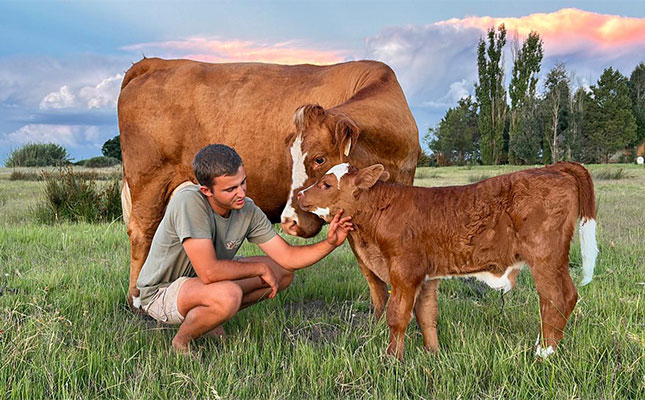
“We place great value on the bull’s maternal line and family history,” Steyn explains. “It often reveals potential that even estimated breeding values do not yet fully capture.”
Young bulls are therefore first tested in the commercial herd before being introduced into the stud.
Milk production is another advantage that Simmentalers bring to a beef operation.
“It has been scientifically proven that for every 1,113kg of milk a calf consumes, it gains 1kg in weight. That is where the extra milk production of the Simmentaler adds real value.”
Three important traits
When selecting animals for breeding, Steyn focuses on three key traits.
“First, we look for balance – a functional, well-balanced animal with sufficient meat,” he says. “Second, we want high weaning weights and growth potential, because that is the foundation of every cattle farmer’s income. Third, masculinity in bulls and femininity in heifers are non-negotiable.”
Although the stud was only officially registered in 2021, the use of performance data has been a priority from the outset.
“We aim to provide honest and complete performance data so that buyers can invest with confidence – not only in the animal they see, but also in the genetics they are purchasing,” says Steyn.
Fertility remains one of the most important benchmarks in the herd. Steyn highlights one particular cow line as an example of the reproductive performance he aims to achieve.
“One of our cow lines, the B-line, is proof of this. The mother, HS131, and her three daughters have produced 29 calves over the past five years,” he says. One daughter in particular has delivered exceptional results.
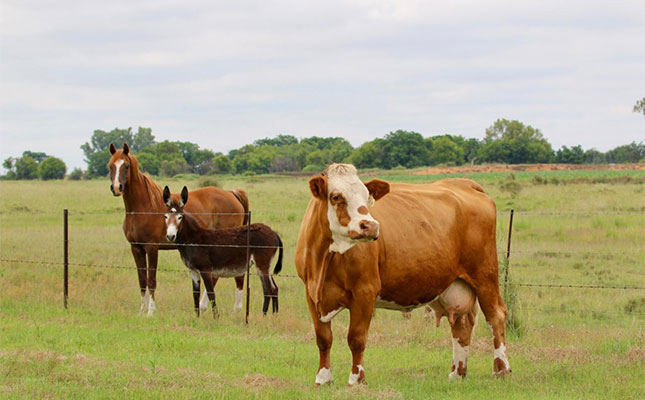
“HS161 had twins in 2021, 2023 and 2026, and triplets in 2024, producing seven calves in the last 30 months,” Steyn notes. “We do not intentionally select for multiples, but it shows the production potential of our cows.”
Across the herd, the average inter-calving period is 363 days, with the stud aiming for a weaning percentage of more than 48%.
The benefits of Simmentaler genetics are also evident in crossbreeding programmes.
“Commercial producers can expect higher weaner weights, better-quality replacement heifers, excellent temperament and improved fertility,” says Steyn.
Feedback from feedlots has also been positive.
“Simmentaler cross calves and culled stud animals grow between 1,8kg and 2,7kg per day on average. What stands out is the consistent growth these animals show throughout the entire feedlot period,” says Steyn.
Temperament is another trait the stud takes seriously.
“A calm animal performs better in a feedlot environment. Our strict selection for temperament makes handling, transport and management safer and more efficient, which ultimately also improves meat quality,” says Steyn.
Looking ahead, he remains optimistic about the future of the breed despite challenges such as foot-and-mouth disease and stock theft.
“I believe Simmentalers have a major role to play in South Africa’s food security,” he says.
For more information phone Hendrik van der Walt on 076 193 0287.