
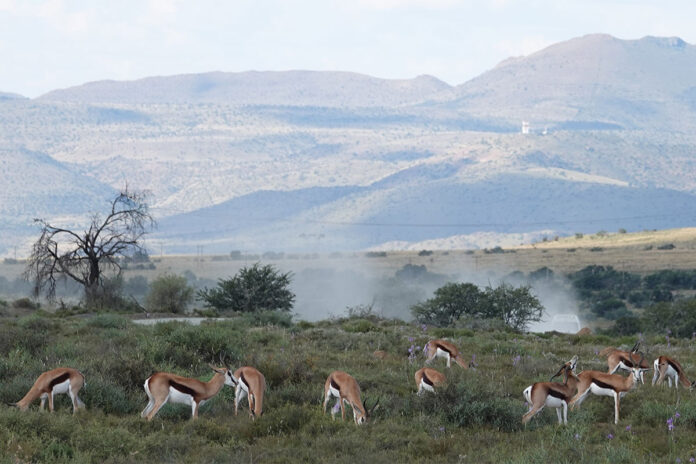
It is believed that the springbok migrations of the 1800s were triggered not by annual seasons but rather by the transition of multi-year wet weather cycles into multi-year dry weather cycles.
The migrating springbok, known back then as trekbokke, would start their exodus by gathering in vast numbers in the Kalahari where they had managed to multiply exponentially on the back of a multi-year wet cycle. Now, however, as drought returned to the region, it was clear there would be impeding nutritional want, a consequence that fired up the springbok’s sense of flight from the region.
Then without warning this gigantic herd of antelope, sometimes 10 million strong, would take off south and eventually stampede over the plains of the many Great Karoo districts, including Prieska, Carnarvon, Beaufort West and even Graaff- Reinet until ‘greener pastures’ were found.
The last migration occurred in the 1890s, and it is believed that several reasons are responsible for the cessation of these mass movements of antelope, including relentless hunting and a boom in livestock farming.
A sight not to be forgotten
Lawrence Green’s book, Karoo: Land Van Weerbegin, is unique in that he took great effort to source remaining eyewitness accounts of the springbok migrations of the 1800s. One of my favourite accounts is that of Gert Van der Merwe, who, like his father, spent his life trekking through what is today the vast North West and Northern Cape provinces in search of grazing for his livestock.
On a day in the early 1880s, a Bushman employee informed Gert that grave danger was approaching beyond the horizon in the form of a massive springbok stampede that would soon sweep across the plain they were standing on.
The Bushman insisted that they build pyres of wood and grass to create columns of smoke and also cut down thorn trees growing in a donga to form a barrier of spears and shrub around their wagon and oxen. It was hoped that the physical barriers and smoke would somehow divert the springbok herd from their precarious position.

A plume of dust that Gert had noticed on the horizon a while ago had by now been transformed into an imposing dust cloud as the mega-herd of springbok came hurtling towards them. Suddenly and rather disturbingly they noticed many animals – completely oblivious to their presence – including hares, meerkats, snakes, wildcats and jackal run, hop and slither past them in panic.
Then the vanguard of the springbok herd arrived, and although at first avoided them, the herd eventually collided with the defences and their oxen were swept away in the stampede. Although the family was safe on elevated ground, thick dust made breathing and visibility poor, and Gert’s wife was forced to cover the children with blankets to prevent them from being smothered.
Incredibly, it took around an hour for most of the herd to pass, after which stragglers passed in dribs and drabs. Furthermore, gullies and depressions were filled with dead and injured springbok that had been trampled under the hooves of the multi-million strong herd.
Also, all over in the churned-up veld Gert noticed wild animals that had been trampled to death while trees and shrubs had been razed to the ground. In fact, the veld looked as if “consumed by fire.” Soon scavengers and carnivores – including wild dogs, hyenas, leopards, jackals and vultures – that had been attracted to the actual springbok migration now moved into its wake to feast on the dead and almost dead.
Hunting
The springbok migrations, often accompanied by other game like wildebeest, blesbok, quagga and eland, offered an opportunity for local and international hunters to engage in very easy and fruitful hunts.
In fact, very little effort was needed, with one Karoo farmer for example bagging 68 springbok while standing in one place. Others killed from their verandas with state-subsidised ammunition as explained by an ex-trooper of the Cape Police who was interviewed by Green. “Everyone seemed to be shooting from their stoep,’’ he recalls when Kenhardt in Bushmanland was overrun by trekbokke. “Police gave the alarm and distributed ammunition to farmers at half-price.’’
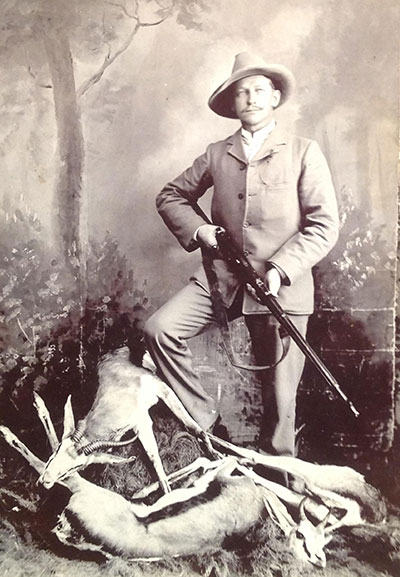
The introduction of breach-loading rifles in the 1870s ensured more efficient killing of springbok at close quarters, while ‘Express’ rifles were increasingly employed for long-distance killing. Such radical improvements in firearm technology made it possible for a group of 28 hunters in 1880 to harvest 750 springbok in a single outing.
These hunters fell within a class that killed at great scale to generate as much income as possible. In fact, they weren’t hunters in the strict sense of the word but rather businessmen on wagons killing for profit, and they used the entire springbok carcass to achieve their goals. Horns were for example sold as curios, skins were sold to specialised hide merchants, and of course the venison was transformed into biltong.
There were also significant amounts of international hunters that visited the Great Karoo, like Gordon Cumming, known as ‘the Lion Hunter’ of the 1840s, who described shooting into the ranks of a migratory springbok herd “until fourteen had fallen.” In regions like Graaff-Reinet, annual springbok hunts were organised with the colonial elite, including visiting nobility, who participated in massive hunts.
The last of the migrations
The springbok migrations of the Great Karoo stopped abruptly in the 1890s. There are thought to be a number of reasons for this, including the impact of decades of industrial-scale hunting that eroded numbers to such a degree that the breeding of the vast migrating herds was simply not a reproductive possibility.
Furthermore, the outbreak of rinderpest in 1896/97 is said to have decimated springbok herds and other antelope populations, aggravating an already serious population decline caused by hunting.
Also, by the late 1800s sheep farming in the Karoo had become profitable, and associated barbed wire fencing projects cut the plains up into countless camps that robbed the springbok of the ability to graze and migrate with freedom.
With the fences came roads, larger urban centres and other developmental initiatives that transformed the iconic semi-desert in a way that would make it impossible to support the springbok’s complex movement patterns and therefore, today, we are left only to imagine what these great migrations might have been like.
Sources: africageographic.com; dailymaverick.co.za; Green, L. 1964. Karoo: Land Van Weerbegin. John Malherbe Edms Bpk, Kaapstad; tswalu.com.