
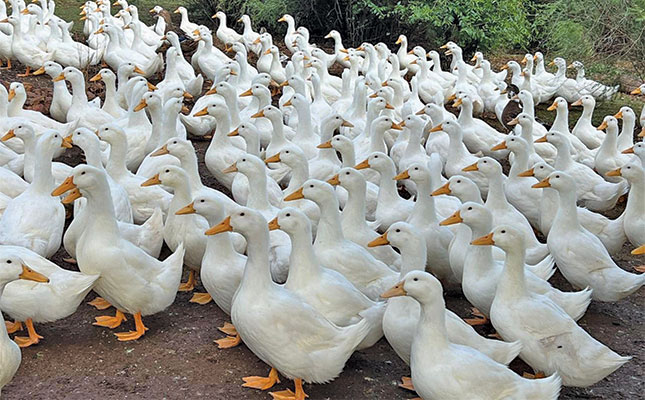
Following her resignation from her job in 2024, Amoré Mannsberger decided to take on a new challenge. Her husband, Ulf, purchased 60 Pekin ducks in December 2024 for her to begin breeding a small flock.
Once the pullets started to lay their first eggs, she decided to invest in an incubator and hatcher, deciding to fully commit to duck farming as her next venture. She and Ulf established Netmooiniks duck farm in early 2025, located near Lindequesdrif in North West.
Mannsberger says she quickly fell in love with the idea of starting her own operation after seeing her first ducks thrive.
“I believe farming was something I was always going to return to. My husband farmed citrus and watermelon in the past, so I have always been surrounded by the lifestyle,” she says.

Since then, Mannsberger’s operation has grown rapidly and she now maintains a fully fledged production cycle. Netmooiniks is a 7ha plot of land that is divided into seven breeding pens with housing to provide pasture for each group at various growing phases. Four of the camps are slightly larger for the grower and finisher ducks, while the remaining three are smaller and designed for newborn ducklings.
Her flock now stands at 2 118 Pekin ducks in total, bred specifically for their meat; 246 are hens, and 25 are drakes, with the remainder being ducklings, growers, and pullets. She keeps an additional 10 drakes separate for new hens that are bought in for expansion through breeding. She keeps her male-to-female ratio to roughly one male to 10 females to prevent overcrowding and stress in the pens.
Pekins are commonly chosen for meat production as they have steady growth rates, good feed conversion, and docile behaviour. Mannsberger maintains a feed conversion rate of 2,82:1.
Production cycle
Mannsberger’s ducks stay productive throughout most of the year. Aside from an intermission period of about six to eight weeks when the ducks moult, they will continuously lay eggs. She collects an average of 300 eggs per hen per year.
To stay on top of a constant growth cycle, Mannsberger relies on an innovative software program developed by her husband.
“Ulf personally developed an app that we use to track every important metric. Because there are ducks at various stages of growth, it is easy to lose track or make an error,” she says.
In the eight-week period from hatching to slaughter, Mannsberger’s app tracks growth rate, egg batches in incubation, feed requirements, and expected hatch dates, and also keeps a record of previous hatchlings.
At the start of the cycle, eggs are collected from the hens and placed inside one of two Surehatch incubators that have a carrying capacity of 1 500 eggs each. The incubators are equipped with sensors that alert Mannsberger to any changes in humidity or temperature. She incubates a batch of eggs once a week, and collects between 55 and 65 eggs daily.
When egg production fluctuates, Mannsberger will buy in eggs from a local farmer to make sure her incubators are stocked to maintain a steady flock growth rate.
Duck eggs must be incubated within one week of collection to stay within the highest embryo viability period. Commercial Pekin duck farmers almost exclusively use incubators and hatchers, as brooding hens halt the production of eggs. Incubation lasts between 25 and 26 days in strictly controlled conditions. The incubators are kept at an average humidity range of between 50% and 60% and maintain a steady 37,5°C internal temperature.
The eggs are regularly misted and ‘candled’, which involves shining a bright light through to check for any infertile eggs.
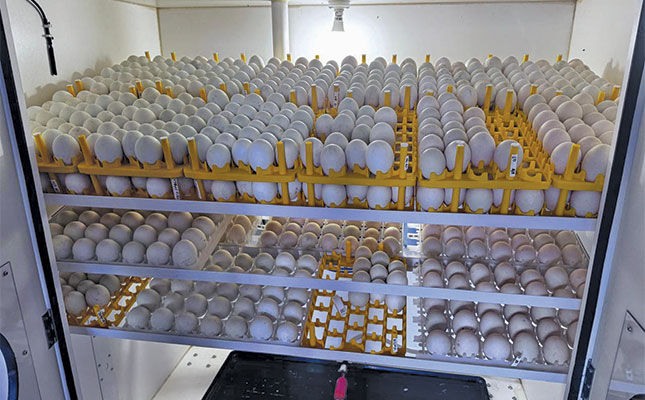
The eggs are moved into the hatcher with a high humidity setting of between 70% and 80% for 48 hours for final preparation. Mannsberger sustains a hatching rate of 80%.
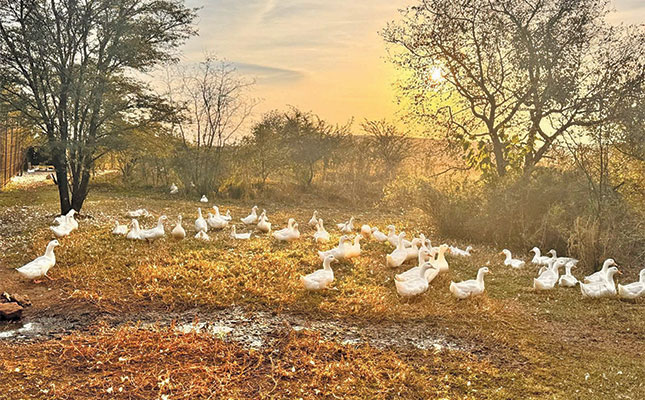
Once the ducklings hatch, they are moved into housing starting in the starter pens, then grower pens, and finally finisher pens. Mannsberger utilises a free-range pen structure with open access to pasture and water sources, with the exception of the duckling starter pens.
These pens have ventilation windows that can be closed during the cooler months, and the floor is covered with a layer of sawdust bedding, which is replaced daily. Each pen is temperature-controlled by means of heat lamps.
She explains that pens absolutely must be kept clean to prevent infections or disease. Each pen is sprayed out daily, and a fresh layer of sawdust bedding is spread out. She mists the ducks with Virukill disinfectant and sprays it over the pen structure and in the drinking water. All manure is collected from both the pens and nearly pasture, which is given to neighbouring farmers for fertiliser. Mannsberger uses a separate fertiliser for her pasture, not made from duck manure.
The newly hatched ducklings stay in a completely sealed off structure of circular pens with heat lamps and no outdoor access for two weeks. The circular pens allow for even heat distribution and prevent suffocation due to overcrowding.
Feed
Mannsberger provides a starter feed and water source, and also gives the ducks sugar water. She believes the sugar helps the ducklings adjust to moving and gives them an energy source. At the starter phase, the amount of feed provided is not measured individually, as Mannsberger allows them to take in as many nutrients as possible to kick-start the rapid growth trend.
From weeks three to five, the ducks are moved into the grower pens. The structure is slightly larger, with free-range access to pasture and ponds. They are given 300g of feed per duck daily in addition to the kikuyu they graze on in the pasture. This feed is a homemade grower mixture that includes Russian grass, maize, and a variety of cereal grains that are bought in.
Russian grass is utilised in the feed for its high protein and fibre content. Mannsberger also occasionally makes use of De Heus grower feed to supplement the mixture.
Netmooiniks has six boreholes that contribute to duck ponds and the water supply for the housing.
Finally, the ducks are rotated into the finisher pens, where they are kept for one to two weeks and rounded off with a finisher feed from De Heus. She switches back to the standard homemade feed just before slaughter. Mannsberger’s Pekins weigh an average of 3kg by the end of the seven-week growth period. Pekin hens stay at a high productive rate for about one year, and are subsequently replaced by pullets.
Mannsberger keeps to her hormone-free policy by not vaccinating or using any medication for biosecurity measures.
“We have not had any disease outbreaks, and we choose to stick to raising our ducks as holistically as possible,” she says.
She sends 600 ducks to the abattoir per week. Once the butchering is complete, the carcasses are collected by Mannsberger to be packaged and sent to her buyers. She markets her ducks to speciality meat markets such as Blake’s Fine Foods in Cape Town. The duck organs are sold to Pawsome Raw in Krugersdorp, who makes raw dog food.
Hormone-free feeds
Mannsberger’s biggest challenge as a commercial duck farmer is the cost she incurs to produce her own feed. Russian grass is expensive, and the need for feed remains constant year round.
According to her, there are no sustainable suppliers of ‘clean’ feed in South Africa that do not contain growth hormones for rapid weight gain.
“It is frustrating that there are no commercially available duck feeds on the market that are hormone or stimulant-free,” she explains.
Over the past year, she has researched international duck farming practices to find out what the most sustainable feed combination would be to make on-site that keeps her ducks free of any stimulants. Due to the lack of supply, Mannsberger is considering the possibility of mass-producing her current feed mixture to sell on the local market.
“We are looking into implementing feed supply into our operation because we feel that there are many fellow duck farmers in South Africa who experience the same issue as us,” she says.
She is also considering introducing the software platform that Ulf designed to other producers, as she feels it could be greatly beneficial for other farmers to help keep track of a non-stop breeding programme.
As Netmooiniks starts to grow into a sizeable operation, Mannsberger is planning ahead to continue keeping up with client demands. As of 2026, she is expanding into egg production for individual consumer demand. She has recently started her first breeding pen with 50 Khaki Campbell ducks bought in from a local supplier. Khaki Campbells are an efficient egg-laying breed, and can yield more than double the amount of eggs per year compared to Pekins. She hopes to begin full production of Khaki Campbell eggs by mid-2026. She also bought an additional incubator from Easyhatch with a larger capacity of 2 500 eggs to compensate for the growing flock.
“I truly never expected the farm to grow so fast, and I am so grateful for what we have achieved. My advice to anyone considering this sort of operation is to be patient and to be as efficient as possible to cut costs while remaining environmentally conscious. Farms are a gift, and everything can be used,” she says.
Mannsberger remains driven as she expands by the month. Her approach to free-range duck farming has ensured clients receive high-quality meat without any concerns of added stimulants.
For more information email Amoré Mannsberger at [email protected].