In South Africa, geese have long formed part of the traditional farmstead and have always been included in the range of smallholder activities around the farmhouse, adding value and income as well as an additional protein source to the household.
Despite this heritage, goose farming has never developed into a significant commercial industry in the country. There is, however, potential for growth in this market for meat and down.
Small local down market
The South African market for down remains too small to support large-scale farmers. Most major bedding and garment producers continue to import down, although a handful of small producers breed geese specifically to supply their own brands.
In the last couple of years, there has been a clear shift away from live plucking, which traditionally took place every two months, towards the use of down harvested as a by-product of the meat industry.
Ethical live plucking during the moulting season is still possible, but it reduces harvesting to only twice a year and limits the amount of down collected, making it unprofitable to farm geese exclusively for this purpose.
On average, each goose yields about 20g of down, and a king-sized winter duvet requires the down of approximately 70 birds, according to Sharon Kock, owner of Ember Down in Clarens in the eastern Free State.
Minimal meat production
Goose meat production in South Africa remains relatively small. Output has risen only slightly over the past decade, from 480t to just over 500t in 2024, with small volumes exported to neighbouring Southern African Development Community countries, indicating some commercial activity in the industry.
Geese can be slaughtered in poultry abattoirs, but the equipment requires minor adaptations to accommodate their heavier weight. Compared with chickens, one of the main challenges in processing waterfowl is the presence of pin feathers, which are deeply lodged in the skin.
Standard scalding and plucking machines may not remove these completely, and manual plucking of the remaining pin feathers, along with the removal of residual down, is often necessary.
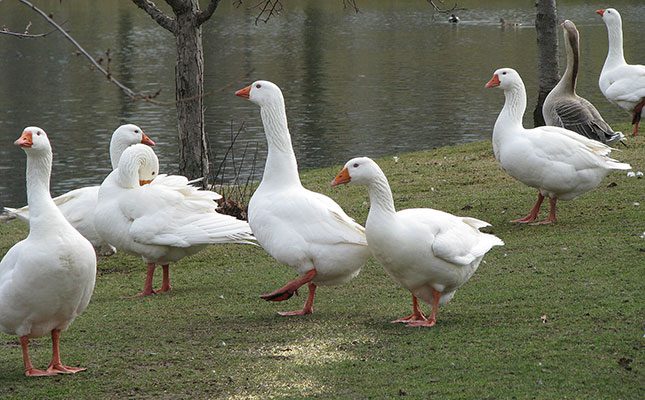
As with all livestock, breed selection is critical. The Embden goose is one of the most common breeds used for commercial farming. It is a large white bird known for its size and rapid growth, and its white down makes it particularly suitable for feather production.
The Toulouse goose is another widely farmed breed. Medium to large in size, with grey plumage, it is primarily raised for meat and is well known for its liver, which is used in foie gras production. There are also more specialised breeds for specific products, such as the Chinese goose bred for specialist Chinese cuisine, and the dual-purpose (meat and eggs) Pomeranian saddleback goose.
Housing, feeding, and management
Housing and management practices are important for maintaining healthy flocks. Geese are typically kept in overnight pens that provide between 0,5m² and 1m² per bird, with larger day pens or free-range areas with shade and cover, allowing them to build nests lined with dry grass, down, and feathers.
Geese require constant access to clean drinking water, and shallow ponds or pools are ideal for swimming, which helps maintain their health. Fencing should be at least 2,4m high to provide adequate containment.
Feeding regimes usually include maize and lucerne pellets. A high-protein diet is essential for ensuring strong fibre development, as insufficient protein results in brittle feathers and poor-quality down. Goslings are started on chick feed containing 20% to 22% protein and are then moved to grower feed with 15% to 18% protein. Adult geese thrive on balanced poultry feed with 14% to 16% protein, supplemented with fresh greens, grains, and vegetables.
Breeding takes place mainly between July and October, and it is important not to disturb the birds during this period. Space requirements are higher for breeding stock, with at least 3m² to 4,5m² per bird in the coop and 15m² to 30m² per bird in outdoor grazing areas. Each season, a goose can lay between 10 and 25 eggs, and goslings hatch after about 28 days of incubation.
Disease management is a significant concern. Geese are vulnerable to avian influenza, Newcastle disease, and infectious bronchitis, all of which can have devastating effects on flocks. Vaccination is an effective means of protection, particularly because the birds are often housed in open pens where exposure risk is high.
Geese and regenerative agriculture
Recent developments in regenerative agriculture have highlighted new opportunities for integrating geese into crop systems. One of the challenges in such systems is relocating livestock during the crop’s growing season. But geese offer a solution, as they reach slaughter weight in about 160 days, allowing them to be integrated after harvest and removed for slaughter before the next crop begins to grow.
This approach has been used successfully in Italy for pest control and weed suppression in orchards and vineyards at densities of 240 birds/ha. It could potentially be adapted in South Africa, but access to goslings remains a major obstacle, limiting farmers’ ability to expand production.
With a reliable route to market, there is scope for expanding commercial goose farming in South Africa for meat, eggs, and down, supported by the growing demand for high-end and specialised agricultural products.