This is not speculation; it is the natural outcome of 5G expansion, device density growth, Internet of Things adoption, automation, and digital dependency across Africa’s most critical industries.
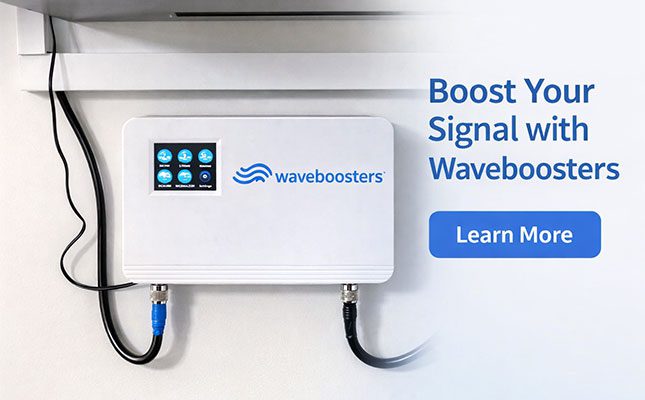
It’s no longer about whether you need better signal, but whether your infrastructure is built for 2026 and beyond. WaveBoosters has the solution.
Why 5G changes the rules entirely
The transition to 5G fundamentally alters how mobile signal behaves within complex environments, yet many suppliers still approach connectivity using outdated 4G-era assumptions. That approach is no longer viable.
Signals in 5G’s higher-frequency bands have difficulty passing through dense construction materials. Performance is increasingly sensitive to interference, structural layout, and signal attenuation caused by reinforced concrete, steel frameworks, shielding, and underground environments. Without a properly engineered in-building solution, 5G performance indoors degrades rapidly.
This is particularly evident in mines, hospitals, and large hotels, where structural complexity and user density are the norm.
A single device mounted on a wall does not constitute a solution. What is required is a considered, engineered signal architecture that accounts for present demand while anticipating future load.
WaveBoosters approaches 5G as infrastructure, not just hardware.
Mines: safety, automation & compliance depend on signal
Mining operations across Southern Africa are undergoing rapid digital transformation. Real-time tracking, autonomous systems, telemetry, workforce co-ordination, and emergency response protocols all rely on uninterrupted mobile phone signal coverage and connectivity.
When signal fails, the consequences are immediate and material. Emergency communications are delayed, underground operations experience blind spots, automation systems falter, and compliance exposure increases. Downtime is no longer measured only in lost productivity but in heightened operational risk, too.
Regulators, insurers, and institutional partners now regard reliable in-building and underground cellular coverage as a baseline operational requirement.
WaveBoosters works with mining operators to design enterprise-grade signal infrastructure that supports safety systems, automation, and expansion without constant re-engineering. Our solutions are built to scale, to withstand industrial conditions, and to support all major mobile networks within a single, unified architecture.
Hospitals: connectivity is a clinical requirement
Modern hospitals function as highly connected environments where mobile communication underpins clinical efficiency, co-ordination, and patient outcomes. Doctors, nurses, specialists, emergency responders, and administrators depend on uninterrupted signal to perform their roles effectively.
Poor mobile signal inside hospitals leads to delayed communication, failed emergency calls, disrupted mobile health platforms, and operational inefficiencies that directly affect patient care. As hospitals continue to adopt mobile-first workflows and digital patient systems, the tolerance for signal failure approaches zero.
Today, healthcare facilities operate with significantly higher device density per floor, increased reliance on real-time mobile communication, and stricter expectations around reliability.
WaveBoosters delivers enterprise-grade in-building cellular solutions, approved by the Independent Communications Authority of South Africa (ICASA), providing consistent coverage across wards, theatres, administrative areas, and critical zones. Our systems manage interference, support LTE 4G and 5G, and deliver performance aligned with clinical demands, while also covering all bands and frequencies, including the traditional 2G GSM/GPRS, SMS, and 3G data.
In healthcare, connectivity isn’t a convenience; it’s a clinical requirement.
Hotels: guest experience is measured in bars
In the hospitality sector, perception is everything. Guests expect flawless mobile connectivity for business communication, streaming, digital payments, and personal use. A single negative review citing poor signal can materially impact booking decisions and long-term brand equity.
Hotels present unique challenges for mobile signal, from reinforced cores and elevator shafts to underground parking, conference spaces, and high-rise floors. As guest expectations rise and occupancy density increases, these challenges intensify.
Hotels that fail to deliver reliable mobile coverage struggle to attract corporate travellers, host conferences, and maintain premium positioning.
WaveBoosters partners with hotel operators to deploy full-property signal solutions engineered for peak occupancy, multi-network support, and future 5G performance. The result is consistent coverage that enhances guest satisfaction, supports operational systems, and protects revenue.
Why commodity installers struggle in today’s market
A significant portion of the market remains focused on selling hardware rather than delivering outcomes. This product-centric approach, common among commodity installers, relies on minimal site intelligence and prioritises short-term fixes over long-term performance.
In complex enterprise environments, that model fails. Companies that treat signal boosting as a box-selling exercise struggle to deliver scalability, resilience, and future readiness. As connectivity requirements intensify, these solutions quickly reach their limits.
WaveBoosters operates differently. We begin with site-specific signal engineering, design
enterprise-grade architectures, and deliver systems that are built to evolve. Today,
enterprises no longer tolerate trial-and-error installations or fragmented solutions – the demand accountability.
The waveboosters difference: designed to last
WaveBoosters South Africa does not compete on price alone. We also compete on performance, compliance, durability, and foresight.
Our solutions are designed to support 2G GSM/GPRS, 3G, LTE 4G, and 5G today, with clear upgrade paths for tomorrow. Every system is ICASA-approved, engineered for multi-network support, and installed with long-term operational performance in mind. With infrastructure lifespans extending well beyond a decade, our clients invest once and scale forward.
We are not transactional installers. We are infrastructure partners.
2026 readiness checklist for decision-makers
Enterprises preparing for the next decade must be certain that their facilities have reliable signal across all operational areas, that their infrastructure can support increased device density, that their systems are genuinely 5G-ready, that expansion can occur without redesign and that regulatory compliance is assured.
Uncertainty in any of these areas represents risk.
Connectivity is strategic infrastructure
Organisations that treat mobile connectivity as strategic infrastructure will consistently outperform those that don’t. Mines will operate with greater safety and efficiency, hospitals will communicate faster and deliver better care, and hotels will protect brand value and maximise guest satisfaction.
WaveBoosters exists for organisations that plan ahead rather than react under pressure.
If your operation is serious about future-proofing mobile signal for 2026 and beyond, engineered, enterprise-grade infrastructure is not optional.
WaveBoosters South Africa builds the connectivity foundations that tomorrow’s enterprises will depend on.
To learn more, request a consultation, or place an order, visit waveboosters.co.za, email [email protected], phone 031 880 1644, or WhatsApp 064 620 2308.