South Africa’s essential oils industry has grown from a little-known niche sector to a standards-driven, globally recognised market player.
Karen Swanepoel, executive director of the Southern African Essential Oil Producers’ Association (SAEOPA), has been at the forefront of the industry long before essential oils became a household favourite.
That interest became the foundation of an industry movement. As producers struggled to access information, Swanepoel became an unexpected anchor.
“People that were doing essential oils knocked on my door and asked me to help them form an association, as they needed a voice. They needed an information desk,” says Swanepoel.
Following that request, SAEOPA was formed ‘by producers for producers’ in 2000 and the foundation was laid for what is now one of the country’s most promising agricultural value chains.
Raising standards to compete globally
By the mid-2000s, the lack of industry standards was holding South African producers back. Without consistent quality testing, buyers could undervalue local products and producers had no leverage when negotiating.
“We were exploited by buyers because we didn’t have standards. That changed when the United Nations Industrial Development Organization (UNIDO) approached SAEOPA and discussed what was needed. They immediately understood.
“UNIDO GQSP-SA (Global Quality and Standards Programme) empowered this industry by guiding us in writing standards so we could negotiate better prices based on quality,” she explains.
Today, all essential oil destined for export must be tested through accredited laboratories.
“We don’t allow people to export any oil if it hasn’t been tested,” says Swanepoel.
There are even special arrangements made for focus species, such as rose geranium, Cape chamomile, Helichrysum (impepho), buchu and Lippia javanica (unzuzwane), to have it tested for free.
Vegetable seed oil testing included is marula, baobab, Kalahari melon, Ximenia, and manketti (mongongo tree).
Growing consumer demand
The pandemic years reshaped global essential oil demand. “During COVID-19, it was definitely eucalyptus, African wormwood (Artemisia afra) and tea tree that flourished. People who never knew about eucalyptus are now disciples of the plant,” says Swanepoel.
Even post-pandemic, eucalyptus remains popular for its clean scent and respiratory support. “It cleans the airways, it makes your house smell nice, and it has a clean smell and a versatile oil,” she adds.
Citrus oils are also being exported by South Africa, driven by their presence in cleaning products, toiletries and perfumes, and also remain consistently high in demand.
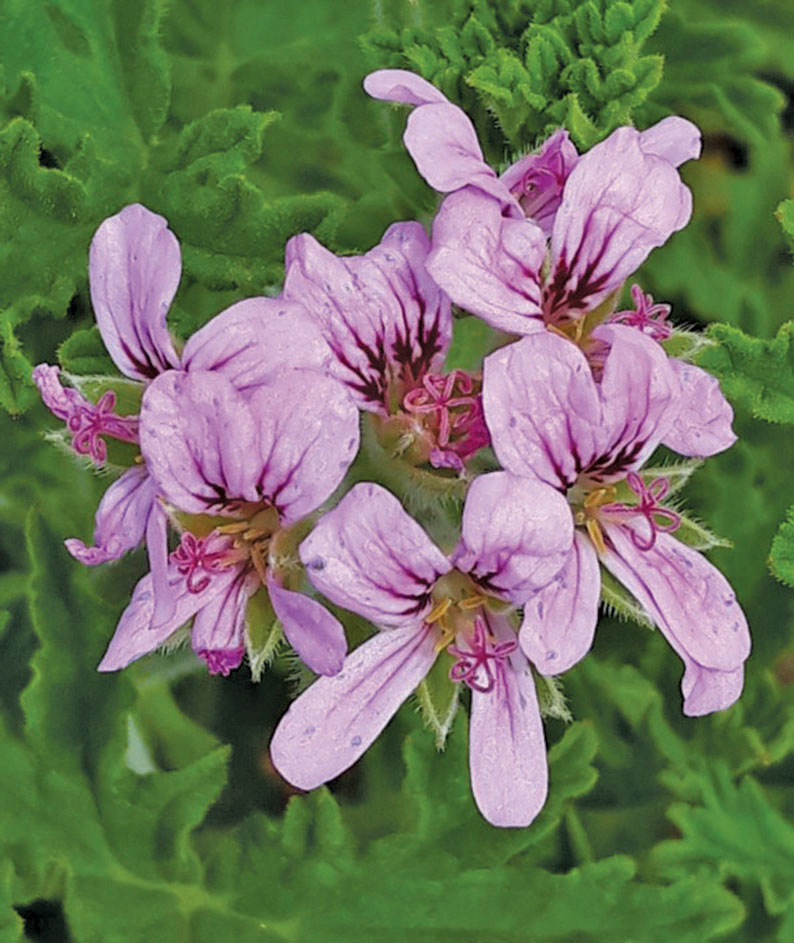
“Anything from industrial cleaning to perfume to toilet sprays have citrus in it,” she says. “Rose geranium stands out as a uniquely South African gem.
“Rose geranium lifts the spirit. In times of melancholy, tragedy or loneliness, it really lifts you and helps with cellulite and concentration; what a bonus.”
Despite indigenous essential oils, South Africa is not a dominant global supplier. The world is mainly supplied by Egypt, India, Madagascar and China.
“We are trying to get into the game because our quality, according to perfume producers, is the best in the world,” says Swanepoel.
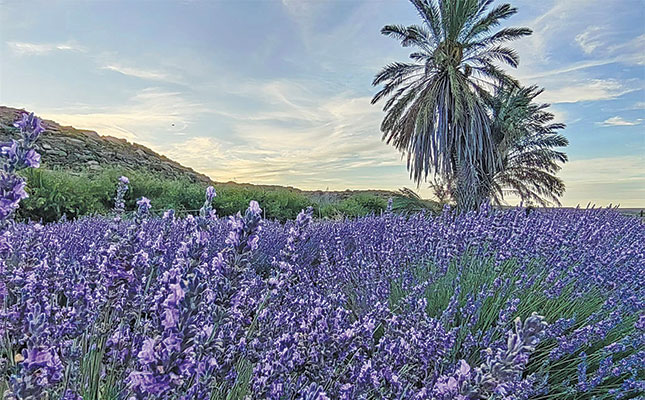
There is a development that will address the increase of quantity and quality of rose geranium oil. Lavender and rosemary also remain perennial favourites.
“They are classic oils and there will always be a demand for them. Everybody likes lavender and rosemary,” says Swanepoel.
A mature, knowledge sharing industry
A key reason for the sector’s steady growth is the shift toward openness among producers.
“We have formed a network for our members in the form of chambers for every species. No more secrets on the production and prices. Silence is broken. They exchange questions and answers, successes and failures,“ says Swanepoel.
This culture of transparency, she believes, is one of the main reasons why the industry is stronger after 25 years than ever before.
Local products finally on shelves
For South Africans browsing pharmacy shelves, South African essential oils are far more visible than they were a decade ago. But competing with cheap imports remains a challenge.
“In Clicks and Dis-Chem, previously you couldn’t find anything South African. Now you do, triple the price though of the products made in China. So the choice is yours. Buy with your heart or buy with your pocket,” says Swanepoel.
Still, quality remains the South African industry’s advantage and increasingly its identity.
Consumers much more discerning
As essential oils become mainstream across South Africa, consumer expectations have shifted noticeably. Swanepoel says buyers today are far more discerning than they were two decades ago.
“Consumers are definitely more informed than in the past. They are looking at the origin, where it comes from, and they are looking at certifications.
“Sometimes consumers also want to know the story behind the oil production, who is benefitting and what is behind this,” she says.
For indigenous oils, the stories carry cultural and sentimental value.
“There is always a lovely story to be told. Whose grandmother used it for a grandchild, and for what purpose? It is the information that is driving demand and the efficacy,” she says.
While price remains a factor, Swanepoel believes traceability is becoming even more important for conscious buyers.
“A nice story with a real face, a real person behind it, and where the farm is must be traceable. People are informed now on traceability,” she says.
Globally, sustainability is also part of the conversation. Swanepoel contends that a consumer does not really care about sustainability, but in the corporate world that has become increasingly important.
“We want to know whether we can get the oil next year and if will it be of the same quality,” she says.
The plants behind the oils
Essential oils are processed from aromatic plants. These species naturally produce highly concentrated oils, often to protect themselves against or to attract pollinators.
“Aromatic plants have a lot of oil glands in them. That is why they smell,” says Swanepoel.
She lists some of the most widely used crops. “Classic plants like thyme, rosemary, basil, marjoram and lemongrass are used globally. Rose oil is also produced in South Africa; parsley and sage are popular too. The seed of coriander and the seed of carrots can also be pressed and used in the essential oil industry.”
While essential oils are valuable, they must be handled with care.
“You cannot generally use any essential oil that’s 100% pure directly on your skin, except maybe lavender. You put it into a carrier oil to make it safe and effective. Some of these oils are a dollar a drop, for example chamomile. You cannot just splash it all over,” says Swanepoel.
Traditional carrier oils include almond, grapeseed, and olive oil, but the rise of African seed oils has changed the landscape.
“Now we also have oils from marula, Kalahari melon and baobab. All the seed oils are carrier oils. Essential oils are put it into a carrier oil in formulations to make it affordable, safe and last longer,” she says.
Costly Equipment and processing
While many people are drawn to the idea of producing essential oils, the reality is that processing equipment is costly and specialised.
“It is very expensive. And it is not worthwhile to buy cheap equipment. You are working with a high-value product,” Swanepoel points out.
South African engineers, however, have designed world-class equipment that is now used globally. The cost depends entirely on the size of the vessels and material used.
“The smallest units can take about 5kg to 15kg, and they can cost you in the region of R25 000 to R50 000 on those used as demonstration models. The commercial ones are 2,5t and more. They can be R2,5 million or more depending on what you are looking at,” she says.
Because of these costs, she encourages producers to co-operate rather than work in isolation.
“The ideal situation is not everybody buying a processing unit, but working together. In an economic model, you need about 25ha to justify a 2,5t unit.”
Large-scale producers may install their own processing plants, but location matters.
“It is not worthwhile to travel more 35km because then your profit goes into transport. That is the critical situation: close enough, big enough and far enough with the right price,” she emphasises.
Why local sourcing matters
With increased competition from imported oils, supporting local growers has become a priority for the SAEOPA.
“It is extremely important. We have a passion for our people. We really want to create jobs. We want ‘proudly South African’ products,” says Swanepoel.
Despite this, she points out that South Africa remains an importing country of many oils, largely due to gaps in production scale, consistency and market access.
Local sourcing and sustainability: planting for the future
Despite South Africa being a net importer of essential oils, Swanepoel mentions the importance of local sourcing.
“We should actually be exporting more, but we are importing. Whilem local sourcing is where we need to go, there is always space for importing things like sandalwood. We do not have that in South Africa. But most of the other crops we can produce, and we should,” she says.
Sustainability is a central concern for producers, especially when harvesting wild plants. “If you are not cultivating, there are concerns. We strongly recommend cultivating it as a crop. You invest in your people and your land, pay electricity to pump water, and cultivate your plants responsibly.
“This way, it is much easier to project what you will harvest each year. Most producers are organically certified and embrace regenerative agriculture as the best practise, as the oils are used in aromatherapy, cosmetics, and pharmaceutical and food products,” she adds.
“It is even included in the veterinary industry. Employment is created and skills are developed throughout. The industry is dominated by dynamic women involved at all levels and the technology involved is attractive to the youth.
“Wild harvesting is not ideal in the long term. You can start that way if a plant has potential in your area, but the best thing is to then plant it. Then you have control over soil and harvesting times, and you can market it properly. You cannot start marketing after harvesting. Markets must be in place before you plant,” she says.
Harvest to oil: the extraction process
Harvesting essential oils requires precision. “You must harvest the plants at the right stage and with best methods. Some plants need to be in full flower, others in late flowering or seed stages. Harvest at the wrong time, and the yield suffers,” says Swanepoel.
Some plants cannot be harvested in rain or moisture, just like tobacco. Rose geranium is very sensitive and Swanepoel maintains you have to read the environment and harvest at the right moment.
Once harvested, the distillation process begins. “You put the plants into the vessel, control the temperature, and use steam distillation. The steam passes through the plants, releasing the oil, which then condenses and separates because oil is less dense than water. Some oils are heavier, but most float on top and can be decanted. Temperature and pressure control is crucial. You cannot mess up a high-value crop,” she cautions.
Temperature varies depending on species, but a safe range is generally between 60°C and 80°C.
“You have to watch the steam, observe what is coming off, and know when it is finished. That is how you ensure yield and quality,” she says. Production guides for most crops are available from the Department of Agriculture and the SAEOPA’s website.
Quality, and innovation
Maintaining quality across batches is challenging because essential oils are natural products.
“You cannot control sunlight or rainfall, but you can control the processing and check every step. Training helps producers manage what they can and apply quality control systems,” says Swanepoel.
Innovation is also shaping the industry. “People are combining solar energy with gas or other energy sources. CO2 extraction is expensive, but valuable for low-yield, high-value plants.
“Steam distillation remains the most popular method because it is clean and reliable.
“We are constantly looking at ways to improve yield and efficiency,” she adds.
The role of research and certification
Swanepoel adds that research begins with plant genetics.
“It is better to propagate plants through cultivation rather than seeds. You need to know the DNA of what you are working with. High yield alone is not enough; quality must meet standards. Active ingredient percentages are measured to balance yield and quality.”
Certification and standards have transformed the landscape of South Africa’s essential oils market. “Once you have standards, you know what your oil should look like. Buyers cannot pull the price down because of perceived poor quality.
You build a database of values, leaving a buffer for variation, like weather. Standards boost confidence and pride in your product. Essential oils are no longer a poor man’s crop and requires smart and precision practices,” says Swanepoel.
Consumer safety is paramount. “Have your oils tested. Testing ensures you know what is in it.
“Safety is the responsibility of producers, manufacturers, and consumers alike. Dosage, formulation, handling, storage, transport, labelling and packaging all matter,” she says.
There are also guidelines on this made available by UNIDO GQSP for maximising profit that include lessons learnt over the past 25 years.