
Nearly 15 years ago, we heard about a Zen Buddhist couple on a farm in the Karoo, somewhere near Colesberg.
Apparently, they (Margie and Antony Osler) had converted their shearing shed into a Zendo, a place of meditation.
Antony had written a sleeper hit of a book in 2008 entitled Stoep Zen.
And that was all we knew. When we arrived at Poplar Grove Farm for the first time in 2013, Margie told us Antony wasn’t yet back from his other job, working on labour mediation up in Kimberley.
We knew nothing yet about this rather special woman who endearingly confided that the small scab on the bridge of her nose was from doing a bollemakiesie in the farm dam.
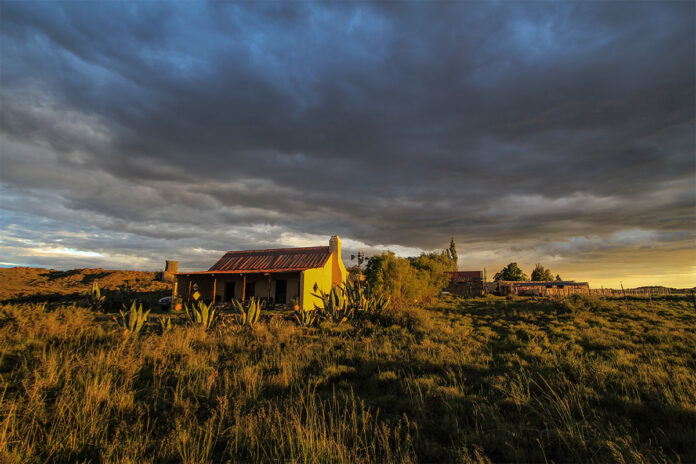
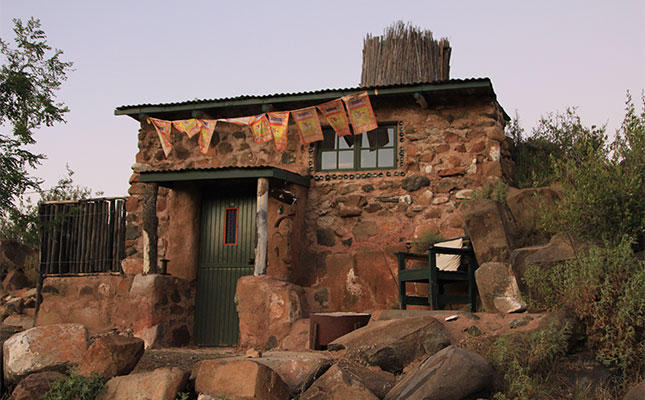
Margie showed us our little cottage, made of stone, cool thanks to its thick walls. Two doors with skinderdeure opened onto the stoep – one a bedroom and bathroom, and the other a lounge, dining room and kitchen.
The long stoep faced willow trees, a koppie and wide-open spaces. After unpacking, we collapsed on the stoep sofa, staring out at the veld in a state of boneless relaxation. There was no electricity, but there was a nearby fridge, a gas stove and a ‘donkey’ for hot water.
A bokmakierie called out and blue cranes flew over the ridge. A nearby Aermotor wind pump whirred quietly, casting a spinning shadow on a cow and her calf.

The Oslers of Poplar Grove
At sundown we returned to the Osler front stoep. Antony had arrived in a cloud of dust from Kimberley still dressed in his smart legal attire, soon exchanged for comfortable farm clothes.
Antony is a Zen Buddhist teacher whose learnings mainly come from time spent at the Mount Baldy Monastery in California – and now, from the Groot Karoo itself.
He is a writer, a builder and a carpenter, son of Springbok rugby centre Stanley Osler and nephew to the legendary Bok flyhalf Bennie Osler.
He was also once a very promising rugby player who chose the rambling life of a folk singer on the high seas instead. Later on, as a qualified advocate, Antony ran a law clinic in nearby Colesberg during the Apartheid era, helping the helpless and standing up, in his quietly defiant but non-aggressive way, to right-wingers who wanted him gone.
He and Margie, who runs the farming, hospitality and outreach side of Poplar Grove, are both self-confessed stoep-sitters.
Over Irish whiskey and popcorn that night, we discussed writing, music and spirituality. Photographer Chris Marais and Antony produced their guitars, and some tentative singing began.
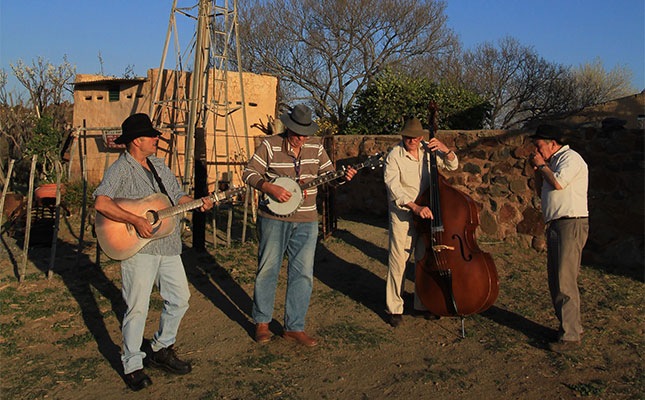
Two Chords and Harmony
The American folk music genre of the 1960s held a special fascination for young Antony. While studying law at Stellenbosch University, he harmonised with a group of 15 other student singers in the residential showers.
“It wasn’t great for the campus water supply, but the acoustics were wonderful,” he says.
Antony began reworking Afrikaans folk songs with fellow student Jan Grové in a two-part harmony style that became their niche, leading to recordings and appearances on Cape Town variety shows broadcast by SABC Radio.
“Then I hooked up with Norman Coates and Marloe Scott-Wilson, we formed a band called Canticle and landed a gig doing cabaret on the Union Castle boats between Cape Town and Southampton.
“Recording in a London studio, we rubbed shoulders with our heroes, the likes of Cat Stevens and the Bee Gees, in the canteen. We were earning decent money, we were in London and we felt part of something really exciting.”
A Monk for Dinner
On a trip to Scotland, Antony met a group of young Tibetan monks who impressed him deeply.
“One minute, they were carefree young men playing catch with frisbees and then, once in a ceremonial environment, they were able to sit still, like mountains. I found that fascinating.”
During his three years in the UK, Antony became increasingly involved in Tibetan Buddhism and, when he returned to South Africa in 1979, helped build and teach at the country’s first Buddhist Retreat Centre at Ixopo in KwaZulu-Natal.
“But Tibetan Buddhism never quite felt like home to me,” he says. “I needed to find a form of Buddhism that was simpler, that I could apply wherever I found myself.”
That discovery was still to come. In the meantime, Antony went to the Mount Baldy Zen Centre in southern California for a three-year residency, training to be a monk.
Returning in 1985, he met Margie Gardner, a remedial teacher, at a yoga class in Cape Town. Margie recounted the story of their meeting to journalist Wanda Hennig in 1994.
“He had no hair. I thought he must either have come out of the army or prison.”
Two weeks later, when he reappeared and asked Margie to the movies, Antony explained the bald head. At the time, she was sharing a house with others, and happily invited him to dinner before the movies.
“As you can imagine, this caused great consternation. I mean, what do you give a monk for dinner? I immediately informed my housemates that they had to behave: no drinking, no smoking and no swearing in front of him.
“But Antony arrived with a bottle of wine for us all, and played the piano for his supper. Monks are normal humans, we discovered.”
They married two years later. After their wedding, Margie and Antony spent the first night of their honeymoon at Matjiesfontein.
The second night was at the 1850 farmhouse that is now their home, then all tumbledown, pokey and inhabited by bats and goggas, after having stood empty for decades.
They moved to Grahamstown (now Makhanda), where Antony began the legal career he had studied for.
Years later, they returned to the family farm. There was no running water. A feature of the house was a stoep with a grapevine planted in the 1830s.
It had stood empty for 40 years, and parts had to be completely rebuilt.
It was here that they raised and home-schooled their daughters Emma and Sarah, and began to hold Zen Buddhist retreats with a special Karoo flavour.
Learning to farm
It fell largely to Margie and staff members Tongo and young Dirk Januarie to start farming with Dohne Merinos. It was a hard journey, especially at first.
“We struggled with diseases and drought,” says Margie. “I knew absolutely nothing about farming.
“I approached four farmers nearby for advice on farming and their calendar of activities. They all gave me completely different answers, and each one was convinced that his was the best way.
“Fortunately, Tongo had some experience as he had grown up on a farm next door. He was illiterate and could not count or measure, but he could spot something wrong with a sheep in the distance, and knew what to do about it.
“So Dirk and I counted and dosed the sheep and recorded the weights of the wool, and bought in good rams. Our farm is small, but we made sure the sheep were well cared for and that they were the best sheep with the finest wool we could breed. We looked after the veld and the sheep and became a good team.”
Farming makes up a portion of the Oslers’ income. The rest comes from retreats and book sales.
The Zen Books
Antony’s first book was Stoep Zen: A Zen Life in South Africa.
Here, he introduces Poplar Grove, his family, his workers, his philosophies and a little of his background.
“In the early days of the Law Clinic, Nelson Mandela was still in jail and democracy still a dream. The security police used to ride up and down the road in a van with blackened windows and they raided us every week, banging on the door and shouting ‘Open up, open up!’
“That was until they realised that they could just come in and talk to us, that we had no subversive political agenda, and that we made a really good cup of tea.”
Although Stoep Zen, with its meditations and musings, has a distinct Buddhist bent, the humour woven into the stories brings the Karoo to life.
Antony’s second book was Zen Dust: A journey home through the back roads of South Africa.
For many years, Antony would spend one week a month in Kimberley as a mediation lawyer.
This meant driving to and from the Diamond City via Colesberg, Philippolis, Fauresmith, Koffiefontein and Luckhoff.
The route is at once breathtaking (big skies, kestrels on farm fences, wind pumps holding the landscape, roadside encounters of a friendly nature) and stark, because some of these settlements are the picture of rural poverty.
He meets a petrol attendant at a filling station along the way. After a colourful, generous encounter, Antony writes: “That is the thing about South Africa. Despite all the separation, despite all the pain and mistrust and fear, we are still able to meet. Human to human, openly and joyously. This is not something that only happens here, but it is all the more astonishing here because of the separate lives we lead.”
His third book, Mzansi Zen, broadens its focus.
Like all of us, he is often overwhelmed by all the bad things that happen in this country. How to face them – how do we stay?
In Antony’s case, he goes to the Zendo. “From here I can open my eyes. It is true we have bad governance. It is true we have great music. It is true that my heart is beating and that the cat is sleeping in the apricot tree.
“It is true that the small boy at the corner of the supermarket in town has no shoes. Now I know that I am facing home.”
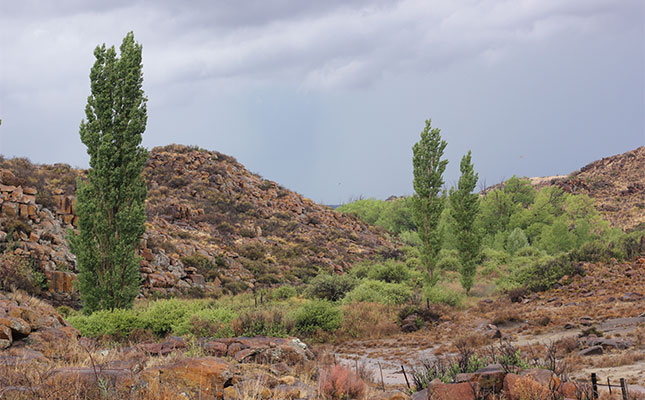
Veld Zen
These days there are two Zen retreats each month at Poplar Grove, a formal one that is more traditionally monastic in style, and a less formal one called Veld Zen.
“We’re just a little Zendo in the veld in the middle of the bottom end of Africa, trying to find our way. It’s compelling us to be authentic about this, about what we do. It is a privilege to be here. How do we honour that privilege?
“Our Zen practice is defined by the kind of attention we pay to the world we live in, which in this case is the Karoo.
“In a way, our teachings come out of the Karoo, and feed back into it. I am not aware of other Zen teachers who teach this way.
“So, our practice is learning to be part of this blue sky, and this brown veld, and the poplars, and the birds, and the scorpions, and whatever is in front of us.”
For more information, phone Margie on 082 816 5903, email [email protected], or visit stoepzen.co.za.