

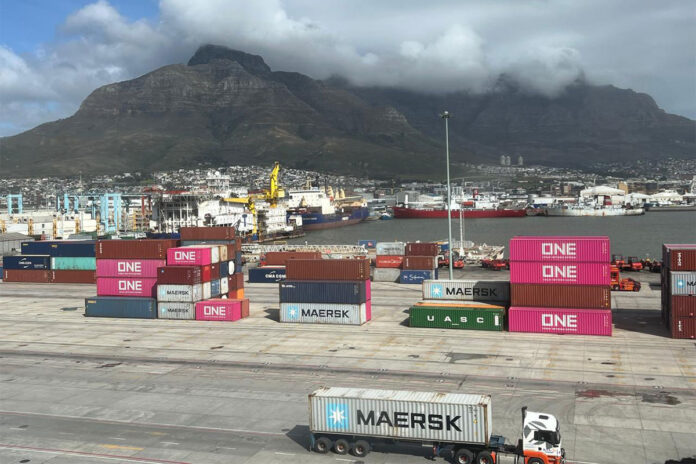
As reported by Farmer’s Weekly earlier this month, the 2025 Container Port Performance Index (CPPI), compiled by the World Bank and S&P Global Market Intelligence, ranked the Cape Town port last out of 400 ports, marking its second consecutive year at the bottom of the index and reinforcing concerns about the reliability of South Africa’s primary export gateway for fruit.
The CPPI benchmarks ports based on the total time vessels spend in port, from arrival at anchorage to departure. It highlighted prolonged vessel turnaround times and operational delays as key factors behind Cape Town’s low ranking, placing it well below global peers despite efforts to improve performance.
Steady progress made
Transnet has highlighted recent operational progress at the port.
Responding to queries from Farmer’s Weekly, spokesperson Ayanda Shezi said improvements at the port are being driven by infrastructure investment, equipment upgrades, and enhanced operational coordination.
“The Port of Cape Town has made significant progress over the past few years. These initiatives are yielding measurable improvements in vessel operations and overall port performance,” she said.
According to her, ship turnaround times have steadily decreased, moving from 103 hours in 2023/24 to 83 hours in 2024/25, and further to 74 hours in 2025/26, with year-to-date averages now around 58 hours.
However, despite these gains, the port remained at the bottom of the latest CPPI rankings, with the reported operational improvements not yet reflected in the international benchmark.
Western Cape Minister of Agriculture, Economic Development and Tourism Dr Ivan Meyer acknowledged that while local performance indicators have improved, this progress has not yet been reflected in the global rankings.
“Container terminal performance at the Port of Cape Town has improved across globally recognised metrics since late 2025, although this is not yet reflected in the CPPI,” he said.
“Engagement with the CPPI team is planned for July to transparently present this progress and provide greater clarity on the factors affecting overall vessel turnaround times from port entry to departure.”
He added that logistics reform is dependent on coordinated action across the broader system.
“Logistics development is being addressed as a multistakeholder responsibility. While the [National] Ports Act assigns Transnet a primary role, performance is influenced by broader ecosystem decisions involving cargo owners and carriers,” Meyer said.
He confirmed that engagement with Transnet leadership, including newly appointed National Ports Authority CEO Mohammed Abdool and the Western Cape Region team, is ongoing as part of efforts to drive improved outcomes for exporters.
Meyer pointed to a series of short-term interventions aimed at easing pressure during peak export periods, including increased equipment availability and operational support.
“Discussions with fruit exporters have been under way regarding the negative impact on returns for high-quality exports. Short-term interventions include container equipment augmentation and increased availability of heavy-lifting operators,” he explained.
He added that equipment upgrades are well advanced, including the deployment of 28 rubber-tyred gantry (RTG) cranes. These measures are expected to improve performance during the 2026 citrus and 2026/27 deciduous fruit export seasons.
New equipment to lift productivity
Investment in cargo-handling capacity has also been a focus for Transnet, according to Yandisa Msileni, acting regional corporate affairs manager.
In a media statement, he said the Cape Town Container Terminal (CTCT) recently took delivery of four new hybrid straddle carriers – used to lift, move, and stack containers – as part of a R96 million investment under Transnet Port Terminals’ broader equipment replacement programme. The technology combines diesel and electric power, improving efficiency while reducing fuel consumption, emissions, and noise levels.
Earle Peters, managing executive of Cape Terminals, said in the statement that the additional equipment will enhance operational flexibility and improve responsiveness to customer demand as the terminal transitions towards a hybrid operating model incorporating both straddle carriers and RTG cranes.
Transnet reports that productivity and annual throughput volumes at the CTCT have improved as a result of these interventions, supported by ongoing equipment modernisation and operational adjustments.
“Transnet Port Terminals has invested approximately R9 billion over the past three years in new cargo-handling equipment across its national terminal network,” Msileni said, adding that further investments are planned for the 2026/27 financial year.
Weather-related setback continue to impact operations
However, operational pressures remain. Msileni noted that disruptions such as vessel ranging delays, caused by wind and fog, accounted for around 74,2 days of lost operating time during the 12-month period ending March 2026.
He said this highlights the continued impact of environmental factors on port performance, which the new equipment is helping to mitigate.
Meyer, meanwhile, called for coordinated effort among role players to improve performance at the port ahead of the 2026/27 fruit export season.
“Every available resource and intervention must be directed at restoring optimal performance at the Port of Cape Town. The competitiveness of our agricultural exports and the sustainability of our farming communities depend on it,” he said in a press release.