
If you are considering ostrich chick production as a primary income stream or to diversify your farming enterprise, there is one fundamental factor to consider before anything else: your location, more specifically, your distance from buyers and affordable, quality feed sources.
“You need to be at least 150km from the nearest processors and 200km from a cheap feed source, with the distance becoming increasingly important as fuel prices rise. Anything further than that, and ostrich chick production is almost a definite no-go,” says Dr Adriaan Olivier, veterinarian at the South African Ostrich Business Chamber.
He explains that feed represents about 75% to 80% of the cost of raising an ostrich chick, meaning that even small increases in transport costs can quickly erode profit margins and make the enterprise unviable.
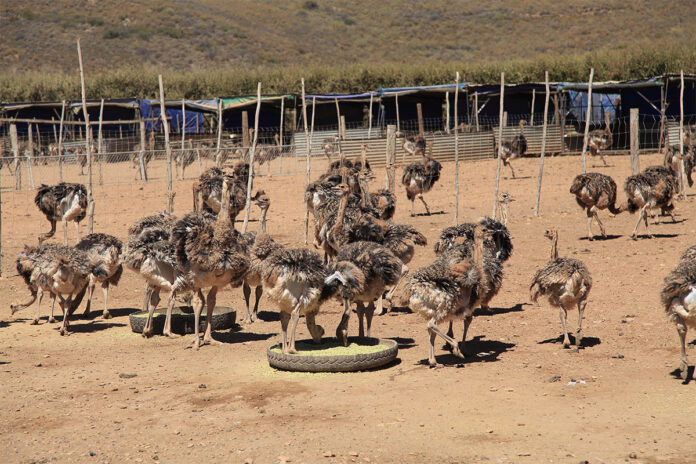
Currently, ostrich production is concentrated in the Western Cape around the Klein Karoo and Southern Cape, while ostrich chicks are raised in areas such as Fraserburg in the Northern Cape, and Aberdeen, Graaff-Reinet and Burgersdorp in the Eastern Cape. Day-old chicks are sourced from ostrich breeders in the Western Cape around the Klein Karoo.
“Producers in the past used to have their own breeding pairs and produce and raise their own ostrich chicks. Over time, however, production has become more specialised and focused, resulting in ostrich chick production moving to areas with lower ostrich populations, localised shared knowledge, and in effect lower disease pressure and risk,” says Olivier.
Small-scale production
The next step is to decide whether you want to operate at scale or keep production small. Examples exist of producers who raise 50 to 100 ostrich chicks as an aside and make good money, largely due to low overheads and proximity to buyers.
Proof of this concept where small-scale farmers work together to establish economies of scale with a small footprint has been done in the Eastern Cape, where 20 farmers, each with 150 birds, farmed as a collective on a 10ha export-registered unit.
The farmers made a good living while collectively supplying high-quality ostriches to the market.
“The project was an excellent example of the potential of ostrich chick production to empower and create income for smallholder farmers,” says Olivier.
Sadly, their production came to an end after the outbreak of highly pathogenic avian influenza in the ostrich industry, which resulted in significantly lower income and disruption of the production chain.
Collapse of export market
The resultant export ban led to the collapse of the fresh ostrich meat export market and a sharp decline in ostrich prices.
“Prices fell almost overnight, which was a significant blow to the industry. Highly pathogenic avian influenza, together with a drought of more than seven years in the Oudtshoorn area and increasing input costs for compliance and sustainable production, resulted in a steady decline in production, from just over 300 000 slaughter birds in 2002 to about 150 000 in 2025,” says Olivier.
A drawback of small-scale production is that most hatcheries are geared to sell big groups of day-old chicks, typically 200 to 400 at a time. Along with this, it might be difficult to get a foothold in the market for small volumes.
“Producers prefer to take large numbers of young ostriches at a time from the same suppliers for uniformity and traceability. They are also hesitant to buy ostriches from unknown sources, as the true potential, such as growth rates and the quality of the feathers and leather, only becomes apparent once they are processed,” adds Olivier.
Trust and transparency in the supply chain are therefore key.

Large-scale production
Intensive production is a very different proposition, requiring careful planning, specialised equipment, purpose-built housing, strict management, biosecurity protocols, and additional labour.
Olivier likens it to intensive poultry production, as producers need to closely monitor factors such as temperature, ventilation, stocking densities and feed quality, while maintaining strict hygiene to limit disease risk. This level of control not only increases input costs, but also demands a high level of skill and attention to detail.
“There are cost benefits to scale and overall income potential is higher, but returns per ostrich is generally lower than in smaller, more informal operations.”
He adds that the intensive ostrich chick production model is under severe pressure due to production costs and competition, leaving little room for error: “You are working with high inputs and tight margins, so even small mistakes can quickly affect both performance and profitability, as is the case with almost any intensive production system. As the saying goes, it is often ‘the small foxes that spoil the vineyard’.
Climatic conditions
Climatic conditions can add a less visible but important layer of cost pressure. In colder months, farmers in the Karoo, for instance, may need to provide heating for chicks for longer because of the cold. To reduce this cost, they might opt to produce chicks from only late winter or early spring.
In other regions, older birds, while hardier than younger chicks, may still require additional shelter or windbreaks to protect them from prolonged exposure to rain, cold spells and strong winds.
These measures may seem minor in isolation, but they add up over time, particularly in more intensive systems where birds are kept at higher densities and management inputs are already elevated.
In such systems, even small increases in energy use, infrastructure requirements or labour tied to weather management can further squeeze already tight margins.
Market alignment
Another underlying challenge in the system, Olivier explains, is that production efficiency is often driven by volume, which can come at the expense of adaptability and resilience, and critically for the ostrich industry, product quality.
“The intensive system rewards mass production, and what you get back is driven by volume, which is not healthy in terms of adaptability or product quality,” he says.
Birds raised under highly intensive conditions, particularly on high-concentrate feed, can become less resilient and struggle to cope with environmental stress once conditions change if management systems are not sound.
They may also struggle to adapt to more extensive production systems, such as those in the Southern Cape, where ostriches are raised further on pasture.
“Farmers in the Southern Cape have little space or time to appropriately manage birds that were fed to adapt to forage-based feeding, so these birds must quickly learn this for themselves,” says Olivier.
Sourcing ostrich chicks already adapted to grazing systems is also easier said than done. Producing birds for this purpose requires more land and space, which increases costs and makes the system more labour intensive. In the end, fewer birds can be carried per hectare.
The situation with high mortality rates has improved markedly over time thanks to improved production systems, nutrition and management practices.
Good stockmanship
“Ostrich chick production has become highly refined, with survival rates these days topping 85%. A business simply won’t survive with high mortalities,” says Olivier.
Achieving these results depends heavily on good stockmanship, a skill that goes beyond technical knowledge and is often rooted in experience, intuition, and daily interaction with animals. Where this skill is lacking, producers need to ensure that someone in the operation has the necessary ability and sensitivity to manage the birds effectively.
“A good stockman will know whether chicks are comfortable or distressed, cold or warm, simply by observing and listening to them.
“Small changes in behaviour, feeding patterns or vocalisation can be early warning signs that something is wrong,” explains Olivier.
He adds that early intervention is critical in ostrich chick production, as problems can escalate quickly if not addressed.
“If you miss those early signs, you can lose birds very quickly. Good stockmanship is often the difference between a profitable operation and one that struggles.”
Despite its importance, this skill is becoming increasingly scarce.
“Fewer people grow up with livestock these days, which means fewer people develop that natural feel for animals,” Olivier points out.
While practical ability is key, theoretical knowledge still plays an important supporting role.
Prospective producers can benefit from livestock production courses to build a solid foundation in animal health, nutrition and management.
“It does not really matter whether the course focuses on ostriches, chickens or any other livestock.
“The basic principles are largely the same. Producers can also draw on the knowledge and support of their feed suppliers,” he says.
More importantly, Olivier encourages prospective farmers to learn directly from others already operating in the industry.
“Visit and speak to as many ostrich chick producers as possible. Production conditions differ from one operation to another, so you won’t be able to copy everything. But why make a mistake if you can learn from someone else’s,” he says.
Animal welfare
Olivier emphasises that production set-up and animal welfare should not be approached as a mere compliance or ‘tick-box’ exercise, but as a core part of a successful production system.
“Animal welfare is not something you should merely do to meet requirements.
“It should form the foundation of how you manage your animals on a daily basis,” he says.
He explains that the industry should be guided by the principle of the ‘Five Freedoms’, which include freedom from hunger and thirst, discomfort, pain, fear, and the ability to express natural behaviour.
“When these basic needs are met, animals are healthier, less stressed and perform better. If they are not, it will show in your production results,” says Olivier.
This is particularly important in intensive systems, where higher stocking densities and controlled environments place greater responsibility
on the producer to maintain optimal conditions.
Poor ventilation, incorrect temperatures, overcrowding or inconsistent feeding can quickly lead to stress, disease outbreaks and reduced growth rates.
In more extensive systems, the focus shifts to ensuring adequate shelter, protection against extreme weather, and access to suitable grazing and clean water.
Ultimately, adds Olivier, welfare and productivity are closely linked.
For more information email Dr Adriaan Olivier at [email protected].