

Day 1, Friday, 3 July: Grateful for every step
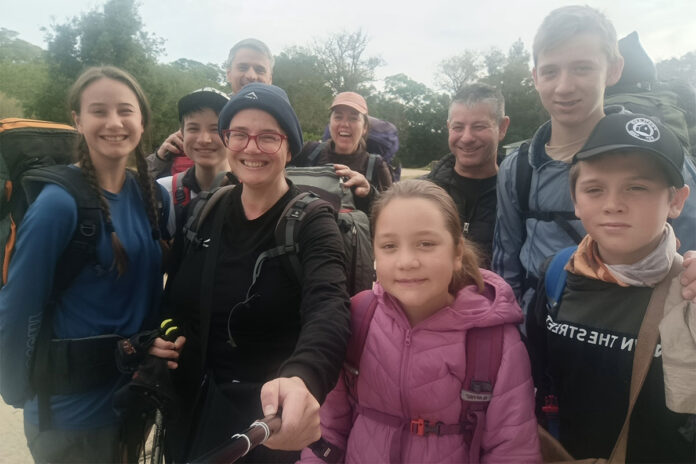
For our first adventure, my family and I joined the Troost family to hike part of the Tsitsikamma Hiking Trail. Between us, our children range in age from 10 to 15 years.
This wasn’t my first time on the trail. I walked it over New Year’s about 20 years ago, before children, and with my now brother- and sister-in-law and Julia Kupka, who was Farmer’s Weekly’s features editor at the time.
Of that trip, I remember my in-laws packing enough food to feed a small village and insisting we eat some of it at every stop. Each of us carried two cans of sparkling wine to drink on New Year’s Eve at the last hut. After carrying them all that way, they were warm and tasted terrible. We couldn’t even finish one.
I remember freezing just centimetres away from a massive spider that had spun its web right across the path, and I remember baboons taking over the toilets at our last hut.
Mostly, though, I remember a hillside covered in proteas that sloped gently into one of the most beautiful forests I’d ever seen. I also remember us singing at the top of our lungs as we walked. I couldn’t tell you what we sang, but I remember the feeling – that carefree confidence that comes with being in your twenties and thirties and believing every adventure will last forever.
This hike feels very different, though. Twenty years later, I’m carrying more than just a backpack.
Over the years, I’ve broken a leg, torn a meniscus, had an ACL reconstruction, and picked up more aches and niggles than I care to count. The problems actually started in childhood and led to several operations.
After one of my childhood knee injuries, I had to do swimming as part of my rehabilitation.

One day, the coach looked at me and said that if I carried on the way I was, I’d probably end up in a wheelchair by the time I turned 40.
Back then, I didn’t really know what to make of it. Today, I’m just incredibly grateful that prediction never became my reality.
A few years ago, though, I was slowly picking my way down Table Mountain on the Nursery Ravine, which leads into Kirstenbosch. It was a painful descent, every step a negotiation with my knees, with a group of pensioners who swept past me as though they were out for a leisurely Sunday stroll, making me feel even more frustrated.
As two of these women passed me, I overheard one saying to the other: “You know, if you don’t use them, you lose them.”
Those words have stayed with me ever since. I know she was talking about our legs, but I’ve come to realise the same principle applies to almost everything. If we don’t use our hands, our eyes, our minds, or our bodies, we gradually lose what they’re capable of. It’s a bit like farming: neglect almost anything for long enough, and it begins to deteriorate.
I’ve realised that while I can’t change the body I have, I can choose how I use it. Sometimes that means working with a physiotherapist, biokineticist, or GP, and sometimes it means slowing down. But it doesn’t mean you should stop moving.

Today, we walked about 7km from Bloukrans Forest Station to Bloukrans Hut.
And you know what?
It was easier than I expected.
The trail was gentle, the forest spectacular, and for the first time in a long while, I felt like all those hours spent strengthening my legs and ankles were starting to pay off.
But that doesn’t mean the rest of the hike will be easy – I have a feeling the Tsitsikamma still has a few surprises waiting for me – but today reminded me why it’s worth putting in the work.
Farmer’s Weekly gave me the opportunity to be here. My family has supported me through years of surgeries, injuries, and rehabilitation. And my body, despite everything we’ve been through together, still carried me 7km through one of the most beautiful forests in South Africa.
For someone who was once told she would probably end up in a wheelchair by the time she turned 40, reaching Bloukrans Hut felt like more than just the end of Day 1. It felt like a reminder that our bodies are often capable of far more than we imagine, provided we’re willing to keep showing up, putting in the work, and taking that next step.
Day 2, Saturday, 4 July: The day the trail cleared my head
You know the British habit of understating everything, where a mountain is ‘a little hill’ and a brutal climb is described as ‘rather strenuous’?
Well, I won’t be doing that.
I’ll tell you exactly how it is. I may even exaggerate slightly to make the story more entertaining.
There’s something you should know about me: the first proper day of a hike always gets inside my head.
Yesterday’s walk to Bloukrans Hut was simply the warm-up. Today was the real thing: about 14km from Bloukrans Hut to Keurbos Hut, with plenty of climbing, descending, and enough tree roots to keep you focused on every step.
I’ve come to think of this as the trail’s cleansing day.

It always starts the same way. My legs begin to tire, then my confidence disappears. Before long, I’m questioning why I ever agreed to do this. I start telling myself I’m not fit enough, not strong enough, and that everyone else is coping better than I am.
Then my thoughts wander even further.
I start thinking about everything that feels unfair: my ageing parents; the devastating floods we’ve been reporting on; the incredible resilience of farming families who somehow keep going after losing orchards, livestock, and infrastructure; friends who are struggling; people who have lost their jobs.
Apparently, my brain likes to solve all the world’s problems while climbing a mountain.
I also become convinced that everyone else is responsible for my suffering: I suggested hiring a porter to carry my backpack, but nobody listened. Never mind that my backpack only contained my clothes, the medical kit, and the washing-up gear.
Logic has very little place in this part of the hike.
Nobody is even allowed to look at me while I’m huffing and puffing uphill.
“Just mind your own business and walk,” I growl if anyone dares ask whether I’m okay.
Fortunately, my family has learnt not to take my grumblings personally.
But somewhere along the trail, something always changes.
Perhaps that’s one of the reasons I think more farming families should do something like this.
Over the years, I’ve interviewed hundreds of farmers, and one thing almost all of them have in common is that they never really switch off. Even when they leave their land, orchards, or livestock behind for the day, part of them stays behind.
They’re thinking about tomorrow’s weather forecast, whether the irrigation schedule needs changing, if the wheat has had enough rain, whether the ewe that’s close to lambing will be okay, or how they’re going to make the numbers work after another difficult season.
The work doesn’t end when the working day does. It simply follows you home.
It was then that I realised the trail was doing exactly the opposite. At first, all those thoughts came flooding in, and my brain seemed determined to solve every problem I’d ever encountered while climbing a mountain.
But after a few hours, there was simply no room left for these thoughts. One by one, they fell away. The worries became quieter. The frustration faded. And for the first time all day, I wasn’t trapped inside my own head anymore.
Instead, I began to notice what had been there all along: the sound of water tumbling over rocks, birds calling somewhere from high in the canopy, something rustling in the undergrowth before disappearing, the silence of an ancient forest that’s been carrying on with life long before I arrived and will continue long after I’ve left.
Coming from the suburbs, I couldn’t tell you the names of half the birds or wild flowers we saw, but not knowing their names doesn’t make them any less beautiful.
The Buffelsbos forest was overwhelming in the best possible way. Towering indigenous trees disappeared into the sky, giant yellowwood trunks were covered in moss and lichen, and every turn in the path revealed another reason to stop and observe.
Then we stumbled on a crystal-clear mountain pool. Despite it being the middle of winter, with the water cold enough to make my toes hurt just looking at it, two members of the Troost family didn’t hesitate, stripping down and jumping right in.

The rest of us admired their bravery from a much safer distance.
We took almost an hour longer than the average hiking time to reach Keurbos Hut. Not because we were slow, but because we kept stopping. Stopping to admire the forest. Stopping to photograph flowers. Stopping simply because some places deserve more than a passing glance.
As beautiful as the scenery was, though, my favourite part of the day was watching the children. For hours they climbed over rocks, explored streams, laughed together, challenged one another, and forgot their phones even existed.
That evening, my two kids came to check up on me, and we had one of the best conversations we’d had in months. There was nowhere to rush off to and nothing competing for our attention. Afterwards, while we got the braai going, they disappeared to play cards and dice games with their friends.
As a journalist, I spend a lot of time writing about the pressures farming families face. There’s always another fence to mend, another pump to repair, another field to inspect, another decision waiting to be made. Taking a few days away can almost feel irresponsible.
But perhaps that’s exactly why it’s so important to get away. Farmers know that land needs time to recover. Livestock need rest. Machinery needs servicing. We accept that almost everything performs better when it’s properly maintained.
Perhaps we’re the ones who forget that we need the same care.
Today reminded me that stepping away isn’t the same as walking away. Sometimes it’s exactly what allows you to come back with fresh eyes, renewed energy, and a clearer mind.
Yesterday the trail reminded me to keep using my body.
Today, it reminded me to give my mind room to breathe.
Day 3, Sunday, 5 July: Different journeys
By the third day, my mind had finally settled. Unfortunately, the trail had no intention of following suit.
According to my son Izak, who hiked this section with my husband Wouter last September, the 14km route from Keurbos Hut to Heuningbos Hut deserves a healthy amount of respect.
“It starts with an uphill, then a downhill,” he warned us. “Then comes Heuningbos … and it just keeps climbing. To make matters worse, when you eventually catch sight of the hut in the distance, it never seems to get any closer.”

Needless to say, I started the day with more than a little trepidation.
As it turned out, Izak wasn’t wrong. Fortunately, we were hiking in winter rather than spring. The cool temperatures, a mind that had finally stopped arguing with itself, and my Nordic walking poles, kindly sponsored by Lohra de Waal, made the climb far kinder than I had expected.
Besides, it was impossible to dwell on aching legs for long. Heuningbos is simply too beautiful.
The forest seemed even more magnificent than I remembered from 20 years ago. Cool, sweet air drifted beneath towering trees, crystal-clear streams crossed our path, and the canopy echoed with birdsong. Every now and then we stopped, not because we had to catch our breath, but because there was something else worth looking at.
At one stage, Annehette Troost managed to charm a Knysna turaco – what many of us still call a ‘lourie’ – and a Southern boubou into coming incredibly close to her.
Watching her, I found myself wondering what was more remarkable: the birds, or Annehette herself.
A few years ago, Annehette was diagnosed with breast cancer. The journey that followed – operations, treatment, and recovery – was far more difficult than anything this trail could throw at us.
Yet here she was, walking strongly, laughing easily, carrying her own backpack and, every now and then, helping her daughter with hers.

Over the years, I’ve met remarkable women while reporting for Farmer’s Weekly. Women who quietly keep farming businesses and families moving forward. They balance the books, raise children, organise workers, help with harvesting, care for ageing parents, support their communities, and somehow still find the energy to encourage everyone else.
I’ve also met farming families facing cancer and other diseases, often hundreds of kilometres from specialist treatment, trying to juggle hospital visits with harvests, lambing seasons, or orchards that simply cannot wait.
They rarely ask for recognition. They simply get on with the job.
Annehette may not be a farmer, but she shares that same quiet determination. She has always been an artist. Watercolour is her medium, and nature has long been one of her favourite subjects.
I remember visiting the Boston Open Studios in Cape Town last year, where she exhibited some of her work. Knowing what she had been through, I found myself seeing more than landscapes and flowers in her art.
Her paintings exposed something of her journey. They spoke of resilience, vulnerability, and hope in a way that words often cannot, while at the same time echoing emotions I think many of us recognise in our own lives.
Even on this hike, she carried a small watercolour set in her backpack.
Whenever we stopped for a while, she quietly unpacked it and painted whatever had caught her eye: a stream tumbling over moss-covered rocks, the play of light through the forest, or a flowering branch beside the path.
Watching her stop to paint while the rest of us admired the scenery made me realise she wasn’t simply looking at the forest; she was really seeing it. Perhaps that’s why she noticed the birds long before the rest of us did.
It also made me think about the many farmers I’ve met over the years. Most of our conversations revolve around production and profitability, because that’s what keeps a farming business alive. But every now and then, another side of someone emerges.
Take the Hanekom brothers in the Koue Bokkeveld, for example. They farm together yet somehow still find the time and determination to mountain bike and have even competed in the Absa Cape Epic.
I’ve met farmers who disappear into the mountains with a camera when they get the chance. Others restore vintage tractors, play music, or spend hours in a workshop making furniture.
None of those things will improve a yield, but perhaps they help people return to the farm with a clearer head and renewed energy.
Farmers know healthy soil won’t keep producing forever unless it’s looked after. Perhaps people aren’t that different.
By the time we reached Heuningbos Hut, I realised the trail wasn’t only teaching me about myself. It was teaching me to notice the extraordinary people walking beside me.
Annehette had spent the day quietly painting the forest. The rest of us had simply been walking through it. Thanks to her, I think I started seeing it a little differently, too.
For the Troost family, however, the adventure on the trail was coming to an end. After reaching Heuningbos Hut, they pushed on to the Boskor forestry station, as other responsibilities were calling them back home. While the rest of us settled into the hut, they shouldered their backpacks once more, said their goodbyes, and disappeared back down the trail.

It struck me then how different all our journeys had been.
Perhaps that’s the beauty of a trail like this. It doesn’t ask everyone to walk it for the same reasons. It simply asks you to keep putting one foot in front of the other.
And if you’re lucky, you’ll discover you’ve brought home far more than what you packed in your backpack.
Day 4, Monday, 6 July: When plans change
Before I tell you about our final day, I should remind you that this is a diary entry about what the trail did to me, not a guide to the Tsitsikamma Hiking Trail.
If you’re looking for practical advice about the route, such as what to pack, where to stop, or whether it’s worth doing, you’ll have to wait for the full feature in Farmer’s Weekly magazine, and later on our website.
The fourth day – the 14km trek from Heuningbos Hut to Sleepkloof Hut – started very much as we anticipated based on the map. A steep up-and-down a hill, followed by another.
By now, though, something had changed. We had found our rhythm, and I finally understood what my father-in-law, Jannie, meant when he told me to “rest on the downhills”.
In Mostertsbos, we stopped beneath the cool shade of the forest, unpacked a few snacks, and simply took in the beauty. Wouter looked around, smiled, and said: “I could keep hiking for another six or seven days. I think I could do this forever.”
I smiled, too.

A couple of hours later, however, the mountain politely disagreed.
The second climb was longer, steeper, and offered little shelter from the sun. Thankfully it was winter. I couldn’t help wondering what this section must feel like in the heat of spring and summer, when the trail is at its busiest.
Loose rocks rolled beneath our boots, and I found myself thinking how easily someone could twist an ankle, especially if the trail was wet. We had already crossed enough muddy patches to know that this route would be a very different challenge after heavy rain.
Then I noticed something else. Wouter was starting to fall behind, and the children were beginning to tire. That’s when I went full mum-mode.
I told the children to head for the saddle at their own pace. I’ve learnt that kids recover far more quickly than adults. There’s no point making them match our slower pace.
Then I turned to Wouter. He was bringing up the rear, making sure nobody fell behind.
“Come on,” I said. He protested.
I pointed at his watch. “Your heart rate isn’t even in the red.”
Some encouragement may have been offered rather more enthusiastically than he appreciated. As a matter of fact, he asked the children if they saw how I shouted at him that last 100m.
Before long we’d all reached the top together, where an endless view over the Tsitsikamma rewarded every aching muscle.
From there on, everything became easier.
The trail dipped back into the forest, where towering trees once again swallowed us up in cool shade.

The children, full of energy again, disappeared down the path ahead of us, only to discover three baboons enthusiastically emptying the rubbish bins outside Sleepkloof Hut.
Twenty years ago, when I last visited this hut, a baboon had claimed the bathrooms as its own. Some traditions, it seems, never change.
Now, I have one final confession to make. Winter hiking means packing warm clothes, but it also means carrying as little as possible, and by this stage, we’d been wearing the same clothes for days.
We had grand plans of heating water with the donkey boiler every evening, but reality turned out differently: wet wood. Hours to heat enough water. Outdoor showers.
After the first night, our enthusiasm for hot showers evaporated almost as quickly as the steam.

On the third evening, I suggested boiling water on the stove and mixing it with cold water in a basin. It worked, but nobody was inspired to repeat the exercise.
By the fourth afternoon, when we arrived at Sleepkloof, our final destination, we looked at one another. Nobody said much. Wouter finally broke the silence.
“Let’s go home.”
Not because we couldn’t finish, but because we didn’t want to spend another night smelling one another.
So, instead of sleeping at Sleepkloof and walking out the following morning, we packed our bags one last time and hiked the remaining 3km to the forestry station.
Some might say we didn’t finish the trail. I think we finished precisely the journey we needed to.
If the Tsitsikamma taught me anything over the past four days, it’s that journeys rarely unfold exactly as we imagine they will.
Sometimes your body surprises you. Sometimes your mind becomes quiet. Sometimes the people walking beside you teach you things you never expected to learn. And sometimes the best decision you could make is changing the plan.
Perhaps that’s true far beyond the hiking trail.
Farmers know this better than most. Every season begins with a plan, but the weather changes, markets shift, machinery breaks, and life has a habit of rewriting even the best intentions.
Looking back, I don’t think I’ll remember how many kilometres we walked, but I will remember the conversations we had, the laughter we shared, the forests and birds we admired, the children disappearing around the next bend, and the extraordinary people with whom we shared the journey.
Perhaps that’s what diaries are for: not recording every step, but remembering the ones that changed you.



