
Nampo Cape may have its origins in grain mechanisation, but this year, the show is broadening its focus to include the Western Cape’s vegetable industry, supported by Bredasdorp Park’s permanent demonstration facility for protected farming and aquaponics tailored specifically to the province’s growing conditions.
In a joint media release, organisers Grain SA and Bredasdorp Park announced a two-hour seminar titled ‘Protected agriculture as the future of the Western Cape vegetable industry’ taking place on 11 September at the Two Oceans Hydroponic and Aquaponic Unit at Bredasdorp Park.
They explained that it will “position controlled-environment agriculture as a practical response to the need for consistent quality, improved resource efficiency, and more dependable year-round supply to fresh produce markets”.
In addition, the seminar will also emphasise the potential for Nampo Cape and Bredasdorp Park to become an ongoing demonstration and knowledge-transfer platform where farmers can learn about tunnel technology, automation, water-saving systems, and production models suited to the province’s conditions.

According to the organisers, the seminar will be aimed at vegetable producers, emerging farmers, agribusinesses, technology providers, retailers, policymakers, investors, and stakeholders who are active in food security, water management, and sustainable agricultural development.
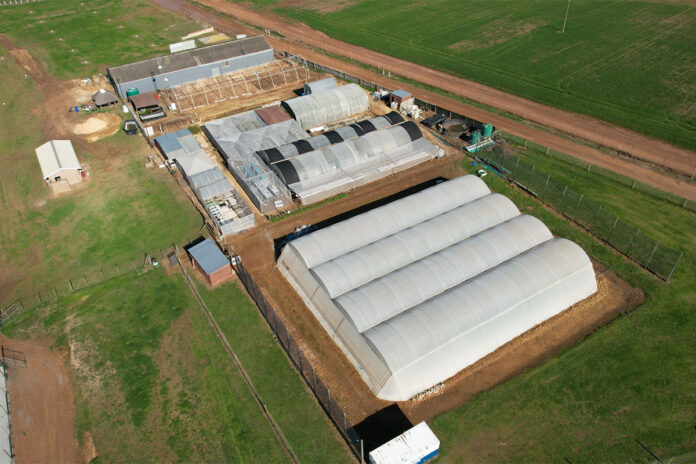
Henk Aggenbach, chairperson of Bredasdorp Park, told Farmer’s Weekly this year’s seminar will be the second held at the venue during Nampo Cape. The demonstration centre, established in 2019, serves as a permanent demonstration and production site for intensive high-tech vegetable farming.
“Our idea behind the vegetable-growing demonstration centre was to demonstrate in a practice-oriented process that you can run a commercial farming operation on a small piece of land without necessarily needing very expensive equipment.
“It was our way of making a contribution to agricultural transformation. We felt strongly that it has to stand on its own feet financially, because it is a demonstration garden rather than a commercial farm,” he explained.
Full-time vegetable production
Since 2019, the Two Oceans Hydroponic and Aquaponic Unit has expanded from a small pilot project to a 2 000m² commercial multi-span greenhouse that uses custom-developed soilless growing systems, including nutrient film technique, deep-water culture floating rafts, and precision drip irrigation.
According to Dr Ian Goldie, CEO of Two Oceans Projects and Services, the facility’s holding company, the operation has significantly reduced water use by combining closed-loop recirculation systems with water purification and rainwater harvesting.
The facility produces high-value crops including lettuce, cocktail tomatoes, spring onions, herbs, and edible flowers, supplying retail partners in the Overberg year-round, as well as the Epping market in Cape Town.
Why protected production matters
Goldie said the Nampo Cape seminar will be a high-level discussion aimed specifically at tunnel and greenhouse vegetable farming in the Western Cape.
“The idea is not to bring a specific supplier who wants to tell you what they sell. Instead, it will be a strategic look at the vegetable business: what the future holds, an overview of the weather patterns, and the impact it may have on this type of farming.”
Included in the speaker line-up are retail buyers, who will explain the requirements a farmer must comply with if they are serious about long-term commercial vegetable farming.
The keynote speaker will be Dawie Roodt, chief economist of the Efficient Group. According to the press release, the seminar will cover climate resilience and production security; protected-production infrastructure; hydroponics and controlled-environment agriculture; water efficiency and precision water management; retailer and fresh-produce market requirements; socio-economic and development opportunities; and the economic case for investment in technology-driven food production.
Goldie said protected-production and hydroponic vegetable farming are far more widespread in South Africa’s northern provinces than the Western Cape.
“It requires an intensive upfront investment, which means you have to need high-quality, high yields to earn that money back. If you have cheap land, and a lot of it, it makes no sense to put up a tunnel, because you can make up for the losses you incur in open-field cultivation with higher volumes.
“But in light of climate pressure and increasingly limited water supplies, tunnel farming enables you to manage your water use far better.”