
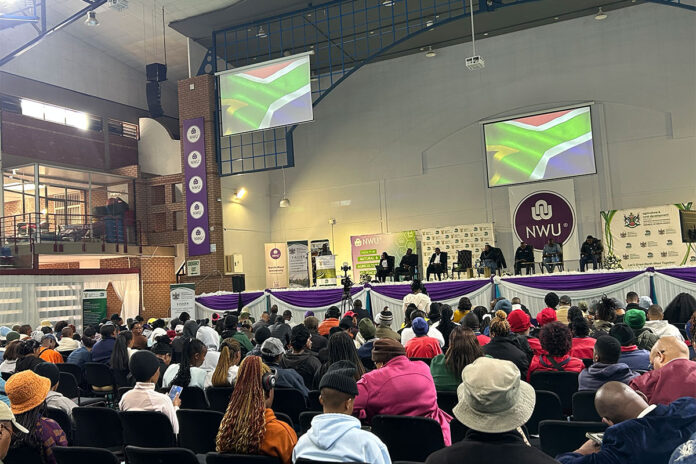
Held under the theme ‘Harnessing the potential of youth to transform agrifood systems and attain sustainable food security,’ the dialogue brought together young people, government officials, private-sector representatives, academics, and researchers to share information on youth-focused support programmes, reflect on their effectiveness, and discuss the challenges and opportunities young people in agriculture face.
In her keynote address, Deputy Minister of Agriculture Nokuzola Capa highlighted the critical role young people play in shaping the future of agriculture.
“Without a doubt, as young people, you possess the ideas, creativity, resilience, and entrepreneurial spirit that our economy urgently requires,” she said.
However, while emphasising the opportunities young people present for South Africa’s agricultural future, Capa acknowledged the many challenges that continue to prevent the youth from realising their full potential in the sector.

“Too many young South Africans continue to encounter barriers that prevent them from reaching their full potential, such as access to land, finance, technology, markets, and opportunity itself,” she said.
Against this backdrop, Capa said the Department of Agriculture (DoA) and its provincial counterparts remain committed to helping young people overcome these barriers.
“The Department of Agriculture remains committed to ensuring that young people have access to meaningful support through initiatives such as the [DoA’s] External Bursary Scheme, the Comprehensive Agricultural Support Programme, the AgriBEE Fund, blended finance schemes, the [Land Bank’s] Agro Energy Fund, and numerous provincial programmes designed to unlock opportunity,” she said.
Representatives from the North West office of the Small Enterprise Development and Finance Agency and the North West Department of Agriculture and Rural Development used the event to explain the funding and business development opportunities available to aspiring young farmers and agripreneurs. These include the Peo Pele Youth Fund, as well as the Assistant Agricultural Practitioners programme, which is aimed at creating youth employment and providing exposure to the agriculture sector.
Youth perspectives
Lebogang Botsheleng, acting deputy director-general for food security and agrarian reform in the DoA, said the dialogue is more than a platform for sharing information about the support and resources available to young people.
She urged participants to view the exhibition stands not merely as places to buy products but as opportunities to learn from exhibitors, engage with institutions, and expand their professional networks.
“The feedback that we are getting from young people is that it is through these exhibition spaces that they get to network with farmers who are already advanced in the market space,” Botsheleng explained.
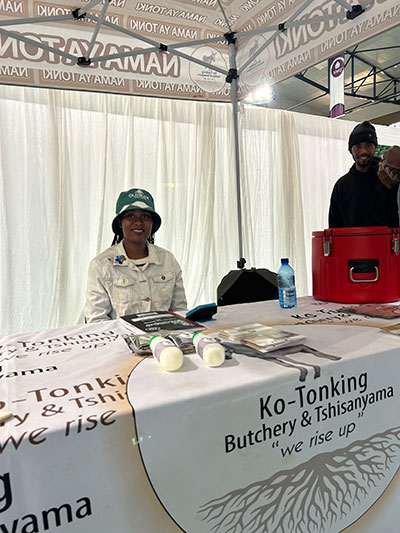
Overseeing the Ko-Tonking Butchery & Tshisanyama exhibition stand for owner Mompati Kgomonyane, Rebaone Sethole was gaining hands-on business experience.
“I have been meaning to start my own business and I am taking notes and learning as much as I can,” she said.
During a question-and-answer session, young people, particularly those interested in farming and related businesses, raised several concerns.
North West African Farmers’ Association of South Africa Youth Chairperson Crisp Crisp asked whether the DoA is creating more entry points for youth into agriculture, given the high cost of establishing a farming business.
“We have graduates who are qualified to be able to occupy the space but are not financially equipped. They cannot wake up and buy a farm for R10 million or buy livestock, and so on,” he explained.
Similarly, Kitso Monyadi, youth deputy national chairperson at the African Farmers’ Association of South Africa, said the association has a mandate to develop farmers, particularly those from previously disadvantaged communities.
She added that her organisation has a national footprint that government could potentially leverage to reach farmers across the country.
“How do we ensure that [young people] are included in the national budget so that we can help farmers with capacity building and training?” she asked.
Exhibitor Koti Seloane said platforms such as the youth dialogue need to do less talking and more doing.
“I think we need more practical ways on how we can develop farmers,” she said, adding that she was unable to engage in the dialogue itself as she was attending to her exhibition stall.
“If you look at the breakfast and lunch that were served [to participants in the dialogue], none of our products were used. That’s one of the ways exhibitors could be empowered.”
Seloane, who owns the agro-processing business All Things Sorghum, said, “What we’re trying do [at the dialogue] is educate consumers that there is more to mabele [sorghum] than motogo [soft porridge] and mqombothi [sorghum beer].”
Support measures
In response to some of these concerns, Botsheleng said there is a misconception that government is not doing anything for agriculture graduates.
She cited the DoA’s Graduate Placement Programme, under which agriculture graduates are placed on farms for two years of hands-on learning and receive a stipend during this period.
Using North West as an example, Botsheleng said the programme also helps graduates develop business skills through partnerships with North-West University (NWU) and NWU Business School.
On the issue of enterprise finance, Capa criticised government-funded development finance institutions (DFIs) for insisting on collateral, saying they “should not behave like commercial banks”.
“How can a child who has come out of school be bankable?” she asked, adding that DFIs “are given money to empower young people who are unemployed”.