
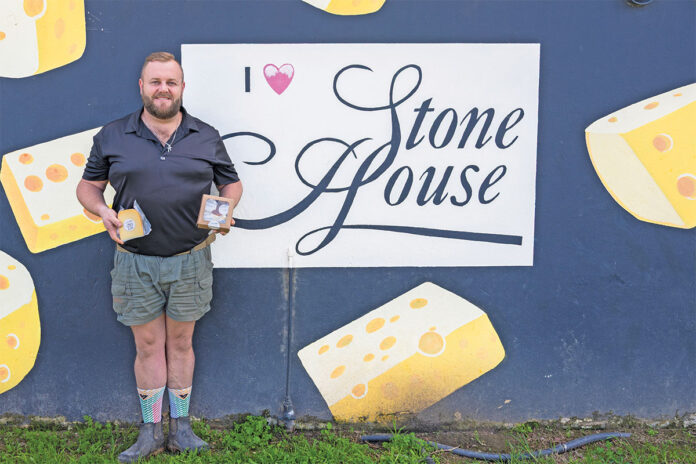
Stonehouse Cheese Estate sits on the R326 at the mouth of the Akkedisberg Pass, outside the village of Stanford in the Overberg, Western Cape.
The family bought the farm in 2013 while Matthew Fraser-Jones was working at Lion Sands in the Sabi Sand Game Reserve.
When the decision was taken to build a cheese factory on the farm, his father, Andrew Fraser-Jones, called him back to run the operation, and he and his wife, Bianca, began making cheese around 2016.
Today, the farm works as a single business with two halves that feed into each other. The dairy supplies the milk, the cheesery turns much of it into cheese, and the by-products of cheesemaking are fed back through the rest of the farm.
From dairy to cheesery
Fraser-Jones says the move into cheese was driven by economics. The price paid for raw milk has not kept up with the cost of producing it, and for a small dairy, the volumes are not large enough to make selling milk alone worthwhile. Turning milk into cheese returns far more per litre.
“The prices that you get paid for the milk doesn’t make sense for what you put in for that milk,” says Fraser-Jones.
He describes the shift as growing the business vertically. Roughly half of the farm’s daily milk output now goes into cheese, while the rest is sold to neighbouring Klein River Cheese. Because Klein River also tests the milk it buys, Fraser-Jones uses the results as a useful guide to how each batch is likely to perform.
The dairy’s output has grown from about 250ℓ/day when the cheesery opened to between 2 000ℓ/day and 3 000ℓ/day, depending on the season.
The morning milk batch goes straight to the cheesery, while the evening batch is collected by Klein River.
Fraser-Jones says he would happily put all the farm’s milk into cheese if the market allowed, but for now, he is content to stay niche.
The jersey herd
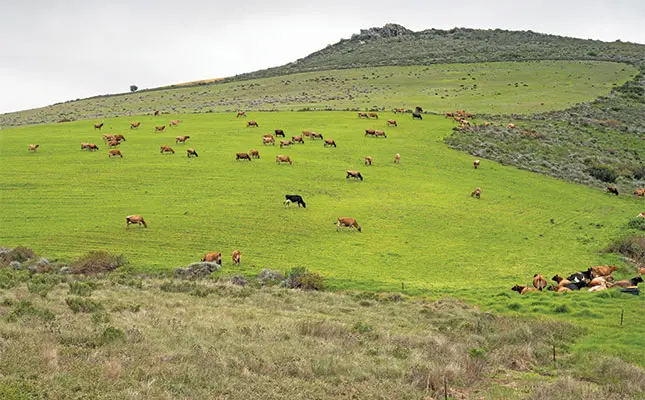
The herd is almost entirely Jersey, a breed Fraser-Jones inherited from his father, and he has stuck with it because of the butterfat and protein content of the milk, both of which are important for cheesemaking. He milks roughly 150 cows, down from a peak of around 350.
The reduction has been deliberate and is tied to the amount of grazing the farm can carry. Fraser-Jones says he may reduce numbers further so that he is milking only what he needs for cheese.
“If I sell the milk, it does feel to me like I’m giving gold away,” he says.
The herd is bred mostly through artificial insemination, with semen sourced from Genimex, which imports VikingGenetics from Europe. Easy calving is Fraser-Jones’ top selection priority, followed by butterfat and protein.
He also looks for a slightly downward hip angle to aid calving, and a strong front end, as his cows walk up to 3km to grazing.
Heat detection is managed with stickers, and Fraser-Jones says the herd achieves a conception rate of around 92%. He does not use sexed semen. Instead, roughly 30% of the herd is bred to Angus and 70% to Jersey. Beef genetics are used on older or weaker cows, leaving about a third of the herd as Jersey heifer replacements. On maiden heifers, Fraser-Jones first uses a Jersey bull before moving them onto artificial insemination.
All calves remain with their mothers for two to three days before being separated, after which the bull calves are sold. As a small dairy, Stonehouse keeps cows in production longer than many larger operations, with some animals still milking well at between 11 and 14 years of age.
Fraser-Jones prefers cows to calve during winter, when pasture growth is strongest, and feed availability is at its highest.
Feeding and milking
The farm covers about 240ha in total, of which roughly 130ha are usable. About 25ha are under irrigation, and around 110ha are dryland. Water is gravity-fed from a dam, while a borehole pump supplies fresh water to the houses, dairy, and staff facilities. River water is used for irrigation.
Pasture forms the backbone of the feeding programme. Fraser-Jones plants a range of forage crops, including oats, black oats, barley, ryegrass, chicory and lucerne. Oats and clover form part of the irrigated pasture mix, while different crops are matched to soil type and seasonal conditions across the farm.
He sows earlier than neighbours who plant for harvesting, putting black oats and ryegrass in during March so that he has grazing available when others do not. Through winter, with steady rainfall, the cows graze across the farm in what he calls the ‘saving period’.
In summer, he plants dryland crops such as babala, lucerne and teff. The herd is split into groups, with about a third kept in the kraal on straw and a semi-complete pellet to reduce pressure on the pastures.
Fraser-Jones makes around 4 000 bales a year as a buffer and trades barley straw with neighbours on a one-for-one basis. A notable change brought about by cheesemaking has been the removal of silage from the feeding programme. Fraser-Jones says silage carries a risk of hard cheese blowing, swelling and cracking as it matures. Although additives can be used to prevent the problem, he prefers to keep them out of the system.
“I don’t do silage anymore because I’m making cheese, and there is a risk of the cheese bloating up if you use silage,” he says.
The problem is a defect known as ‘late blowing’, in which butyric acid bacteria carried in silage survive into the milk and the maturing cheese. As they ferment, gas builds up inside the cheese, causing the wheel to swell and crack.
The cows are milked twice a day through a 40-point herringbone parlour, an older system that still records data by hand. The first milking starts at 6am, and the second at 4pm.
Milk production varies considerably with pasture availability. During the pasture-growing season, cows average between 18ℓ/ day and 24ℓ/ day, while production during the dry season falls to between 13ℓ/day and 17ℓ/day per cow if supplementary feed is limited.
Somatic cell counts typically range between 150 000 cells/ml and 250 000 cells/ml. For cow comfort, Fraser-Jones runs mist fans during the summer heat and plays classical music through speakers in the parlour. He says both help keep the cows calm and reduce stress before milking.
Milk moves directly from the parlour to the cheesery, where it is filtered for a second time to remove any straw or other particles before processing. It is then held at the appropriate temperature for the type of cheese being made.
Inside the cheesery
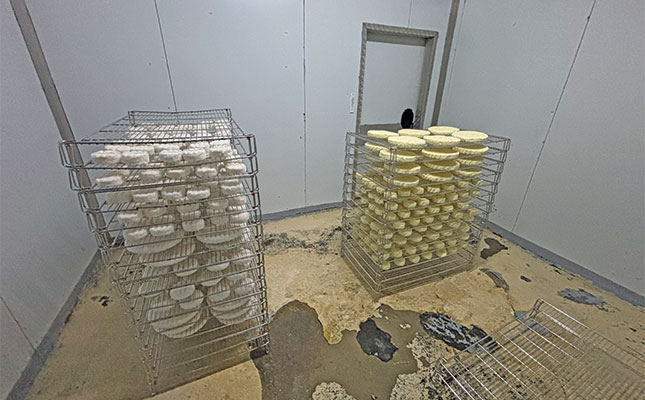
In the cheesery, the milk is pasteurised before moving to the production room, where it is formed into cheese, and the whey is drained off. The cheeses are salted in brine, dried for about two days, and stamped with their production date before being moved to the maturing rooms.
These rooms are kept at varying temperatures and humidity levels depending on the type of cheese being stored. The soft white mould cheeses leave the production room with no visible mould on them. Stonehouse uses stabilised cultures that allow the characteristic white rind to develop naturally as the cheeses mature, eliminating the need for a separate spray.
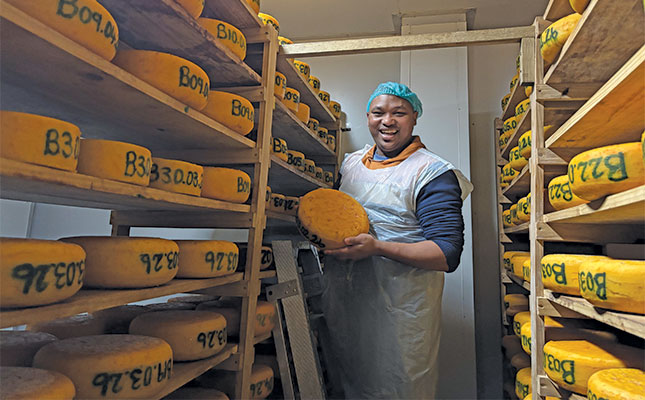
The cheeses then spend about one week in the room before being moved on. The core of the range is white mould cheese, particularly Camembert and Brie. Fraser-Jones also makes harder cheeses, including Bergkaas, a cow’s milk version of Pecorino, Boerenkaas and cumin Boerenkaas, as well as a range of semi-hard cheeses flavoured with Cajun spice, Italian herbs, black pepper, and garlic and chives. Smaller picnic-box cheeses are produced for wine farms to pair with their wines.
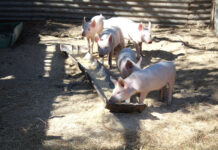
The whey left over from pressing is fed to pigs kept on the farm. Fraser-Jones says this not only makes use of a by-product, but also provides an additional income stream. Offcuts and cheeses that do not look their best are turned into grating cheese, while the soap used in the factory is selected so that wash water can safely drain onto the land.
The day-to-day cheesemaking is now led by Kay-Marie Swart, who began with on-farm work before moving into the factory and learning the craft under former head cheesemaker André Kruger. Swart reports to Fraser-Jones’ wife, Bianca, who oversees cheese orders and distribution.
Swart was among several women profiled by Farmer’s Weekly on World Milk Day in June 2026 for their work in the dairy industry. Reflecting on her craft in that space she said: “The art is what makes the cheese good.”
Herd health and biosecurity
Fraser-Jones considers the Stanford area relatively forgiving when it comes to disease. He has had only one case of redwater in about three years, and gallsickness is an occasional concern. The herd is vaccinated against foot-and-mouth disease.
Most of his neighbours have moved away from dairy operations, though there is a beef herd next door, and Fraser-Jones notes that any cattle bought in are checked for disease before they arrive.
Marketing the cheese
Stonehouse sells a large share of its cheese directly to restaurants and wine farms, which Fraser-Jones counts among his biggest clients. Beyond that, the cheese moves through a handful of distributors, including Prime Foods, Wild Peacock (a Stellenbosch-based fine-food wholesaler and his largest distributor), and Food for Thought in Johannesburg.
For now, Stonehouse remains deliberately niche and focused mainly on the Western Cape, although Fraser-Jones says he is open to expanding into other provinces over time.
The cheeses have performed well at the South African Dairy Championships. This year, Stonehouse earned third places for its Stonehouse Pecorino (made from cow’s milk) and semi-soft black pepper cheese. Its cumin Boerenkaas narrowly missed a placing, scoring 24 points against a winning score of 24,33.
Fraser-Jones says the acclaim is gratifying and serves as an acknowledgement of the work put in by the cheesemaking team.
“It is good for the cheesemaker and makes us proud of what we have accomplished.”
Fraser-Jones is realistic about what the recognition means for sales. He estimates its direct marketing effect at no more than about 10%. “Marketing ourselves and letting the cheese talk for itself is very important to us,” he says.
Looking ahead
Fraser-Jones wants to channel more of the farm’s milk into cheese. He is also considering opening a butchery on the farm, which would use the pigs raised on cheesemaking by-products and further link the dairy, cheesery and meat sides of the business.
He already has a building for the venture and now needs to have it audited before he can begin.
He has considered buying in milk or stepping back from milking altogether, but keeps coming back to the value of producing his own milk, both for what it adds to the final product, and for the jobs the dairy supports.
“Moving away from milking just doesn’t add a nice story to your product,” says Fraser-Jones.
More than a decade after the family bought the farm, the cheesery now shapes much of how the operation runs, from the Jersey herd and pastures through to the pigs.
Fraser-Jones has carved out a niche that a milk cheque alone could not provide.
For more information, email Matthew Fraser-Jones at [email protected].