

In the 30 or so years that I have been a florist, I cannot count the number of times that one of my clients have said to me: “I don’t need a lot of flowers; just fill the arrangement with greenery.”
What people don’t realise is that good-quality in-demand greenery can fetch the same price, and at certain times of the year even more, than some of the in-demand flowers on the Multiflora Flower Market auction.
Welma Viljoen, owner of Mobjadi Farm, supplies the flower market with various types of greenery almost on a daily basis. I wanted to find out from her if greenery farmers face the same obstacles as flower farmers, who have surprisingly high electricity and other input costs.
Mobjadi, which means to grow or to cultivate, is situated in Hekpoort in the Hartebeesfontein area of Gauteng, and nestled at the foothills of the Magaliesburg mountains.
When Viljoen and her husband Dawid bought their farm about 20 years ago, Dawid suggested that they use the land to do some type of farming. Neither of them had any farming experience; Viljoen was an interior designer at the time, working for a firm of architects, and her husband was a systems analyst.
After doing some research looking for a niche in the farming industry, they decided to grow greenery for the flower market.
Now, 18 years later, Mobjadi has grown so significantly that Viljoen bought the adjacent farm. The farm now consists of 11ha.
Under shade netting
At Mobjadi, most of the greenery is growing under shade netting, surrounded by windbreaker trees. Viljoen says they sometimes sell greenery from the windbreaker trees if their leaves are in good condition. Out of the 11ha of land, 8ha are under shade netting. No heating is required for the type of greenery grown at Mobjadi.
“I don’t know how flower farmers cope with the high cost of heating their greenhouses. My electricity bill is high enough without any heating costs,” says Viljoen.
Mobjadi grows various types of greenery, including laurel leaf, Pittosporum, Weigela, red robin, rosemary, snow-on-the-mountain and various varieties of Viburnum, and supplies the flower market almost all year round.
All these varieties, other than snow-on-the-mountain, are grown under shade net. Snow-on-the-mountain, which is a softer variety of greenery, is grown in a greenhouse, but does not require heating.
Viljoen farms on the south side of the Magaliesburg mountains, which is prone to cold and frost. As such, she cannot grow any tropical plants, such as palm, Aralia, Monstera, Philodendron and leatherleaf, which are popular on the flower market. The north side of the mountain, however, is more protected from the elements.
“If I’d known this before I started farming, I probably would have bought a farm on the north side,” she says.
However, she points out that the north side of the mountain can get very hot, which brings its own set of problems.
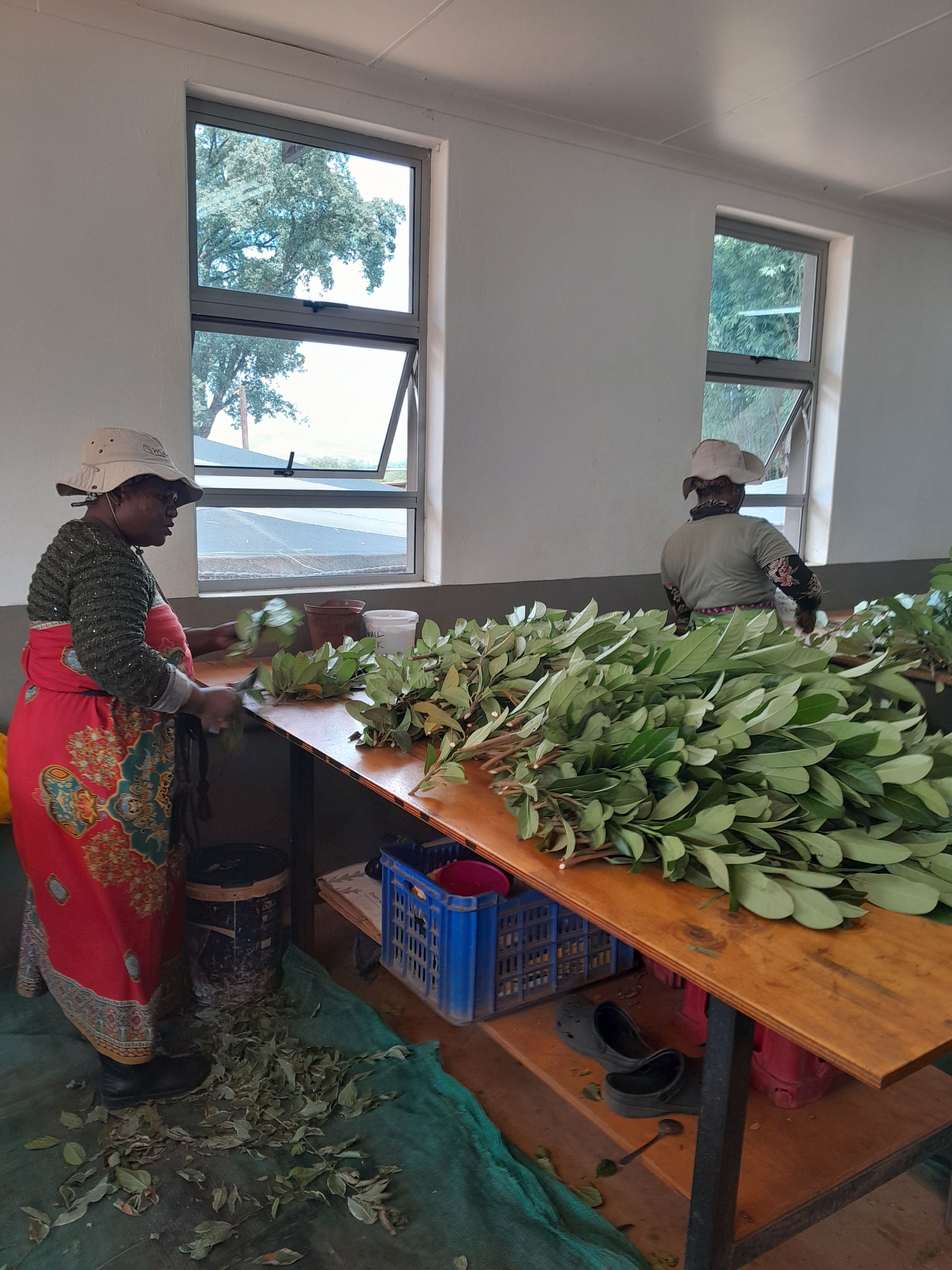
Viljoen currently employs 30 permanent staff members and 20 additional temporary staff members for seasonal work.
“Some of our permanent staff have been with us since the farm started 18 years ago,” she says.
All the structures on the farm were erected by the staff.
Market business
The order in which the greenery is arranged on the trolleys at the flower market, including stating any defects on the greenery, is the farmer’s responsibility. This is then coded in by Multiflora Flower Market and reflects on the screen during the flower auction.
Some of the defects that should be noted include marks on the leaves, crooked or thin stems, and any type of bacteria or pests.
If the farmer sends greenery in an order that does nor correspond to the way the buckets are arranged on the trolley, the staff at Multiflora have to recode the item during the auction, causing a delay. The farmer is fined each time this occurs. The grading of the product is also done by the farmer.
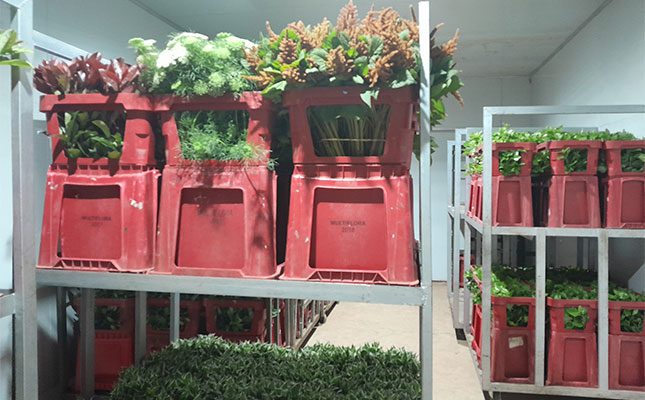
The auctioneers check the trolleys of flowers and greenery every morning to facilitate correct grading. If defects on the plants have not been included and this is picked up by the auctioneers, the item may be downgraded. The downgrade will then reflect on the screen at the flower auction, so that buyers are made aware of the quality of the product.
Multiflora takes 8% of any of the items sold on the morning flower auction. By selling their product at the flower auction, farmers can carry on farming and do not have to go out looking for buyers for their product.
There are usually 18 buckets on each standard market trolley (more smaller-sized buckets will fit on a trolley).
Production basics
There are six boreholes on the property; the water is pumped from the boreholes to a dam and then distributed to the plants by a mainline and dripperline system, pumping 2ℓ of water per hour. The dripperline system is also used to supply the plants with liquid fertiliser.
Viljoen constantly checks the plants for signs of pests or infection. Marks on the leaves caused by pests or pathogens can cause the plant to be downgraded, thus fetching a lower price on the market. Some of the most common pests that Viljoen scouts for include red spider mite, thrips and white fly.
Viljoen explains that the top leaves of the Viburnum trees must be regularly removed to allow for more shoots to branch out on each stem, giving a fuller stem of leaves. This is time-consuming, but florists and flower buyers prefer the fuller stem to a single stem. Longer stems also fetch a higher price than shorter stems.
Some of the other trees, like Pittosporum, have a longer life span, so after a certain number of years, the trees are removed and the orchard replanted. Trees like Viburnum and laurel only have to be pruned (not replanted). In these cases, Viljoen and staff chainsaw the trees right down to the base of their stems. The regrowth of these trees takes approximately five to six months.
Supplying the market
Mobjadi grows all their new trees from scratch by rooting the shoots first and then planting them into small amounts of soil in pots before transplanting them directly into the soil. Samples of the soil on the farm are sent for analysis on a regular basis, as poor soil quality can significantly affect the quality of the plants.
The plants on the farm are in different stages of growth and development, and there are always plants of every variety ready for picking.
“At peak times like Valentine’s Day and Mother’s Day when there is a big demand for both flowers and greenery, we double our supply to the flower market. As we have only a small truck, we drive to the flower market twice a day during these peak periods,” says Viljoen.
She supplies the flower market with three to four trolleys of different varieties of greenery almost on a daily basis. After the leaves are cut and checked for defects, they are packed carefully into the red buckets supplied by Multiflora. The farmer pays a hiring fee of 71c per bucket per day of use.
While Mobjadi has its own trolleys, Viljoen prefers to transport the greenery in Multiflora’s bucket and hire trolleys at the market, as the trolleys are heavy and can move around during transport, creating a dangerous driving situation on the narrow mountain roads en route to the market.
Viljoen is careful not to flood the market with too much greenery as this can bring down the price of the product.
As Mobjadi is situated at the end of a few kilometres of gravel road, the road can get flooded during extended rainy periods, making it impossible for the truck to take the greenery through to the flower market. Long periods of heavy rain also makes it impossible for Mobjadi staff to pick the greenery. On those days, the farm thus loses income from the flower auction or any other sales.
Leaving a legacy
Viljoen has become well known and respected in the flower industry. The standard of her product is high and she now supplies some of the bigger flower farmers, including Uniflo, Bloomex and Selemo Valley Farms, directly with greenery. Some of these flower farms make up bunches to supply Woolworths or to put ready-made bunches onto the market floor.
Viljoen also has an agreement with some farmers to supply them with certain products that she will grow specifically for them to be ready during peak times. These include sunflowers, Adenanthos and lace flower. As a woman in a predominantly male industry, she has had to earn respect, both amongst her staff and fellow farmers.
“My biggest challenge as a farmer has been to learn that you cannot fight nature, and having patience, as nothing grows overnight,” she says.
Her biggest reward has been to stand back at the end of each day and see all that the farm has accomplished. She tries to ensure that the enterprise is constantly growing year by year.
For more information email Carol Sutherland at [email protected].