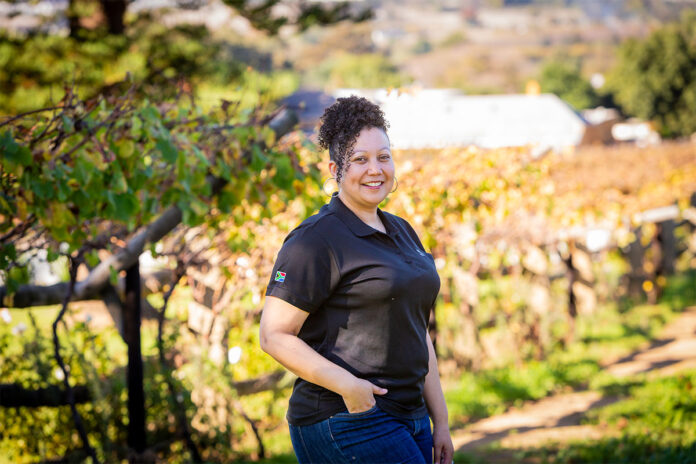
When Mecia Petersen came across a SATI job advertisement on LinkedIn in 2022, she had no experience in agriculture, let alone the table grape industry. Little could she have known that, just over two years later, she would be leading its national industry body.
Petersen was working at Stellenbosch University when the position of market development and communications manager caught her attention. Although the sector was unfamiliar, the challenge appealed to her.
“I took a chance, joined SATI, and I haven’t looked back,” she says.
She joined the organisation in March 2022 and was appointed CEO from 1 July 2024 – a rapid rise that surprised even her.
The move from managing a single portfolio to heading SATI brought an entirely new level of responsibility. She had to master a wide range of issues, lead a team of specialists, and help steer an industry operating within a complex global value chain.
Petersen admits that she felt overwhelmed at times and did not feel entirely prepared when the opportunity arose.
“I don’t think anyone ever feels completely ready for a role of that magnitude. For anyone out there reading this, it’s normal to feel overwhelmed.”
Rather than allowing that uncertainty to hold her back, she trusted the experience she had gained and her ability to grow into the role. She asked questions, listened to those with greater industry knowledge, and sought help where she needed it, including appointing a coach to guide her through unfamiliar aspects of leadership.
She also invested time in her employees, both individually and as a team, to build a shared culture and keep everyone working towards common goals.
“You don’t need to have all the answers, but you must ask the right questions and know where to find the information you need,” she says.
Petersen credits SATI’s team of specialists, directors, and industry stakeholders with helping her find her feet – reinforcing her belief that leadership need not be a solitary undertaking.
An unexpected destination
Petersen’s appointment as SATI CEO was not the culmination of a childhood dream to work in agriculture. Growing up in Cape Town, she had little exposure to the sector as a possible career.
Her parents both worked in corporate environments, and neither Petersen nor her younger brother had a direct connection to farming.
“Agriculture really found me rather than the other way around,” she says.
Although her destination was unexpected, the values and interests that carried her there were established early in life.
Her parents taught their children the importance of hard work, gratitude, humility, kindness, and respect for others and themselves. They encouraged them to set goals and work towards them, but also allowed them to question established ideas and challenge conventions – as long as they did so respectfully.
“I think much of my work ethic and the way I approach people today comes from those lessons,” says Petersen.
She remembers herself as a curious child who asked many questions, sometimes testing her father’s patience. Her ideas about what she would become changed frequently, but the kind of working life she wanted remained surprisingly consistent.
She wanted to work with people, make a meaningful contribution, and encounter different cultures and ways of thinking. She was also drawn to the idea of a dynamic career that could involve travel.
At Rustenburg Girls High School in Cape Town, the wider learning environment encouraged her to think independently, form her own views, and stretch herself beyond her comfort zone.
Those qualities would later give her the confidence to pursue opportunities outside the world she knew.
Preparing for the unexpected
Petersen began her career outside agriculture, working in both the public and private sectors.
Her time at the City of Cape Town gave her a strong grounding in governance. Later, working as part of a global marketing team and as a brand strategist exposed her to international industries, client management, and strategy development.
Her desire to expand her outlook also took her to the UK, where she completed an MBA at Nottingham University Business School.
Petersen deliberately sought an international education. She wanted to study alongside people from different countries and backgrounds and learn how they approached business and problem-solving. Nottingham’s focus on the United Nations Sustainable Development Goals also aligned with her interest in sustainability.
Living abroad for about 18 months required her to adjust to a different environment and reconsider some of her own assumptions.
“Being immersed in a different environment forces you to adapt, broaden your perspective, and question some of your assumptions,” she says.
Taken together, these experiences may not have seemed like an obvious route towards leading an agricultural organisation. They nevertheless equipped Petersen with the broad perspective and skills needed to manage SATI’s diverse stakeholders.
Producers and other stakeholders helped her build the necessary industry knowledge, while her outsider’s perspective enabled her to bring fresh insights to the organisation.
Creating the next leader
Petersen is proud to be a woman in a dynamic and resilient industry with an important role in South Africa’s economy and considerable global reach.
Agriculture has traditionally been male-dominated, and she believes women need to be visible within the sector. More opportunities must also be created for them to participate and lead.
Yet Petersen says her own experience has challenged assumptions that agriculture is closed to outsiders.
“As someone who came into the sector from outside and perhaps didn’t fit the traditional mould, I have not experienced agriculture as closed or unwelcoming. Quite the opposite, I have experienced a remarkable willingness to collaborate and support one another.”
She believes this support should be passed on. Leadership, in her view, is not only about personal advancement or attaining a senior title. It is also about helping other people recognise and develop their potential.
“A leader should create another leader, and that doesn’t necessarily mean creating another CEO. It can be encouraging someone to pursue an idea, helping them develop a skill, making an introduction, or simply giving someone the confidence to take their next step.”
Mentors and role models are also not limited to those in senior positions. Petersen says leaders can learn from team members, peers, friends, and family. They should remain aware of their own development and recognise that the support they need will change over time.
Her message to young women, particularly those who cannot yet see many opportunities around them, is to avoid measuring their future against their present circumstances.
“Have dreams bigger than what seems possible and don’t limit yourself based on what you see around you today. Opportunities are not always obvious, and sometimes they appear in places you would never have expected.”
She encourages young women to stay curious, build relationships, and enter spaces in which they may initially feel uncomfortable. Her own career is evidence that a person’s existing experience can have value in a sector they have never previously considered.
Agriculture, she adds, offers far more career paths than farming alone. Its value chain needs expertise in science, technology, finance, marketing, logistics, communications, research, sustainability, and international trade.
“It is a dynamic sector that needs people with different skills,” she says.
Building a legacy
Petersen hopes eventually to leave SATI and the table grape industry stronger, more innovative, more sustainable, and better able to respond to change. However, the legacy she wants to create goes beyond export performance and industry statistics.
She wants to open doors, share knowledge, and help others see possibilities they may not yet recognise. For her, leadership should be exercised with humility and kindness, and opportunities should extend beyond those who first receive them.
“Agriculture is too important to South Africa for us not to invest in its future, and that includes investing in the people who will lead it,” says Petersen.
“For me, Women’s Month is a reminder that the opportunities we have should not stop with us. We have a responsibility to pay them forward.”