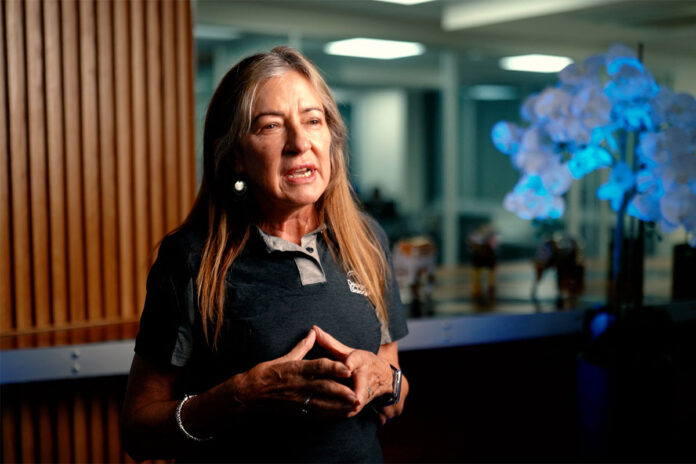
Karen Nel, one of the founding members of Design Biologix, began her career as a biochemist at Roodeplaat Research Laboratories, working there until it closed in 1994. Facing unemployment, she and two colleagues made the life-changing decision to start a small business manufacturing vaccines for use in feedlots.
Founding the business
“I was employed at Roodeplaat Research Laboratories, along with Pieter Smuts and George Gaenssler. One of the projects Pieter was involved in was the manufacture of a respiratory vaccine for shipping fever in calves entering feedlots. When it became clear that Roodeplaat was going to close down, we approached the veterinarian for whom we made the vaccine and asked for his support for a new business we intended to start, to manufacture this vaccine.
“That new business was Design Biologix. So basically, we started this business because we needed jobs,” Karen shares.
From the start, Design Biologix set out to promote and improve animal health in South Africa and across the wider African continent. What began as a small laboratory on the CSIR premises has grown into a commercial developer, manufacturer and global distributor of animal health vaccines and injectable mineral supplements for livestock and wildlife. Today, the company produces more than 40 million vaccine doses each year.
Karen has played a key role in growing Design Biologix from a small laboratory into a trusted name in animal health. “We started with only the essential equipment we could afford and gradually, over the past three decades, added clients, staff and” products.
Today the company specialises in developing, registering, and manufacturing vaccines. Karen’s commitment to innovation and quality continues to guide the company’s mission of providing effective animal health solutions.
The development of a new vaccine is a lengthy process that can take several years.
“We start by, in collaboration with veterinary pathologists, identifying a need, whether it is the emergence of a new disease or an existing disease for which available vaccines are not effective against local strains,” she explains.
What sparked Karen’s interest in science?
Karen mainly grew up in Pretoria, although her father’s career in the Defense Force meant the family moved frequently before settling there.
“When I was considering options for tertiary education, my mother mentioned a field of biology called biochemistry. I spent a morning with Prof Dan Potgieter, then Head of the Biochemistry Department at the University of Pretoria. He described the department’s research projects, and I was immediately inspired. I fell in love with biochemistry, and my passion for biology has never faded,” Karen recounts.
Karen graduated with a BSc (Agric) degree in Biochemistry and Chemistry and later obtained her MSc (Agric) in Biochemistry.
“The course was designed to provide exposure to a number of biological disciplines in the form of semester courses. We studied zoology, botany, plant pathology, genetics, anatomy, physiology, animal nutrition, mycology, microbiology and statistics. During my MSc (Agric) Biochemistry studies I focused on Immunology.”
She began her PhD in Molecular Biology under the supervision of Prof Braam Louw from the University of Pretoria’s Biochemistry Department but says that although she gained valuable knowledge through the process, she did not complete the degree, choosing instead to focus on the growing demands of the business and her daughter.
She says that now, looking back, she can unequivocally state that her studies in biochemistry, immunology and molecular biology gave her a solid foundation to ensure that their work remains science-based. “Our Research and Development team provides a strong scientific foundation for product development.”
Her work is her Inspiration
A passionate horse and dog lover, Karen says working in animal health is especially meaningful to her.
“I love my business, the people in our company and our clients, whether veterinarians, farmers or retailers, because we are all focused on animal health and food security.”
Karen believes her openness to new ideas and willingness to learn from both people and books have served her well.
“I don’t feel the need or pressure to always be right. I am willing to listen to other people’s views and make sure I have enough information to make a decision, not necessarily all the information, but enough.”
Focusing specifically on the business, Karen mentions that she understands that a sense of belonging and a sense of purpose create meaning to people.
“I am in the fortunate position as the owner of a business with no external shareholders, to be able to try and create such an environment for all our employees.”
According to her, Design Biologix’s philosophy is that they are in service of the animal health industry of South Africa.
“Our goal is to maintain and improve the health of commercial animals by always delivering appropriate and effective products to the market.”
Lessons for success
She credits her mentor, George Gaenssler, the business’s third partner until his retirement, with three lessons she still often applies. These are:
- There is enough sun to shine on everyone. “Other businesses do not have to go under for you to succeed. Cultivate a generosity of spirit if you don’t already have one.”
- Appoint people who know more and are better than you and then get out of their way and let them get on with the work.
- There is no such thing as a free lunch.
With her focus on people development, her advice to the younger generation are:
- Be curious about everything. Knowledge is never wasted.
- Be willing to work hard. It is not enough to just show up at work.
- Be proud of the work you do and do it to the best of your ability.
- Accept that you do not know what you do not know. Be prepared to learn from everyone. “This means engaging with people around you, so no headphones or social media scrolling in public places or at work. Mouth closed, ears open, I always say.”
- Be respectful of everyone around you. “While you are special, don’t forget, so is everyone else.”
- Go easy on the work-life balance concept at the start of your career. Be prepared to work hard and to put in extra hours.
- Never, ever lie on your CV.
- If you are not prepared to put information on a billboard, do not put it on any of your social media platforms.
She also emphasises the importance of learning to be responsible and independent.
“If your parents are doing your school projects or contacting your teachers or lecturers on your behalf, you may struggle in the workplace unless you have a trust fund. If you have not developed the basic skills of being independent and accepting responsibility by the time you leave school for tertiary education or work, life will be difficult. It is wonderful when parents are interested and involved, but they should not manage or carry out the day-to-day responsibilities of your life,” she advises.
More broadly, she stresses the need for strong working relationships between commercial agriculture and government to empower agriculture to support the food chain.
“Government should expand the markets for these products. It would seem that the Department of Agriculture has now resolved to act as an enabler and not a stumbling block. I hope that this spills over into agriculture as it relates to the infrastructure in our small towns that used to be thriving and are now merely surviving, if that.”
She feels strongly about the role of agriculture in society.
“Agriculture underpins food and job security. Food does not simply come from supermarket shelves; it is produced by farmers, farmworkers and their families. She believes it is wrong for producers to face tight margins while retailers and shareholders benefit, often without adding to product quality or the ground-level economy. In her view, farmers should earn fair, sustainable margins that encourage them to keep farming,” she says.