
On the previous day, the focus was on improving grain farming sustainability through conservation agriculture.
A common theme of the second field day, held on 6 August, was the need to combine multiple management tools to address challenges such as herbicide-resistant ryegrass, rising input costs, and climate uncertainty.
One of the first stops on the day focused on harvest weed seed control (HWSC), a technique widely used in Australia but still being evaluated under South African conditions.
Kaylen van Wyk, an MSc student at Stellenbosch University (SU), explained that the technique targets weed seeds at harvest, before they can return to the soil seed bank.
“It’s that final opportunity for you to reduce the amount of weed seeds that can enter your seed bank,” she said.
Trials at Langgewens are comparing two HWSC practices, namely narrow windrow burning and chaff lining, across different crop rotations. While still in the early stages, Van Wyk said burn temperatures averaged 603°C, exceeding the temperatures required to destroy ryegrass seed.
However, she noted that international experience suggests growers may need five to eight years of consistent application before significant reductions in weed pressure become evident.
Improving crop competitiveness
Another approach to weed management is improving crop competitiveness. Jade Hans, a PhD student at SU, is investigating how wheat cultivar selection and planting density influence weed suppression.
“With herbicide resistance, weeds are becoming uncontrollable, and we need to find alternative methods to put pressure on weeds,” she said.
Her research found that the wheat cultivar SST 0166 was generally more competitive against weeds than SST 0187, while increasing plant populations of both cultivars improved weed suppression up to about 130 plants/m².
Rebecca Ellerbeck, a PhD researcher at SU, presented results comparing wheat-medic rotation systems with conventional cash crop rotations. She showed how medic pastures and livestock integration can reduce ryegrass pressure while lowering fertiliser requirements.
“The overall ryegrass pressure in the camp where we have medics is much less than where we don’t have any medics or livestock integration,” Ellerbeck explained.
She noted that when wheat followed medics, it received less nitrogen than the adjacent non-medic systems, yet it still performed better in terms of yield and quality. In 2024, medic-based systems yielded about 3,1t/ha, compared with roughly 2,2t/ha in the non-medic system.
Expanding on these findings, Rens Smit, who works at Langgewens, explained how livestock provide additional management opportunities not available in crop-only systems.
“The mixed systems where you have livestock and wheat in the same field have, by far, the lowest ryegrass counts,” he said.
Combatting emerging pest challenges
The field day also highlighted emerging pest challenges. Piet Lombard, a scientific technician in agronomy at the Western Cape Department of Agriculture, warned that slugs have become an increasing concern in parts of the Swartland under conservation agriculture systems.
He cautioned growers against routine applications of slug pellets.
“I don’t want the last thing you take away from here to be that next year, you must apply slug pellets,” Lombard said.
Instead, he advised producers to first confirm whether economically damaging slug populations were present.
“Make sure the problem is in your area; that the problem is your specific field,” Lombard said.
Understanding soil variability
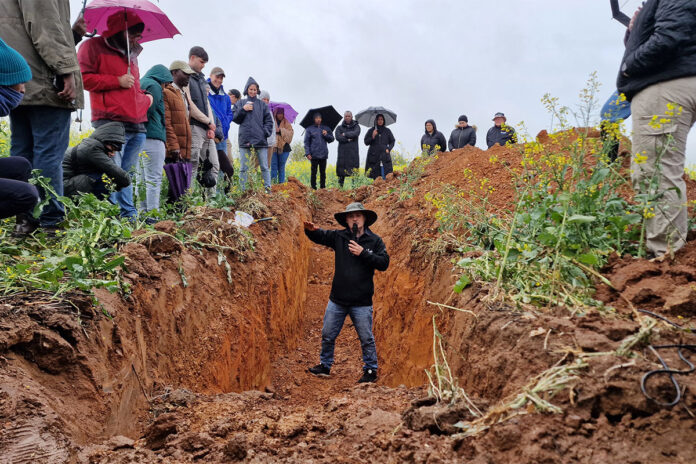
Prof Leon van Rensburg, founder of Van’s Lab and a former professor of soil physics at the University of the Free State, held his demonstration from the bottom of a six-foot-deep soil profile pit.
He said that an improved understanding of soil variability and water-holding capacity could help farmers make more informed decisions on planting density, fertiliser use, and risk management.
“You’ve got rainfall, and your soil is the converter of that water,” he said.
Van Rensburg advised farmers that by understanding how water moves through and is stored in soils, they can improve decision-making and build more resilient production systems.
“It’s a new way of thinking. It’s to reduce your risk,” he added.