
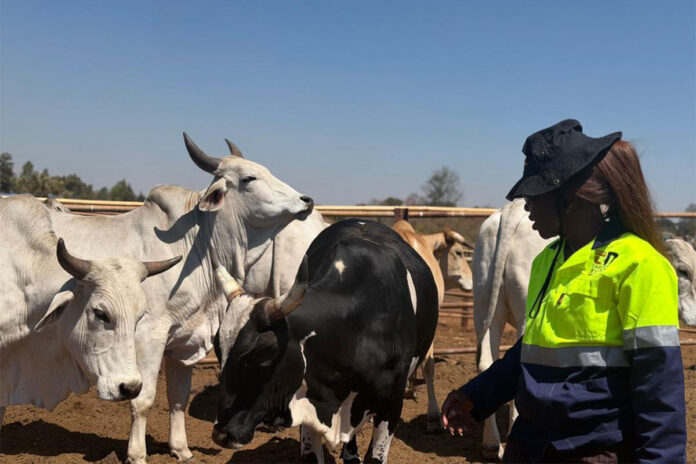
Nyambirai’s rise to become a CEO is an inspiring fairy tale. She tells Farmer’s Weekly that TNLT, which was formed in 2012, has a vision of converting cattle into a bankable asset.
She is the first to admit that both privilege and hard work have played a part in her career: her father, Tawanda Nyambirai, a top lawyer and businessman, owns the group of companies she has worked for.
In the 13 years between mopping those floors and running a cattle bank, she completed a law degree from the University of East Anglia in 2018 and a master’s degree in international trade and commercial law at Durham University in 2020.
Professional growth
She says after graduating with her law degree, she went to work at TN Baker, where she began essentially as a general worker. “It wasn’t a glamorous launch into my career, but it was necessary,” says Nyambirai.
After instituting significant operational changes, such as the standard operating procedure for the bakery being enhanced with a production plan that helped to accurately predict how many loaves the bakery would have produced at any given time by just referring to the plan, sales took off and production capacity began to scale.
She explains that after that performance, she was appointed as the production manager, managing over 300 people, and the operation was bringing in hundreds of thousands in US dollars weekly.
According to her, at peak the bakery was selling close to 60 000 loaves daily at US$0,80 (R16) per loaf.
That contribution did not also go unnoticed, and company executives and her father moved her to the group’s asset management division.
“I was there for a few months until an analysis I did of TNLT when I was put in charge of livestock portfolios gave my dad the crazy idea of making me the head. He said I was the only one who really understood the model as he had intended it, and so he trusted me with taking over and bringing his vision out,” says Nyambirai.
Appointed as CEO in 2024, she ensures that farmers who deposit their animals are issued with tradeable financial instruments called tokens that can be used to facilitate investments, trade, and commerce.
Digital tokens systems
According to Nyambirai, here is how it works: a farmer brings cattle to one of the institution’s secure feedlots. Vets check the animals, they’re weighed, and after 21 days in quarantine, a farmer gets back digital tokens. One token equals 1kg of good-quality live cattle weight deposited by a farmer.
The farmer can use the digital tokens as collateral for a loan at TN Cybertech Bank. Zimbabwe’s central bank regulates the token system.
“These tokens represent your ownership, and you are free to sell them or buy more tokens at your discretion. After five years, you can then come with your tokens and claim live cattle of similar or better quality to the herd that you deposited plus any interest earned over the years. You can also opt for cash instead, or a hybrid of both cash and cattle.”
She says the cattle bank also makes money from fattening and slaughtering cattle for sale through TN Butchery.
She explains that TNLT also has its own proprietary herd, which is twice the size of the tokenised herd to ensure double cover for farmers if anything goes wrong.
According to Nyambirai, 50 farmers have deposited their cattle, which are kept at the organisation’s farms.
TNLT can work like insurance for commercial farmers who may get better returns for themselves than the model promises because although there is slower growth, their deposited herd is shielded from drought, theft, or disease risk.
“We guarantee returns,” she adds.
With feedlots spread nationwide that makes being on every farm difficult, she still travels to kraals often, but relies on systems and a trusted team that function without her.
She says she considers herself fortunate to be doing this job at a time when women are gaining ground in agriculture, but notes that in the kraal, her position as a woman leading in a male-dominated space is most apparent.
She says agriculture is dominated by men, with women owning less than 2% of agricultural land, and because of the cultural significance of livestock, they tend to only come into ownership when someone dies or when they get married.
She’s confronted by this disparity daily and has found that farmers aren’t always willing to listen to a woman tell them about their cattle or their finances.
“I’m often patronised, with people believing that I’m ignorant or incompetent. Some conversations have people speaking around me to my male subordinates or talking down to me, which I surprisingly don’t encounter in boardrooms or other formal spaces. However, I am quite resilient, and just like other women in this industry, I’m not so easily deterred.”
State of livestock sector
Turning to the livestock sector, she says the most immediate challenge is the probability that a second drought is bearing down before farmers have recovered from the 2024/25 El Niño drought.
She says the last drought was catastrophic, as Zimbabwe recorded roughly 50 000 cattle deaths from starvation and thirst that season alone, with Matabeleland South and Masvingo hit hardest.
“Herds only began rebuilding with the better 2025/26 rains. But Zimbabwe’s Meteorological Services Department put El Niño probability for the coming 2026/27 season at 88% to 94% as of its April 2026 assessment, which is why the Insurance Council of Zimbabwe in July extended agricultural insurance beyond crops into livestock cover specifically, an acknowledgment that another drought cycle is considered close to a certainty, not a risk,” says Nyambirai.
She explains that farmers need plans for irrigation and feed mobilisation if they hope to save their herds and crops this time around. Nyambirai is playing her part to save the cattle deposited with her bank. With another El Niño likely to occur, she’s betting on cattle tokens to be the difference between rebuilding herds and burying them.