
Welcoming guests to the farm, Manjo Stiglingh, director of Lucerne Fields, said the anniversary was about far more than marking a milestone.
“What we are celebrating today is much more than just 15 years of growing carrots. It gives us an opportunity to pause, reflect and appreciate what has happened over these years,” she said.
She added that the business’s success was the result of the collective efforts of its employees, traders, suppliers, financiers, government and customers.
“No farmer can operate in isolation. Without their support, we couldn’t have achieved what we have.”
From dream to reality
For founder and director Jan Stiglingh the journey started long before the first carrot was planted.
After leaving school in 1982, he told his father he wanted to become a farmer, only to be advised to first build a career and finance the dream himself. More than two decades later, around 2006, he returned to the family farm determined to establish his own enterprise.
After securing land along the Limpopo River and confirming sufficient groundwater supplies, he began clearing land and installing irrigation infrastructure before planting his first commercial crops.
The business’s first lesson came quickly. Convinced that Botswana needed more cabbage, Jan planted 20ha, only to discover demand was nowhere near enough to absorb the crop.
“I realised I’d made a big mistake,” he recalled. “I was struggling to sell the cabbages.”
Onions and beetroot followed and helped recover some of the losses, but it was in 2010 that Jan identified carrots as the crop that would define the business.
Despite being warned that Botswana’s climate was too hot for carrots, he visited growers in South Africa to learn as much as he could before taking the gamble.
“It took us the first two or three years to really master carrot production, and we’re still learning today,” he said.
Investing in quality
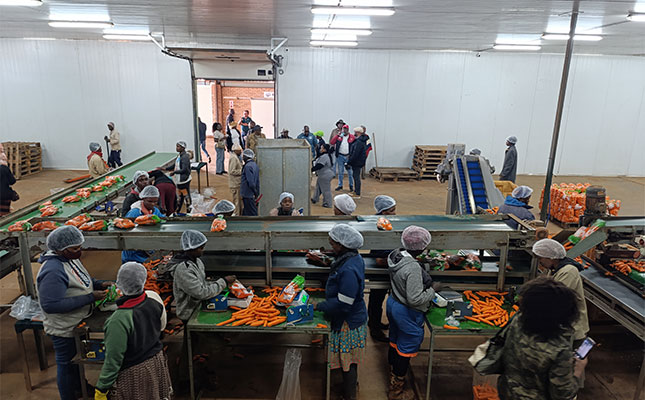
That commitment to continuous improvement was evident during a tour of the packhouse, where visitors followed the journey of a carrot from harvest to dispatch.
After arriving from the field, carrots are washed and sorted to remove damaged ones, before entering a brush polisher where the carrots gently rub against one another to remove a thin layer of skin and enhance their bright orange colour.
They are then transferred to a hydrocooler, where water at around 0°C rapidly removes field heat. After about 30 minutes, the carrots emerge with a core temperature of between 0°C and 2°C before being graded, packed by hand into 1kg retail bags and 10kg packs, palletised and moved into cold storage. From washing to final packaging takes about 55 minutes.

Jan said the hydrocooling system represented one of the company’s biggest investments and followed complaints from retailers that carrots arrived in good condition but deteriorated rapidly on supermarket shelves during Botswana’s hot summers.
Following visits to producers in South Africa and Germany, Lucerne Fields invested in the technology, significantly improving shelf life and product quality.
The investment also marked a turning point for the business, prompting the rebranding of its produce from Tuli Carrots to B-Fresh, a name chosen for its dual meaning: ‘Be Fresh’ and ‘Botswana Fresh’.
The company has continued investing in its future. A weir constructed on the Limpopo River has improved water availability during the dry season, a Limousin cattle stud was started to add value to root vegetable waste, while crop rotations with maize, oats and cover crops help maintain soil health.
More recently, Lucerne Fields has invested in solar power and battery storage to reduce the rising cost of operating its packhouse and cold rooms.
“We’ve never stopped investing,” Manjo said. “Everything we make goes back into the business because we always see opportunities to improve.”
Quality starts in the field
The field demonstrations showed that producing a premium carrot starts long before it reaches the packhouse.
Anton van der Merwe, key account and processing manager at Hazera, which has supplied Lucerne Fields with vegetable seed since production began, explained that varieties are carefully matched to the season.
Summer varieties are selected for their resistance to Alternaria leaf blight and Xanthomonas, while winter varieties are chosen for their resistance to bolting and their ability to remain in the field for longer.
The farm uses specialist Nantes-type carrot varieties sourced from French breeding programmes to produce smooth, uniformly shaped carrots with small cores.
“Consumers buy with their eyes,” Van der Merwe explained.
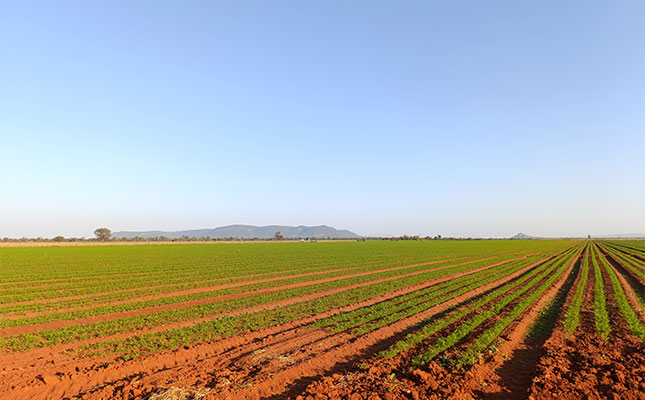
Visitors also learnt how agronomic practices influence quality. Carrots are planted on ridges in three rows, about 4cm apart, with the middle row being planted less densely than the other two. This prevents competition for light, encourages straight root development and manipulate width.
Irrigation is deliberately withheld at the four-leaf stage to encourage deeper rooting before watering resumes later in the season to promote root bulking.
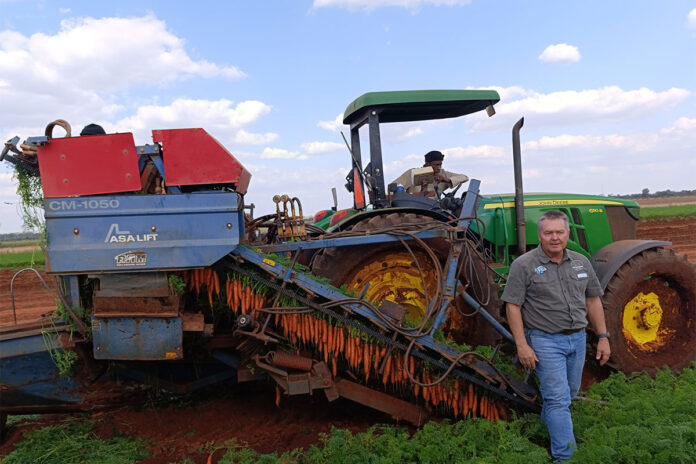
Visitors also watched the farm’s mechanical carrot harvester at work, illustrating the level of mechanisation required to consistently supply retailers across Botswana.
Jan said that harvesting by hand was no longer practical for a business supplying retailers across Botswana: “Retailers expect full truckloads to be delivered constantly. So on a commercial basis, this is what you have to do.”
An inspiration for others
Congratulating the business on the milestone, Kgosi Sello Molebatsi Moroka of Lerala and the Tuli Block said Lucerne Fields was making an important contribution to Botswana through job creation, improved food security and by demonstrating what could be achieved through commitment and faith in agriculture.
The journey, however, has not been without its setbacks. Over the years, Lucerne Fields has overcome costly production mistakes, floods along the Limpopo River, extreme summer temperatures, rising input and electricity costs, and the challenge of producing a cool-season crop in Botswana’s harsh climate. Each challenge has reinforced the business’s philosophy of continual learning and reinvestment.
“As a farmer, you cannot operate if you’re not positive,” Jan said. “We keep making plans.”