For South African vegetable farmers, the sudden closure of a neighbouring market can mean having to find new buyers for crops already in the ground. Failure to do so can leave surplus produce on the domestic market and depress prices, a consequence seen time and again when export markets close unexpectedly.
For Botswana’s farmers, however, the opposite is true. When imported vegetables enter the country during the local harvest, farmers might be forced to sell at a loss, or domestic produce may go unsold altogether.
Manjo Stiglingh, director of Lucerne Fields in Botswana’s Tuli Block, explained to Farmer’s Weekly that competing with South African produce is already difficult because Botswana imports almost all its farming inputs, mostly from South Africa, resulting in substantially higher production costs.
The disadvantage is compounded by the fact that many inputs and crop-protection products available to South African growers are not available in Botswana.
Targeted, not permanent
Botswana’s import restrictions have generated criticism within the Southern African Customs Union (SACU), with some commentators portraying them as hostile to regional trade.
Stiglingh believes this interpretation overlooks the realities confronting Botswana’s emerging vegetable industry.
She stressed that the country did not permanently close its borders to all vegetables, and that imports of specific commodities were merely restricted when local produce was available.
Where domestic supply was expected to fall short, imports were progressively permitted, with the volumes adjusted according to the estimated shortfall.
She explained that the objective is not to exclude South African farmers indefinitely but to give Botswana’s growers an opportunity to supply their own market during local production windows.
According to her, the size of that market is another factor South Africans do not always appreciate. Botswana’s 2022 census recorded a population of 2,36 million, which is less than 4% of South Africa’s population.
Consequently, volumes that may appear relatively small to South African exporters can quickly saturate Botswana’s market and displace locally grown produce.
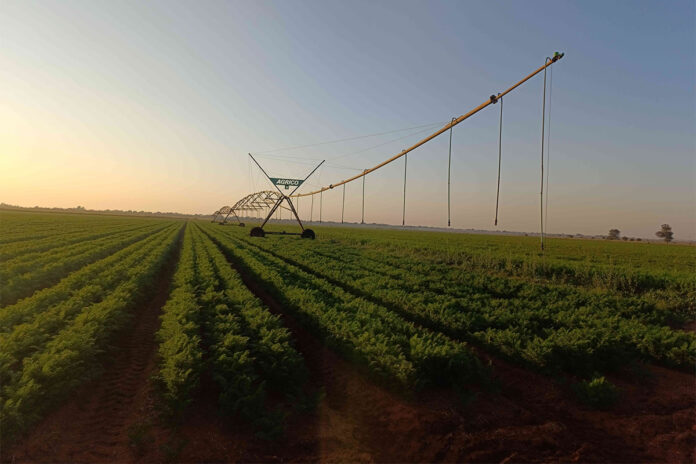
Demand is further shaped by differences in consumption habits. Lucerne Fields, for example, produces carrots. Stiglingh said that while South African consumers use carrots in salads, stews, and various other cooked dishes, consumers in Botswana primarily eat them in salads. This creates a narrower market and limits the volumes local farmers can sell.
Building a domestic industry
Botswana’s efforts to expand agriculture have taken on greater urgency amid mounting economic pressure. According to the World Bank, diamonds account for about 80% of the country’s export earnings, but weak global demand has placed the mining industry under strain, contributing to slower growth and job losses.
The World Bank estimates that Botswana’s economy contracted by 0,9% in 2025, while the latest official unemployment rate stood at 27,6% in 2024. Inflation reached 10,7% in June 2026, adding further pressure on households and businesses.
Agriculture, forestry, and fishing contributed only 1,7% of GDP in the first quarter of 2026. Developing the sector is therefore seen as an opportunity to diversify the economy, create employment, and reduce Botswana’s dependence on imported food.
Stiglingh said this development would require substantial private investment, which depends on farmers having reasonable confidence that they can sell what they produce.
“Vegetable production requires spending on irrigation, machinery, inputs, storage, and other infrastructure. Farmers would be reluctant to make these investments if they could not be reasonably confident of finding a market when their crops were ready,” she explained.
Seasonal marketing windows could provide that confidence, encouraging growers to expand production and improve their operations. The resulting investment would support jobs not only on farms but also in input supply, harvesting, packaging, transport, storage, and marketing.
Greater domestic production would also retain more value within Botswana and reduce its exposure to disruptions in regional food supplies. For Stiglingh, importing vegetables that the country is capable of producing effectively means exporting the investment and employment opportunities associated with them.
A regional balancing act
Wandile Sihlobo, chief economist at Agbiz, placed Botswana’s restrictions within a broader regional shift. He described them as a “silent but growing discontent” with South Africa’s agricultural dominance in Southern Africa.
Botswana and Namibia have periodically restricted South African agricultural imports, particularly fruit and vegetables, while Mozambique has signalled its intention to reduce its reliance on certain food imports from South Africa.
Sihlobo said South African farmers understand why neighbouring countries want to develop their own agriculture sectors. The concern is not the objective but the use of irregular and poorly communicated restrictions to achieve it.
“As fellow members of SACU, South Africa, Botswana, and Namibia had committed themselves to closer economic integration. Frequent restrictions have undermined the spirit of that commitment and created uncertainty for farmers and exporters,” he explained.
Better communication
Sihlobo believes seasonal protection could be accommodated more effectively if governments announced the affected products, implementation periods, and reopening dates well in advance. This would mean that while neighbouring countries supported local growers during peak harvesting periods, South African producers could adjust their production and marketing plans.
Restrictions also need to reflect actual supply conditions. If they are maintained when domestic production is insufficient, they risk disrupting food supplies and fuelling unnecessary inflation.
In the longer term, greater cooperation could help neighbouring countries build their agricultural capacity by drawing on South African technology, expertise, and inputs.
Nevertheless, the trend highlights the need for South Africa to diversify its agricultural exports by developing markets in Asia, the Middle East, and elsewhere.
Sihlobo said this should occur alongside continued consultation to address trade friction within Southern Africa.
“We want our neighbouring countries to thrive, because a rising tide lifts all ships,” he said.