
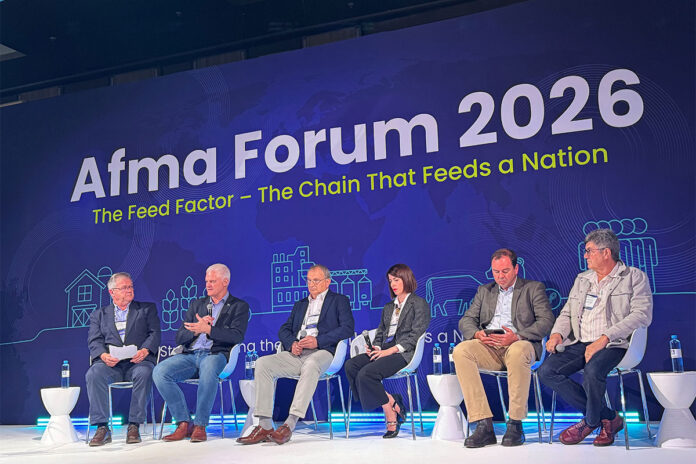
Prof André Jooste, chairperson of the National Agricultural Marketing Council, made this statement while facilitating a CEO panel discussion at the Animal Feed Manufacturers Association’s AFMA Forum 2026, held last week at Sun City, North West.
The discussion focused on the collective role of industry associations and the importance of collaboration across the agriculture sector and the broader food value chain in strengthening the country’s food security, competitiveness, and resilience.
The other panellists were Dr Tobias Doyer, CEO of Grain SA; Fanie Ferreira, CEO of the Milk Producers’ Organisation; Dr Marlene Louw, CEO of the South African Pork Producers’ Organisation; Dr Frikkie Maré, CEO of the Red Meat Producers’ Organisation; and Izaak Breitenbach, CEO of the South African Poultry Association.
Jooste also pointed out that although there had been strong production growth over the past couple of years, the management of on-farm risks, and those beyond the farm gate, was emerging as a crucial issue across the sector.
He said the following challenges added to the risk environment:
- Geopolitical tension;
- Logistical problems;
- Infrastructural collapse;
- Biosecurity issues;
- Adverse weather; and
- Supply chain bottlenecks.
Jooste added that what made things particularly difficult for South African farmers competing in global markets was the fact that farmers in the EU receive 22 times more support from their governments.
“South Africa lies second in the world for countries that receive little farmer support,” he said.
He added that three aspects were important for agricultural competitiveness:
- The value chain cannot operate if any one of the links is not profitable.
- All sections of the value chain should be profitable.
- Individual businesses must be resilient for the entire value chain to be resilient.
Challenges across the value chain
Looking at key on-farm challenges that could negatively impact farmers’ competitiveness, Doyer listed the following:
- Access to key technologies. “We need regulations that enable farmer and the industry rather than preventing them from accessing the latest technologies and germ plasm.
- Efficiencies in the value chain and in government.
- “It is 30% cheaper to transport grain via rail than by road. The lack of infrastructure thus makes it so much more expensive to produce grain.”
Regarding red meat, Maré said animal diseases and stock theft were negatively affecting the industry.
“Although foot-and-mouth disease [FMD] is a major issue within the livestock industry, it is actually the shortcomings exposed by the FMD outbreaks that are a major concern,” he added.
While each industry focuses on solving specific issues, Breitenbach highlighted the following areas that require attention across the broader agriculture value chain:
- Consumer education;
- Stock theft;
- Biosecurity and traceability;
- Rising input costs;
- Infrastructure such as water, electricity, road, rail, and ports;
- Rural safety;
- Tenure security; and
- Transparency.
On the topic of biosecurity, Louw noted that government and industry need to move in the same direction.
“Lately, it feels like we are constantly putting out fires, and this may sometimes create a lack of trust. We need to talk about collaboration and strategies and not about solving a crisis. We should be in a position where we have a proper private–public partnership with regular meetings addressing the same issues and striving to achieve shared goals.
“More frequent engagement will lead to more fruitful discussions and results,” she explained.