
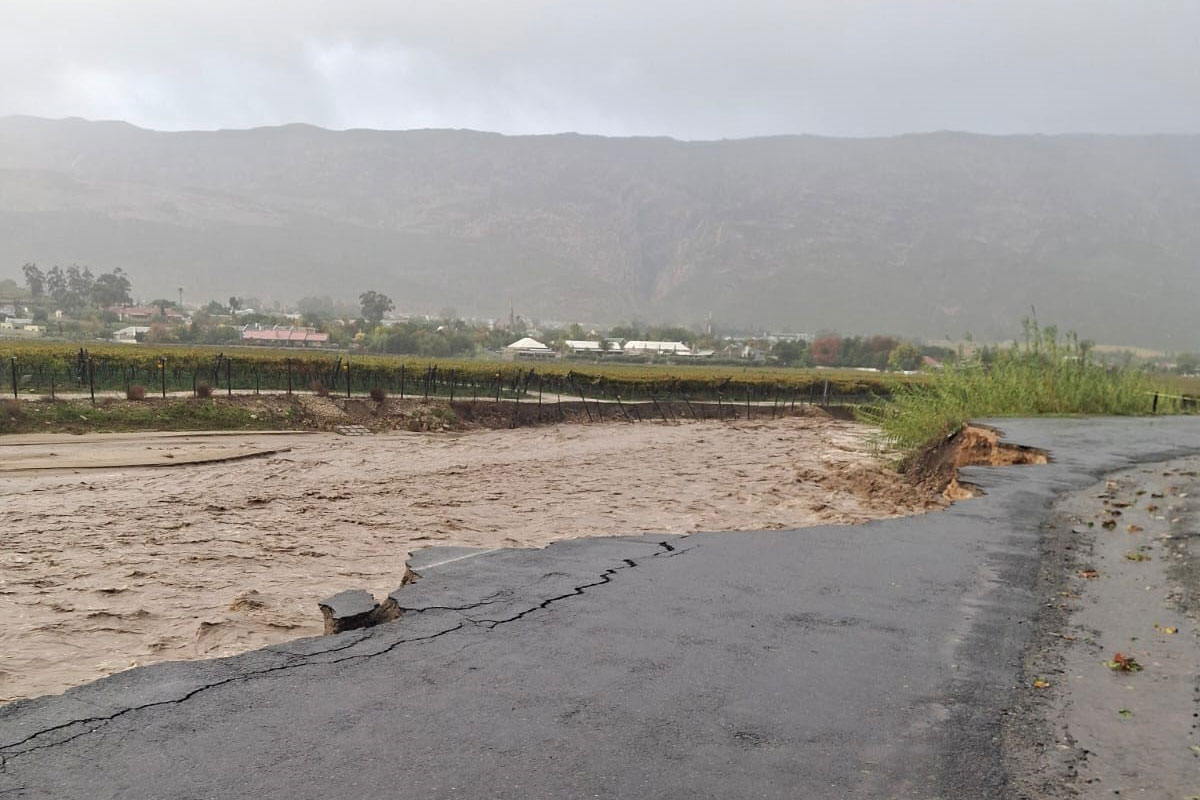
The series of intense cold fronts between 10 and 13 May caused widespread flooding, infrastructure damage, and disruptions to farming communities across key agricultural regions in the Western Cape.
Extensive damage was reported in the Hex River Valley, Grabouw, Ceres, and Worcester, where flooding destroyed vineyards, orchards, and croplands, with some farmers reporting complete crop losses, including apples in Grabouw.
“I am deeply concerned about the huge damage caused by the recent floods in the Western Cape. The agriculture sector experienced losses worth billions of rands across farms, roads, irrigation systems, packhouses, vineyards, orchards, and farmhouses,” Minister of Agriculture, Economic Development and Tourism Dr Ivan Meyer said in a media statement.
“Electricity and telecommunication networks were also affected, with some rural towns cut off. The province has prioritised repairing roads and other critical infrastructure.”
He added that several towns were isolated for days due to flooding and washed-away bridges, including Vredendal and McGregor. Other affected areas were Klawer, Ceres, Witzenberg, Wolseley, Breede Valley, and parts of the Cape Winelands, including the Hex River Valley.
Pome fruit industry at risk
National Minister of Agriculture John Steenhuisen and Hortgro representatives visited Ceres on 19 May to assess the impact on the apple and pear industry and surrounding communities.
“The storms have been devastating; there’s been significant damage to horticultural units, farm infrastructure, and plantings,” Steenhuisen told Farmer’s Weekly ahead of the visit.
He said the storms highlight the need for a more effective agricultural risk framework, arguing that current systems are too slow and expensive for many producers. He also pointed to the need for broader, more accessible insurance options, including blended and index-based models, to improve resilience and speed up payouts.
A major concern during the visit was the collapse of between six and 10 pylons in the Waaihoek area between Wolseley and Worcester, leaving the region with a severely constrained power supply.
Industry leaders warned in a Tru-Cape Fruit Marketing media release that the estimated four-week repair timeline poses a serious threat to the fresh fruit industry, which depends on electricity to maintain fruit quality and support processing operations.
Pieter Graaff, chairperson of Tru-Cape Fruit Marketing, and Jacques du Preez, general manager of trade and markets at Hortgro, accompanied Steenhuisen on an aerial site visit to assess damage in the Witzenberg and Breede River Valley areas, where heavy rainfall and strong winds caused widespread destruction to orchards, roads, homes, and critical infrastructure.
Steenhuisen also met with directors from Ceres Fruit Growers, Dutoit Agri, and De Keur, among others, as well as Witzenberg Municipality Executive Mayor Trevor Abrahams.
According to Graaff, the scale of the damage will have long-term economic consequences for the region and the broader agriculture sector.
“The impact has been catastrophic. As rivers swelled, roads, homes, and lives were swept away. The damage to infrastructure will take years to repair and cost billions of rands. This disaster has set our province back significantly, but with strong leadership, we will prevail,” he said.
Electricity crisis threatens exports and jobs
However, Graaff said an immediate crisis is looming as a result of the storm damage.
“There are more than 300 000t of freshly harvested export fruit currently in cold storage that require electricity to maintain market quality,” he said.
“There is insufficient generator capacity to keep these cold stores operational, while diesel costs are placing enormous financial pressure on businesses. If the fruit deteriorates, it cannot be packed, which could result in thousands of job losses and major export revenue losses.”
Graaff further noted that Ceres Fruit Processors is under mounting pressure, as the facility still needs to process more than 100 000t of apples and pears into concentrated fruit juice while operating on costly generator power.
Francois Malan, managing director of Ceres Fruit Growers, said virtually every farming operation in the region had suffered some form of damage.
“Everyone in our area has experienced damage to some extent, whether orchards were washed away, infrastructure destroyed, or crops lost. However, restoring electricity to the town and surrounding farms is now critical, as millions of rands are being spent daily on diesel to keep packhouses, farms, and communities functioning. Electricity is currently our biggest crisis,” he said.
Meanwhile, the South African Table Grape Industry (SATI) conducted a snap survey of members to assess initial storm damage.
In a media statement, SATI CEO Mecia Petersen called for urgent provincial and national disaster relief assistance for affected farmers.
“A major concern at present is access. In several areas, roads have been damaged or washed away, leaving some farms inaccessible. Producers have reported widespread damage to vineyards and infrastructure, including flooded vineyards, collapsed netting and poles, and damaged trellising and irrigation systems. Some farms reported that more than one-third of their plantings had been affected,” she said.
She noted that the flooding has been particularly severe in the Hex River Valley, which has now experienced major flooding for the third time in five years, resulting in repeated damage to vineyards and infrastructure.
“In some cases, vines that were replanted in August 2025 to replace vineyards damaged during the 2024 floods have been washed away again. The average cost of establishing 1ha of table grapes can be up to R1,2 million, making the financial impact on affected producers extremely severe,” Petersen added.
Affected producers are encouraged to complete the WCDoA’s damage assessment survey as soon as possible.