
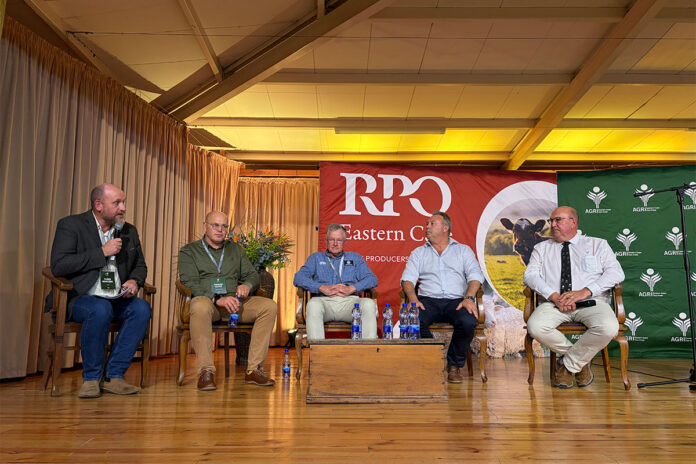
The panel discussion, facilitated by Chris Burgess, editor-in-chief of Landbouweekblad and African Farming, brought together Peter Cloete, president of Agri Eastern Cape; Johann Kotzé, CEO of AgriSA; Edgar Brotherton, dairy farmer and co-founder of Just Milk in Makhanda; and Pieter Nortje, citrus farmer and owner of Sitrusrand in Kirkwood.
Opening the discussion, Cloete said resilience required producers to look beyond their farm boundaries and engage with broader issues affecting the agriculture sector.
He said deteriorating infrastructure, particularly roads, remained one of the biggest constraints on agricultural growth, prompting many producers to step in where government services had fallen short.
“We simply cannot wait for things to improve. Farmers are often forced to become part of the solution because our businesses depend on functioning infrastructure.”
However, he added that government still had a responsibility to create an enabling environment for agriculture.
“Our job is to farm. Government’s job is to create the environment in which agriculture can grow and remain competitive,” he explained.
Engagement must continue
According to Kotzé, while organised agriculture has an important role to play in responding quickly to crises, it must maintain constructive engagement with government to address longer-term challenges.
Using disaster responses to the recent floods in the Eastern Cape as an example, he said agricultural organisations immediately mobilised support for affected producers while simultaneously engaging authorities on recovery efforts.
“We need to respond immediately when farmers are affected, but we also need to keep engaging government so that the same problems don’t continue to occur,” Kotzé said.
He added that policy reform was often slow, but sustained engagement remained the only way to achieve meaningful change.
“It’s a slow process, but collaboration around one table is how lasting solutions are built,” Kotzé said.
Job creation drives inclusive growth
Brotherton added that agriculture should be recognised for its contribution to employment, rural development, and economic growth, saying resilience must include creating opportunities for people.
“When we speak about inclusive growth, we’re talking about creating jobs, building businesses, and giving people opportunities to earn a living,” he said.
He added that agriculture continued to provide employment for thousands of people despite increasingly difficult operating conditions, highlighting the sector’s commitment to rural economies.
Transformation depends on practical skills
According to Nortje, resilience also depends on equipping aspiring farmers with practical agricultural skills, rather than focusing solely on asset transfers.
He added that long-term transformation would only succeed if aspiring farmers received the technical knowledge and mentorship needed to build sustainable businesses.
“If you give someone skills, they can build a future. Transformation isn’t only about giving someone land; it’s about teaching people how to farm successfully.”
Nortje said practical farm-based learning often equipped young people more effectively than classroom instruction alone, and he called on government to increase investment in agricultural training programmes.