
The experience South African farmers have gained from operating under pressure could become increasingly valuable in a more fragmented and unpredictable world.
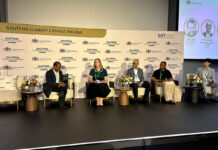
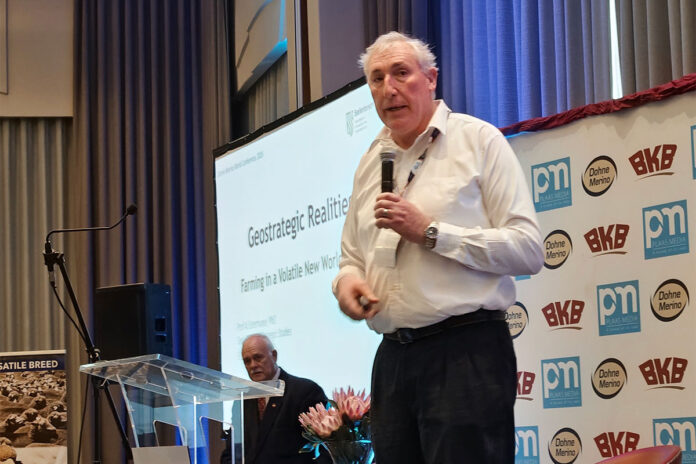
Speaking at the World Dohne Merino Conference at the Arabella Hotel near Kleinmond in the Western Cape, Esterhuyse described the prospect of a “South Africanisation of the world”.
The concept, which he attributed to Prof David Betz, professor of war in the modern world at King’s College London, describes widening socioeconomic divisions, with functioning private enclaves existing alongside deteriorating public infrastructure.
Esterhuyse illustrated how these enclaves could exist at different scales, from a privately maintained venue such as the conference setting to an entire country. Addressing the Australian delegates, he described their country as a large “enclave of haves”.
His comparison suggested that relative prosperity and functioning services could increasingly become concentrated in protected pockets, while conditions outside them deteriorated.
South African farmers already understood something of this divide, he argued. They had learnt to secure their operations and keep businesses functioning despite weaknesses in the surrounding infrastructure. Australian producers, he suggested, could increasingly encounter pressures their South African counterparts already knew.
Alongside social fragmentation, Esterhuyse identified four other forces reshaping agriculture: demographic change, geopolitical instability, environmental pressures, and technological disruption.
Fewer workers, different customers
Esterhuyse used the EU and China to illustrate the demographic and financial pressures facing major economies.
The contrast was stark: according to his presentation, the EU accounted for just 5,5% of the world’s population, but 58% of global social welfare spending and 16% of defence expenditure. Its median age was 44,7 years, projected to reach 49,6 by 2100. Esterhuyse questioned the sustainability of its welfare model as an ageing population left fewer young workers to sustain economic activity and support the state’s commitments.
China faced an even sharper demographic shift. His presentation put its contribution to global GDP at 18% and its share of the world’s population at 17,7%, with a median age of 40,6 years.
By 2100, the projections he presented showed China’s population share falling to 5,3%, while its median age climbed to 61,3 years. For agriculture, the implications included an older customer base with different consumption patterns, fewer young workers, and greater pressure to use technology to sustain production.
Esterhuyse argued that labour pressures were already driving China’s pursuit of artificial intelligence and technologies capable of replacing human labour.
Africa’s opportunity – and its security challenge
Africa presented a different outlook: a continent expected to account for most of the world’s population growth this century, but contributing roughly 8% to 10% of global agricultural output, according to Esterhuyse’s presentation.
Although its average fertility rate had declined from about 6,5 children per woman in 1980 to about 3,9 in 2025, he expected Africa to become increasingly important to the global workforce and future food markets.
“Africa is going to drive the demand for food in the world in future,” Esterhuyse said.
Rapid urbanisation would add to the transformation. His presentation put the flow of people into African cities at about 50 000 a day, underscoring the need to connect agricultural production with growing urban markets.
For farmers, this offered potential alongside the challenge of ensuring sufficient food was available at affordable prices. More mouths to feed would not automatically translate into greater purchasing power.
Esterhuyse also questioned whether security received sufficient attention to support the continent’s potential. According to his slide, Africa accounted for just 2% of global defence spending, with only 30% of the continent’s defence expenditure occurring south of the Sahara.
He argued that stronger security was essential to capitalising on Africa’s demographic opportunities, including the ability to produce and supply food reliably.
Conflict reaches the farm balance sheet
Geopolitical instability added risks that farmers could neither control nor afford to ignore. Esterhuyse highlighted tensions involving the US and China, China and Southeast Asia, the US and Europe, Russia and Ukraine, and the Middle East.
He argued that unpredictable and sometimes irresponsible behaviour by major powers was feeding uncertainty into the international system.
For agriculture, the consequences included disruption to the food and fertiliser trade, pressure on energy supplies and costs, and greater competition for water, land and other strategic resources.
Maritime security was a particular concern. Technology allowing shipping to be threatened from land was making it harder for naval forces to protect routes through the Strait of Hormuz and the Red Sea, he argued.
Against that backdrop, Esterhuyse highlighted the growing strategic importance of the Cape sea route to the safe movement of goods.
For farmers, these risks extended to both exports and access to imported inputs, exposing their businesses to conflict far beyond their boundaries.
Environmental pressure becomes a security issue
Esterhuyse described climate change as a scientific reality and emphasised three concerns for farmers: freshwater scarcity, disruption to food systems, and migration driven by environmental stress.
His presentation also highlighted biodiversity loss and ecosystem collapse, warning that environmental pressures could contribute to state fragility and conflict.
The challenge was to produce sufficient food in an environment becoming more climatically volatile, water-constrained and ecologically degraded.
These pressures would compound other risks. Scarcer water could intensify competition over resources, while environmental migration could place additional demands on infrastructure and public services.
He described environmental security as a shared problem requiring cooperation across borders.
Technology brings productivity and vulnerability
Technology offered tools to address labour shortages and improve productivity.
Esterhuyse said precision agriculture was already a reality, warning that producers who failed to adopt it risked falling behind. Artificial intelligence and other technological developments could further enhance production, although their full implications remained uncertain.
An abundance of information did not automatically translate into better decisions, he argued.
Greater dependence on digital systems also introduced vulnerabilities. He singled out cybersecurity, the protection of farm information, and access to money through banking systems.
Farmers therefore needed to consider the protection around their information as carefully as the protection around their physical operations.
Could agricultural power shift?
Esterhuyse closed by asking whether today’s agricultural powers would retain their positions in 50 years. He identified China as the largest producer, the EU as the largest integrated agricultural bloc, the US as the most influential exporter relative to its size, and Brazil as the fastest-rising agricultural superpower.
For South African farmers, his presentation pointed to an opportunity closer to home: Africa’s growing food demand. Their experience of operating amid insecurity and infrastructure failures offered some preparation for an increasingly unstable world.
Turning that experience into a business advantage would depend on addressing the challenges running through his presentation – producing competitively, protecting operations, and maintaining reliable access to markets.