
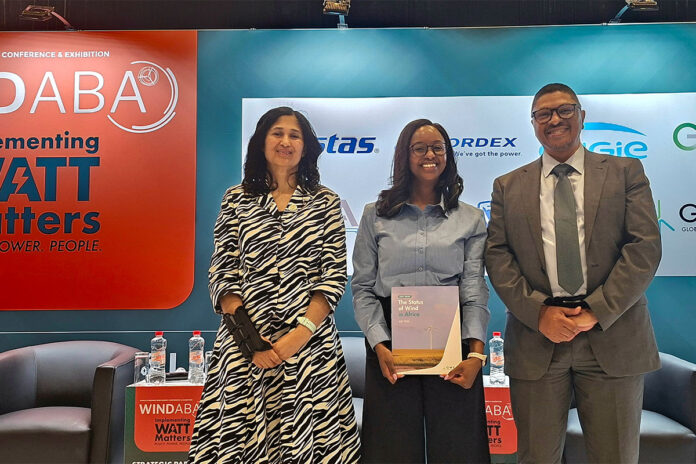
“South African corporates have signed wind contracts at a faster rate compared to the traditional state procurement route,” said keynote speaker Juliana Kainga, Africa WindPower director at the Global Wind Energy Council (GWEC).
More than 3,3GW of corporate power purchase agreements reached financial close in South Africa in less than three years, with regulatory changes enabling mining and industrial companies to procure renewable electricity directly.
Kainga launched the GWEC’s ‘Status of Wind in Africa Report 2026’, tracking progress in Africa’s wind energy sector between December 2024 and December 2025.
Africa’s enormous potential
Africa has huge technical onshore wind energy potential of 58 400GW. While it had installed just 11,1GW by December 2025, 1,53GW was added during the year – a record annual increase.
“Less than 0,02% of Africa’s technical onshore wind potential of 58 400GW has been developed. It is clear that Africa has enormous potential, but it needs to turn this resource into operating projects,” Kainga said.
The continent has a 186GW planned pipeline spanning 260 projects, although development remains highly concentrated. South Africa, Morocco and Egypt have built 85% of Africa’s installed capacity, yet they hold less than 10% of the continent’s technical potential.
“Algeria, Libya and Sudan have the largest technical wind potential on the continent, but together have built less than 200MW,” Kainga said.
The disparity illustrates that strong wind resources alone are not enough to attract investment. “The difference is market conditions around this resource, including credible buyers, a bankable contract, access to the grid, and financing,” she added.
Grid constraints
Wind energy projects on the continent face a common constraint: the electricity grid. “Transmission capacity is becoming a limiting factor in some of the strongest markets. South Africa is an example of this. A project can have the best wind resources, a buyer and financing in place but be unable to proceed due to constraints of the grid,” Kainga said.
This is evident in the Cape provinces, which is home to some of South Africa’s strongest wind resources, but where transmission infrastructure has not kept pace with new generation projects.
Scaling up
Kainga noted that wind energy projects in Africa were becoming larger.
“The Gulf of Suez project in Egypt is the first gigawatt project on the continent at 1,1GW. The average turbine size installed in 2025 was around 5MW, so we are seeing increased sizing and technology that is being used. This gives a sense of how quickly projects are scaling.”
GWEC forecasts that Africa could reach between 30GW and 50GW of installed wind capacity by 2035. South Africa could exceed 15GW, while Egypt is forecast to reach 8GW to 10GW and Morocco 5GW to 8GW.
Download ‘The Status of Wind in Africa Report 2026’ here.