
Speaking to Farmer’s Weekly, Ayanda Mnguni, general manager of the South African Agricultural Awards (SAAA), encouraged young people involved in agriculture to seize the opportunity to participate.
“Don’t discount yourself, no matter the scale at which you are operating. Give yourself this chance to tell your story and inspire others,” she urged.
Mnguni emphasised that the competition offers far more than the prospect of winning a trophy.
“Although entrants will be competing against others in their field, the competition also offers them an opportunity to measure their progress and learn from others.”
She also encouraged applicants to invest time in preparing comprehensive entry submissions.
“Make sure you carefully compile all the evidence relating to your farming operation, as this will be the adjudicators’ only insight into your business when judging the entries,” she advised.
Celebrating agricultural excellence
Presented in partnership with the Agricultural Sector Education Training Authority, the awards recognise excellence across the agricultural value chain, celebrating innovation, sustainability, community impact, and youth leadership.
Beyond recognising outstanding achievements in the sector, they also aim to create opportunities for skills development, training, and mentorship, contributing to a stronger, more sustainable future for South African agriculture.
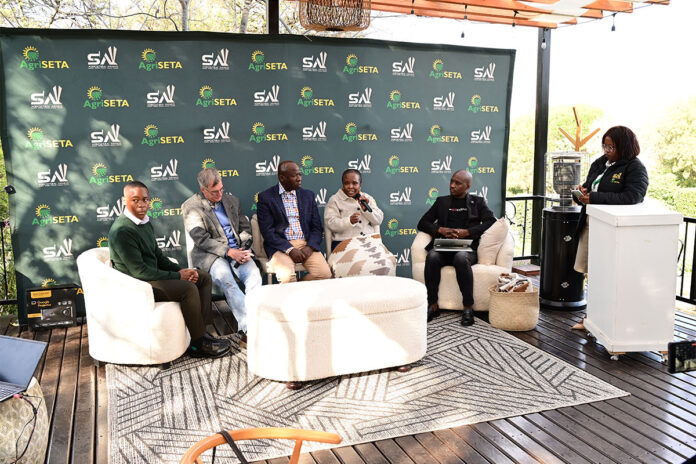
The breakfast briefing included a panel discussion led by Mnguni, during which speakers shared insights with aspiring young farmers.
“When one young person stands on the [SAAA] stage, it inspires thousands of others by showing them that recognition for the tremendous effort that farming requires is possible,” Musa Sono, a young farmer and director of the Emuseni Foundation, said. His foundation is a non-profit organisation dedicated to community empowerment, food security, and skills development.
Inspiring the next generation
Sono challenged the perception that farming is only pursued as a career when other dreams have failed.
“For too long we have believed that lie, but when we recognise young farmers on stage, it motivates other young people by showing them that they can also succeed; they can also reach a place of excellence. The competition also helps break the stigma that farming is dirty work for people wearing overalls,” he said.
He also suggested that the way agriculture is presented to young people should change.
“If a person says they are farming simply to feed themselves, that is fine. But if we say we are farming to build a nation in which our children will one day live, it places the message in a far greater context.”
Fellow panellist Prof Naudé Malan, member of the SAAA adjudication board, also encouraged young farmers to enter the competition.
Although he described himself as highly competitive in sport, Malan acknowledged that he had not always won.
“I passionately compete because I believe it is more important to compete than to win. It is the rest of the field – those who finish second and third – who push the winners to the top. They are the ones who set the standards.”
Malan also highlighted the challenges many agricultural students face in securing internship opportunities. He encouraged training institutions to strengthen their engagement with farmers and industry organisations to create more practical learning opportunities for students.
Expanding opportunities in agriculture
According to Malan, young people interested in agriculture need a message of hope, as the sector is often perceived as requiring significant capital, land, and equipment, while presenting institutional barriers.
“This perception causes people to disengage from agriculture because the [perceived] threshold for entry has been set too high. Many believe the only model is the traditional, highly capitalised commercial farming system born from the Green Revolution, but there are alternative approaches that create new possibilities.”
He referred specifically to regenerative agriculture, and the technologies, techniques, and smaller-scale production methods associated with it.
“These approaches offer a way to farm more profitably because they require far fewer inputs while producing products of much higher value. They are also much easier systems to establish.
“We must show our youth alternative ways of producing food and, in doing so, create more livelihoods,” he said.
Manti Maifadi, co-founder of Naledi Farm and a 2025 SAAA winner, echoed Malan’s views.
“When I was young, agriculture was not simply a sector; it was a way of life. It was where communities came together, where routines were shaped by the seasons, and where children learnt through observation.
“If we measure agriculture only by the tons harvested or the hectares owned, we lose sight of the very fabric that built our communities. Future generations need to know how to grow food and feed themselves. If we can achieve that, we’ll know our job is done,” she said.
How to enter
Prospective entrants can choose from 30 award categories under the following eight themes:
- Core farming excellence and production
- Sustainability, environment, and conservation
- Innovation, technology, and diversification
- Food, restaurants, and culinary arts
- Social impact, inclusion, and community development
- Education and knowledge advancement
- Leadership, influence, and advocacy
- Skills development
Entries for the 2026 awards must be submitted online via the official SAAA website. Entrants are required to:
- Complete the online entry form;
- Select the appropriate award category;
- Upload the required supporting documents; and
- Provide a letter of motivation together with evidence of impact.
Applicants may enter up to three different categories. Depending on those entered, applicants may also be required to submit:
- Proof of identity or registration;
- Photographs or videos;
- Business or project profiles;
- Financial or operational information; and
- References or letters of support.
The awards ceremony will take place on 16 October 2026 at the Sandton Convention Centre in Johannesburg.
For enquiries relating to entries, categories, or partnerships, email [email protected].