
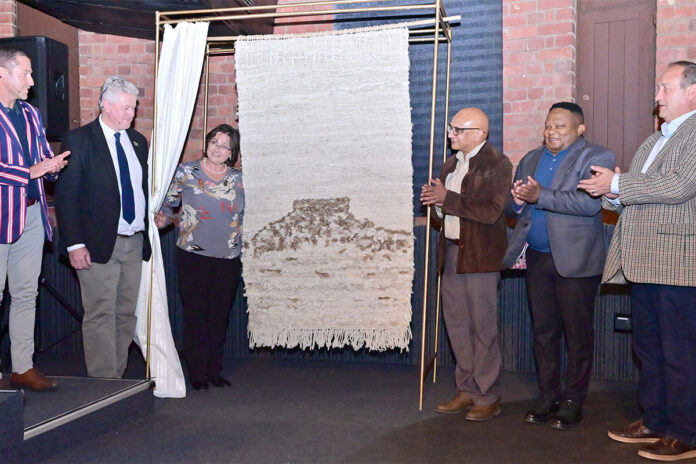
The fund was officially launched on 17 August at the Naval Hill Planetarium in Bloemfontein. It is a partnership between the National Wool Growers’ Association of South Africa (NWGA) and the University of the Free State (UFS), and grew from the extraordinary story of a sheep that captured the hearts of South Africans.
Rico became a symbol of resilience, perseverance, and hope after surviving alone for seven years in the harsh Karoo landscape. His story has resonated far beyond the wool industry and has become a source of inspiration across the country.
Dan Kriek, general manager of the NWGA, said the initiative originated with Rico’s owners, Marietjie and Neil Brink. After the couple found Rico in the Moordenaarskaroo, on the border of the Western and Northern Cape, they approached the NWGA with an idea to extend his heritage. The initiative has since developed into a fund intended to leave a lasting legacy.
“The idea came from the Brinks. It was their wish that we set up a bursary fund,” Kriek explained.
The Brinks’ motivation was rooted in their own experience of farming through drought conditions in the Karoo. During the drought, they experienced first-hand the financial difficulty of sending their children to university.

The idea was to use a tapestry made from Rico’s wool as a symbol of his legacy and the bursary fund. The NWGA subsequently approached the UFS and its Faculty of Natural and Agricultural Sciences (the faculty), where professors Johan van Niekerk and JW Swanepoel embraced the initiative.
The university has already committed eight full bursaries for master’s degrees in sustainable agriculture to the fund. In addition, the partners are establishing two undergraduate bursaries, which will allow successful students to study any agricultural course offered by the faculty.
The first of these will be reserved for a deserving learner from the agricultural community of the Karoo, where Rico came from. The second will be available to a deserving student from one of South Africa’s wool-producing areas.
Capacity through partnership
For the NWGA, partnering with the UFS provides the capacity needed to administer and manage the fund. Kriek explained the association did not have the capacity to operate a bursary fund itself, while the university already has the necessary structures and expertise.
“We’re very proud of this initiative and very thankful for the university,” he said.
The fund represents a shift in focus from Rico’s remarkable survival story towards people whose futures can be altered by the opportunities it creates.
Kriek said the ultimate measure of the bursary fund’s success will not be the continued fascination with Rico but rather the achievements of the students it supports.
“This is an investment in the future,” he said.
He hopes that, in years to come, Rico will be remembered not only for his extraordinary story that inspired the initiative, but also for the students who benefitted from the fund and went on to make their own contributions to agriculture.
The goal is for these students to become the leaders, scientists, and agricultural producers who will help shape the sector’s future.