
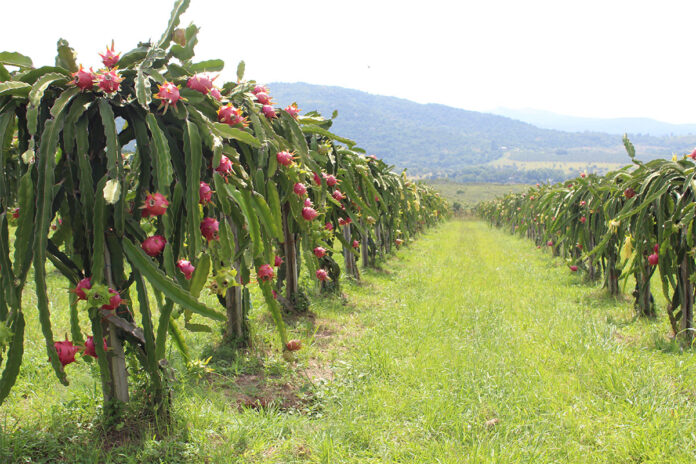
Dragon fruit is particularly sensitive to weather extremes. However, Fred Steyn, a dragon fruit farmer at Kuifkop Boerdery in Mpumalanga and deputy chairperson of the Dragon Fruit Growers’ Association of Southern Africa (DFGASA), told Farmer’s Weekly that adverse weather was only part of the reason for the taxing season.
“It’s not an easy crop, and the industry is still in its infancy. There isn’t a lot of information available about how to cultivate dragon fruit in South African conditions, so farmers are still experiencing a lot of trial and error,” he said.
CT van der Merwe, CEO of Al3 Boerdery in Limpopo, added that the 2026 season was “by no means good”.
“But we learn more every year and we keep improving. The challenges are more than what we initially thought, but we are at least learning and moving forward,” he said.
A point of positivity is market conditions, with demand steadily increasing.
“There weren’t any fireworks in terms of prices, which seem to be moving sideways, but demand is steadily rising, as the fruit is becoming more well known among consumers,” Van der Merwe said.
Al3’s fruit is sold locally, since increases in airfreight rates this year have made exports prohibitively expensive.
Steyn added that while export opportunities exist, the cost of exporting means there are only two or three farmers who export. Local demand, however, was promising, with demand growth evident in the number of retailers that had started incorporating dragon fruit into standard fresh produce programmes.
For Kuifkop Boerdery, their supply to retailers had doubled over the last two years.
“Farmers or DFGASA don’t have the funds to launch big marketing campaigns to drive demand, but the fact that retailers are driving inclusion in their programmes is positive to boost consumption,” said Steyn.
Both farmers agreed that supplying the market with better-tasting varieties was crucial to growing consumption.
“Unfortunately, there is still a lot of tasteless fruit on the market, which puts a damper on demand, as consumers will not readily buy dragon fruit again if their eating experience was negative,” Van der Merwe said.
Steyn noted that varieties with better-tasting fruit were being developed, and that more volumes could be expected to reach the market in the coming season.
Industry consolidation
The complexity of dragon fruit farming is evident in the shrinking base of commercial producers. Steyn noted that several commercial farmers had exited the industry over the past year.
“Many went in hard when they first started planting dragon fruit. But there is a steep learning curve, and the industry is only starting to understand how this crop should be treated in South Africa, both in terms of production and marketing.”
He added that much dragon fruit had been planted in climates that were not ideal (dry and warm rather than subtropical), which led to low yields.
Steyn said that the DFGASA currently had 14 members, down from 20 two years ago. The last census on hectares, conducted in 2024, showed that 120ha were cultivated commercially. He estimated that this had now shrunk to 100ha.
According to Van der Merwe, many farmers had gone through a trial-and-error process, quickly realising that dragon fruit was not a simple crop.
“And you need economies of scale to make it worthwhile, planting at least 20ha to justify the expense of cooling facilities,” he explained.
Cultivating incorrect varieties had also led to many unsuccessful ventures. Steyn said that while better-tasting varieties had been found, they did not always produce the tonnage that made production worthwhile.
Nonetheless, he is optimistic about the industry’s future.
“Around Nelspruit, orchards are expanding, with new hectares set to come into production in the coming season.
“While the crop has been misunderstood, knowledge is gaining traction, and we’ve seen that, planted in the right areas and paid the right attention, dragon fruit does well. It’s an intensive crop that needs a lot of care, but it pays off,” he said.
Steyn noted that, unlike many other fruit crops that are facing market saturation, dragon fruit volumes were still low and therefore had a lot of room to grow.
“The market is reacting well to dragon fruit, and with better varieties coming online, there is much potential to grow consumption both locally and abroad.”