

The case, confirmed last week, highlights the growing difficulty of containing the virus in communal grazing systems, where animal movements are informal and biosecurity controls limited.
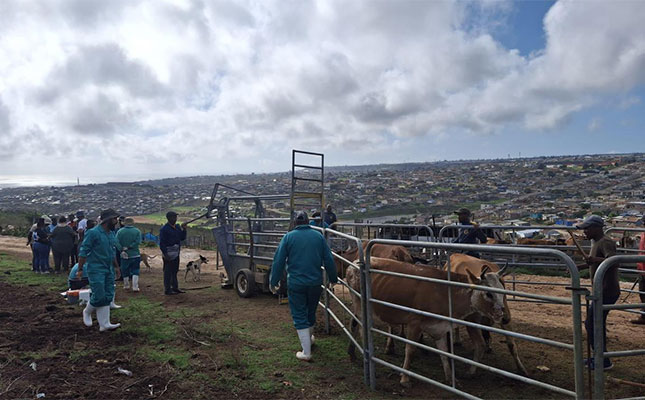
Chief state veterinarian Dr Ayla Newmarch confirmed to Farmer’s Weekly that the virus was isolated following a positive PCR laboratory test on an adult animal from Keiskammahoek village.
“This animal was born and raised in the village where it was identified earlier this month. Backward tracing has yielded very little information, and the owner has not introduced new animals or travelled himself,” Newmarch said.
READ Steenhuisen unveils the FMD vaccination plan for the national herd
She said the communal grazing system complicates source identification. “In communal settings, animals all graze together, and the source could be another person or animal not yet identified. A team of animal health technicians is currently sampling any new suspect cases.”
The latest detection follows the earlier containment of outbreaks in Kouga and Koukamma and comes amid reports of suspected FMD cases with lesions in Mbhashe (Dutywa), Matatiele and the Winnie Madikizela-Mandela Local Municipality.
All affected and suspected farms have been placed under quarantine, and a 30-day ban on animal movements, except for slaughter, remains in place across the province.
Vaccine vacuum heightens Eastern Cape risk
What makes the renewed Eastern Cape case particularly concerning is the absence of FMD vaccine stock in the province. According to Agri EC in its year-end advisory to members, vaccination is only expected to become possible at the end of January 2026, leaving producers reliant on strict biosecurity and movement controls for at least another month.
Agri EC has urged farmers to immediately reinforce farm-level biosecurity, including 28-day quarantine periods for all new animal introductions, restricting non-essential visitors, disinfecting vehicles and clothing, and maintaining strict access control.
“Until vaccine supplies arrive, biosecurity remains the single most important tool to protect herds and prevent further spread,” the organisation said in its advisory.
Shortages remain the national choke point
The Eastern Cape situation mirrors the broader national challenge: South Africa continues to battle a fast-moving virus with insufficient vaccine supply. Dr Peter Evans, veterinarian for Red Meat Industry Services and a member of the ministerial FMD task team, confirmed to Farmer’s Weekly that vaccine shortages are the biggest challenge in managing the disease nationwide.
Industry has welcomed government’s growing openness to sourcing vaccines internationally, including potential imports of vaccines from Turkey and supplies from South American manufacturers.
READ Industry, government warn against use of illegal FMD vaccines
These efforts follow global developments in which Brazil was declared FMD-free without vaccination by the World Organisation for Animal Health, while two zones in Argentina achieved similar status earlier this year.
A key development came on 18 December when the national Department of Agriculture confirmed that the Botswana Vaccine Institute could supply up to one million doses of vaccine per month from January 2026. These volumes are expected to support a phased national mass-vaccination campaign in South Africa, starting in high-risk areas and expanding to lower-risk regions.
Virus spreading faster than expected
Despite these plans, Evans warned that the virus has already spread far faster than initially anticipated. While environmental factors such as humidity and wind may play a role under certain conditions, he believes human-mediated transmission remains the dominant driver of new infections.
“I am more concerned about virus spread via the clothing of farmworkers who visit other farms than about windborne spread,” Evans said.
The FMD virus can survive for up to five days on contaminated clothing, particularly where saliva or manure from infected animals is present.
Continued animal movements, despite restrictions, have also accelerated the spread, exposing gaps in enforcement and compliance across both commercial and communal livestock systems.
Feedlots resume operations
On the supply side, Frikkie Maré, CEO of the Red Meat Producers’ Organisation, told Farmer’s Weekly that some previously quarantined feedlots have resumed slaughtering. This is improving beef availability.
While retail prices remain high, Maré noted that producer prices have only recently recovered to levels last seen in 2018, following several years of suppressed returns.
Eastern Cape case exposes national fault lines
The Amahlathi outbreak once again exposes fault lines in South Africa’s FMD control strategy: uneven biosecurity, delayed vaccination and weak enforcement in high-risk communal areas.
With vaccine supplies only expected to improve from early 2026, producers warn that the coming months will be critical. Whether further economic damage can be avoided will depend on how quickly vaccination can outpace the virus, and whether co-operation between government and industry moves from rhetoric to reality.
For now, the Eastern Cape case serves as a stark reminder that in the fight against FMD, containment is only as strong as the weakest link in the system.