
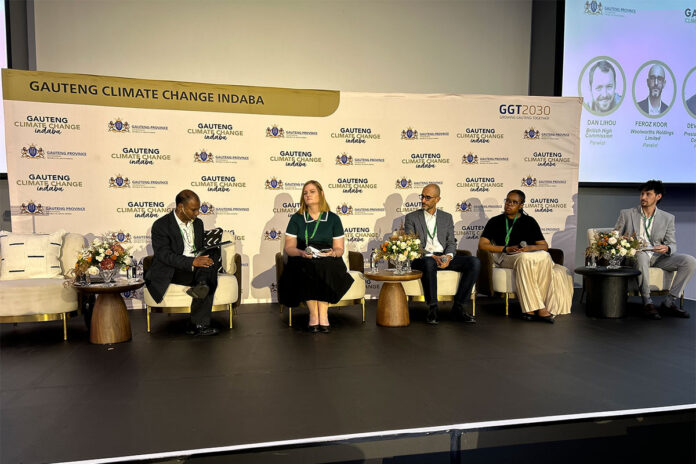
This was the message from MEC for Environment Ewan Botha to delegates at the Gauteng Climate Change Indaba in Modderfontein, Johannesburg, on 15 October.
Held under the theme ‘Transformative Innovations for Climate Action and a Sustainable Future’, the indaba brought together government officials, business leaders, and climate specialists to discuss climate resilience, climate finance, and implementation of South Africa’s Climate Change Act (No. 22 of 2024) in Gauteng.
“Responding to disasters will keep us alive this summer, [but] adapting is what will give us the future,” he said, citing recent extreme weather events around the world, from flooding in Nelson Mandela Bay, Eastern Cape, to heatwaves in France, as examples of the growing climate-related risks facing communities.
He warned that intensifying El Niño conditions could compound the effects of climate change, increasing the risk of water shortages and crop losses if summer rainfall is below normal.
Subsistence and small-scale farmers who rely on municipal water supplies, as well as dryland farmers dependent on rainfall, were particularly vulnerable to such risks, he added.
Gauteng’s response strategy
Botha called for coordinated action to translate climate risk assessments into practical measures to strengthen Gauteng’s resilience to adverse weather conditions. He explained that these efforts were guided by the Gauteng City Region Over-arching Climate Change Response Strategy and Action Plan (the strategy), approved by the Gauteng Provincial Executive Council in 2020.
Developed to help meet South Africa’s obligations under the 2015 Paris Agreement on climate change, the strategy identifies agriculture and agro-processing as one of 11 response programmes. These programmes support efforts to meet South Africa’s Nationally Determined Contributions under the agreement and limit global warming.
“The Climate Change Act, which came into operation in March 2025, now puts [Gauteng’s] work on a statutory footing,” Botha said.
He added that the Act required every province, metropolitan and district municipality to complete a climate change needs and response assessment, as well as adopt and implement climate change response and mitigation plans.
“[Gauteng] will meet that obligation, and we will ensure that our municipalities do the same,” Botha said.

The power of green procurement
Botha said the Gauteng government was developing Green Public Procurement Guidelines that would enable the province to use its substantial purchasing power to encourage the uptake of environmentally sustainable products and services. This could include prioritising produce from farmers who could demonstrate that they used water-efficient irrigation systems or rainwater harvesting, helping to promote more sustainable agricultural water use in agriculture.
Speaking during a panel discussion titled ‘Unlocking Green Procurement, Carbon Markets and Climate Finance for a Smart Gauteng’, Feroz Koor, group head of sustainability at Woolworths Holdings, highlighted how the company uses its procurement power to encourage climate-resilient practices across its supply chain.
Koor said Woolworths’s Farming for the Future programme works with food suppliers to improve sustainable farming practices, reduce water use, and identify risks to agricultural supply chains.
Through its annual Water Footprint Index assessments, the company tracks suppliers’ performance across 116 parameters, including water-use efficiency, wastewater management, invasive vegetation control, and soil health monitoring.
Climate risk insurance
Dr Musiwalo Moses Khangale, manager of stakeholder programmes at Santam, said the increasing frequency and severity of extreme weather events was driving up costs for insurers and policyholders alike, forcing the industry to reconsider its business model or “walk away” from insuring climate-risk-prone areas.
“Nature-based solutions should be part of the toolbox for managing climate risks,” he said during a panel discussion titled ‘Integrating Nature-based Solutions and Ecological Infrastructure into Development Planning’.
Speaking to Farmer’s Weekly, Khangale said uninsured small-scale farmers bore the brunt of climate-related production losses and struggled to recover.
He proposed that government consider subsidising small-scale farmers’ insurance premiums to strengthen their resilience.
“You cannot be resilient if you cannot finance the transfer of your risks,” Khangale said, explaining that without insurance, farmers’ cash flow could be severely affected when disaster struck.
Farmers key to climate resilience
Asked to contextualise his call for climate adaptation for farmers, Botha said while he acknowledged that there are best practices for climate change adaptation in the agriculture sector, there was room for engagement around the expected heatwaves in Gauteng and their management in times of water scarcity.
“Farmers are adopting a lot of innovative technologies, but I think the dialogue is open. We need to learn from them and understand how these innovations contribute to climate resilience,” Botha said.