
Hortgro has released its 2025 Key Deciduous Fruit Statistics, showing record apple and pear export volumes alongside a changing production landscape. Total deciduous fruit area stood at 53 832 ha, little changed from the previous two seasons, with industry turnover at R25,14 billion and 48% of production exported.
The number of pome and stone fruit producers declined to 1 109, from 1 128 in 2024 and 1 155 in 2023, pointing to continued consolidation in the sector.
Favourable growing conditions and younger orchards coming into production supported output in several categories, while apple growers continued replacing older blocks with higher-density plantings. Reflecting on the latest figures in an interview with Farmer’s Weekly, Hortgro chairperson Nicholas Dicey said pressure on the cost side remained a major concern.
“We’re seeing a tremendous rise in input costs. The pincer effect of your income versus your cost is certainly starting to be felt, and the costs are getting very close to the income,” he said.
Changing orchard economics
Apple exports reached a record 619 435t, up from 608 163t, despite total production declining about 5% to 1,26 million tons. Apple area edged up to 25 385ha.
Dicey said much of the movement in apple orchards reflected replacement rather than straightforward expansion, with weaker blocks being removed and replanted at higher densities using newer rootstocks, cultivars and netting. Younger orchards had also not yet reached their full production potential.
He said growers could no longer afford to carry poorly performing plant material.
“You can’t afford these days to have sub-par plant material. It’s got to be the best. It’s got to come into production quickly. It’s got to have the right size. It’s got to have the best quality,” he said.
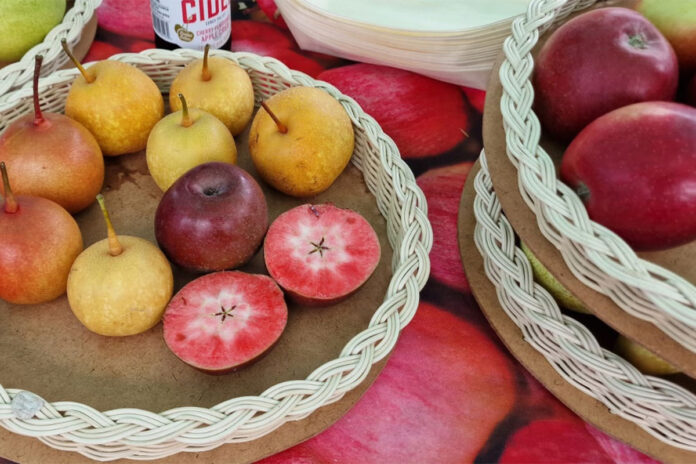
Pear production rose 20% to 574 056t, while exports reached a record 288 627t, compared with 253 649t in 2024. Margins remained a concern, however. Dicey said pears offered fewer cultivar options than apples and faced stringent quality requirements, making profitability more difficult to achieve consistently.
The crop mix also continued to shift. Peach area declined to 4 524ha, while dessert peach hectares have fallen by about 34% over the past decade as producers increasingly replace orchards with white-flesh nectarines. Cling peach area has also been in long-term decline, which Hortgro partly attributed to weakening demand for higher-sugar canned fruit products.
Nectarine area was virtually unchanged year on year at 2 844ha, but has expanded by about a third since 2019. Better cultivar selection and production practices have also helped lift production. Exports reached 26 056t in 2024/25.
Apricot production, meanwhile, declined about 6%. The reduction was concentrated largely in processing fruit, while fresh exports increased. The 2025 figures show fresh exports rising from 2 281t to 3 515t, while volumes going for processing declined from 23 490t to 18 259t.
Dicey said the wider movement between stone-fruit categories was increasingly being shaped by the economics of individual crops, with producers prepared to replace orchards where better-performing alternatives were available. This was easier in stone fruit, where orchards could come into production relatively quickly.
For now, parts of the stone fruit industry remain concentrated in relatively few export markets. Apricots remain heavily dependent on the Middle East, Europe and the UK, with nectarines showing a similar concentration. Hortgro said these left producers exposed to changes in demand, market access and geopolitical conditions.
The road ahead
Dicey expected production potential in several categories to continue building as younger orchards mature. In plums, Hortgro said 5% of orchards had yet to come into full production, while 59% were in their peak production phase. It expects improved yields and pack-outs to support production in the near term despite declining hectares.
Plum growers are also increasingly moving towards higher-density systems. Hortgro put the average density of older orchards at about 1 524 trees/ha, compared with around 2 286 trees/ha in newer orchards, an increase of about 50%.
The outlook for cherries is similarly positive despite planted area declining by 17ha to 802ha in 2025. About 30% of existing cherry orchards have yet to reach full production, while only 10% are older than 18 years, leaving significant additional production potential as younger orchards mature.
Market access could provide another avenue for growth. Hortgro said initial consignments of South African nectarines had recently reached China, while the new 0% tariff on South African fruit entering China could provide further opportunities. The US and Canadian markets were also showing positive growth.
“It’s one of the top priorities,” Dicey said of market diversification. “We can never feel that we have got all the markets that we need.”
Getting fruit to those markets efficiently remains a concern. Dicey said port performance and the ability to move highly perishable fruit out of the country on time remained critical, with delays also adding to producers’ costs.
“We cannot afford to have fruit sitting in the harbour for long periods. It needs to get on a boat, and it needs to get to the market as soon as possible. It’s an area of grave concern,” he said.
Across the 2025 figures, Dicey saw consolidation and replacement rather than outright expansion as the longer-term direction of the industry.
“Where orchards are being replaced, as opposed to expansion, that’s the trend; removing sub-par orchards or varieties and replacing them with something that can make an impact straight away,” he said.