While a few projects were successfully completed and new ones launched in 2025, Free State Agriculture (FSA) has said that a trail of failed projects, poor management, and squandered funds, all in the name of job creation, leaves nothing to celebrate this year.
Speaking to Farmer’s Weekly, Dr Jack Armour, commercial manager at FSA, said roads managed by SANRAL had seen significant improvement over the last few years, while those managed by the Free State Department of Community Safety, Roads and Transport (DCSRT) had largely collapsed.
He said FSA believes the reason for the poor state of the province’s roads is political interference “imposing socialist ideologies and race-based policies that aid in the appointment of select cadres to do the work”.
“Jobs created are reported as a target and not kilometres repaired,” Armour added.
He explained that as part of the Expanded Public Works Programme (EPWP), contracts were allocated to contractors based on requirements that included sourcing at least 30% of the labour locally and fulfilling black economic empowerment requirements.
However, Armour said this was a guise for cadre employment and resulted in the appointment of inexperienced contractors who could provide a ‘kickback’ to the DCSRT.
“The contractors soon go bankrupt, abandoning the projects before they have been completed. Another contractor must then be brought in to complete the job, at an added expense,” he said.
Francois Wilken, FSA president, added that the Contractor Development Programme, which sought to provide opportunities for the youth, had been misused.
“The only logical explanation for the repeated failures of fly-by-night contractors is that the public procurement process is also captured by the construction mafia or the politicians themselves,” he explained.
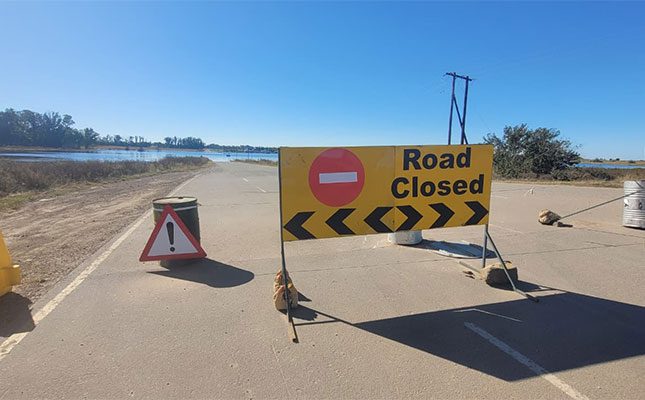
A case in point was the raising of a 200m stretch of the R59 bypassing Viljoenskroon that was flooded three years ago but which remained submerged, while the detour through the town’s industrial area had now decimated those roads, too.
Two critical road projects were terminated during the last year: the R709 between Tweespruit-Excelsior road and the R708 Clocolan-Marquard road. The DCSRT cited incompetence as the reason for the terminations.
Wilken said that if the DCSRT had heeded FSA’s calls to appoint external consulting engineers to oversee and manage the projects, as was standard practice globally, instead of cadre-deployed internal engineers, this may not have happened.
False empowerment cripples communities
FSA also disputed the true value of empowerment and job creation. Wilken said the salary component of the DCSRT’s budget continued to rise but was concentrated on top-level salaries.
“The work of the lower ranks is being substituted with EPWP workers who are employed at the special EPWP rate that is almost half the minimum wage,” he said.
He added that while job creation remains a national imperative, it cannot be the key performance indicator for the maintenance of critical infrastructure.
“If the DCSRT was really serious about job creation, it should have started with restructuring its own top-heavy personnel and appointing many more desperately needed grader operators and pick-and-shovel workers.”
The poor state of the roads has far-reaching consequences for the economies of small towns. Armour noted that a dairy farm in the northern Free State, employing 300 people, closed down a few years ago since milk buyers refused to drive the road to the farm to collect the milk.
“The Beefmaster Feedlot close to Christiana has to source its grain from Bloemfontein, rather than the closest silo in Hertzogville, because the 40km road is not drivable. It is cheaper for them to drive more than double the distance on a national road rather than risk damage to trucks,” Wilken said.
Persistent non-compliance
Armour added that one of the systemic issues was that the DCSRT was incapable of maintaining the ‘yellow fleet’. “The roadworks machines are routinely vandalised and have parts stolen because they are kept in areas that are not fenced off or secure.
“Earlier this year, the DCSRT confirmed that the machines had trackers. But later, when the question was asked in Parliament, they admitted that the trackers had been removed, ostensibly because they drained the machines’ batteries.
“We don’t believe that this is true. Rather, the trackers were removed so that the machines could be sub-let to generate extra income. This is not allowed since it makes the equipment unavailable to do the work they are supposed to do,” he explained.
Jafta Mokoena, DA spokesperson for roads and transport in the Free State Legislature, said in a statement that the DCSRT’s ongoing financial and governance failures posed a direct threat to residents, road users, and the provincial economy.
This came as the Auditor-General released a report detailing persistent non-compliance with legislation, weak financial management, and the deterioration in the DCSRT’s financial health.
“The DCSRT is now in a near-insolvent position, unable to meet even its most basic financial obligations,” Mokoena added.
Meanwhile, Wilken said farmers were forced to use their own funds to maintain critical roads.
“This is not sustainable and decimates funds that could have been used to reinvest and grow their businesses. As the main driver of economic growth in the Free State, our farmers feed the nation and provide more than 70 000 real farming jobs in the province,” he concluded.