

Dr Michael Southwood, independent agricultural consultant, owner of Southern Cross Trust, and organiser of the symposium, said the aim of the event was to take plant nutrition “from world-class research to your soil and crop”, giving farmers information they could apply in practice.
Integration, not replacement
The first day explored how fertiliser could be incorporated into regenerative production without compromising crop nutrition. A recurring message was that mineral fertilisers remain necessary but can be used more efficiently alongside organic inputs, soil biology, and better water management.
Gavin Olsen, director of operations and business development at Radicle Group, said organic and mineral fertilisers should not be viewed as mutually exclusive. Organic inputs can help build soil carbon and microbial biomass, while enriched products combine organic material with mineral nutrients.
“Baseline NPK [nitrogen, phosphorus, and potassium] remain essential for yield,” Olsen said.
He explained that the appropriate combination depends on soil conditions, crop requirements, transport costs, and the return from each plant-available kilogram of nutrient.
Marc Slabber, managing director at Talborne Organics, warned that farms could maintain yields while their soils became progressively more expensive to manage. As natural soil functions declined, farmers often needed additional inputs to sustain production.
“The soil is productive capital. Maintain it,” Slabber advised.
He said future fertilisers should provide sufficient nutrients while supporting roots, biological activity, and nutrient cycling. These benefits also had to make commercial sense.
“The farmer must be better off, too, not just the soil,” Slabber said.
Prepare the future root zone
Dr Pieter Raath, co-owner of Labserve Laboratories and coordinator of Citrus Research International’s Pre-harvest Production and Quality programme, emphasised the importance of correcting soil acidity before establishing permanent crops.
This is critical for orchards and vineyards that can remain productive for 20 to 30 years. Once planted, incorporating lime throughout the profile becomes difficult. Raath said producers therefore needed to determine the lime requirement and mix it into the future root zone during initial soil preparation.
He advised growers to use an accredited laboratory and request the additional acidity test.
“The Eksteen method offers producers a simple and proven way to calculate the actual lime requirement of their soils,” Raath said.
Keep nutrients within reach
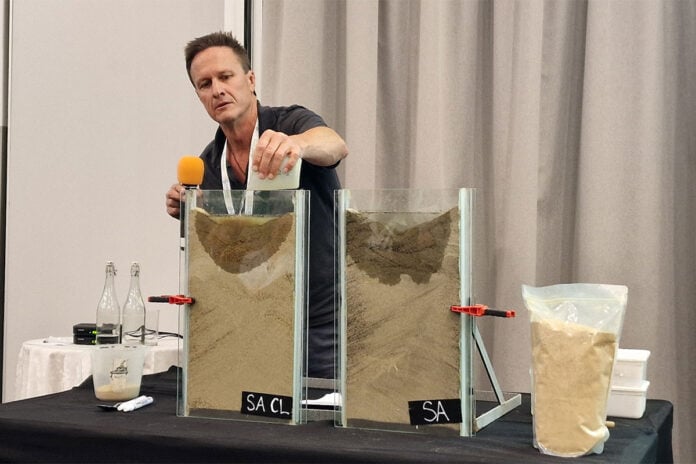
James Dick, agronomist and plant physiologist at Crop Walker Consultancy, gave delegates a practical demonstration of how the physical and chemical properties of soil influence fertiliser efficiency.
He encouraged farmers to dig profile holes to establish effective root-zone depth, examine root development, and understand water movement through the subsoil. They also needed to know how much nutrient their soil could hold.
“Prevent leaching, avoid competition, and check nitrogen status,” Dick advised.
Christo van der Westhuizen, agriculturist at Netafim South Africa, reinforced the importance of matching irrigation delivery to soil texture and rooting depth.
“Understanding your soil profile and soil texture tells you how to manage your irrigation,” he said.
Slower, controlled irrigation can help water and dissolved fertiliser spread through the effective root zone rather than moving below it. Water and nutrients carried beneath active roots are largely lost to the crop, wasting electricity, fertiliser, and water.
In a citrus case study conducted by Netafim, 20% over-irrigation represented R4 346,21/month in unnecessary expenditure. Van der Westhuizen said the example illustrated why irrigation and fertigation should be based on soil properties and actual rooting depth rather than a standard programme.
Match nutrition to crop development
Dick said producers should track phenological stages such as bud break, leaf development, flowering, fruit set, and fruit growth. Fertiliser should be supplied when the crop needs it, rather than simply according to a fixed calendar.
Michael Koch, controlled-release fertiliser market development manager at Haifa Group, explained that controlled-release products could supply nutrients at a predictable rate, more closely matching nutrient availability to crop demand at different phenological stages.
“Controlled release and slow release are not the same,” he added.
Controlled-release products use a coating to regulate nutrient release, whereas the performance of slow-release products may be influenced by microbial activity, soil chemistry, and moisture.
The technology could reduce nutrient losses and help farmers manage variable rainfall and dry conditions associated with El Niño. It could not, however, replace water.
“Moisture still has to be present in the root zone for nutrient release and plant uptake,” Koch said.
Lauraine van Zyl, science specialist at 9Five Integrated Nutrient Systems, said microbial communities support nutrient cycling, carbon storage, and soil aggregation, helping to improve aeration, water retention, and resilience.
“Biodiversity is not decoration; it’s functional insurance,” she said.