Sometimes, building a more resilient farm starts with a spade. Digging beneath a tree to examine root growth and irrigation depth can reveal opportunities to save water, improve irrigation scheduling, and boost production.
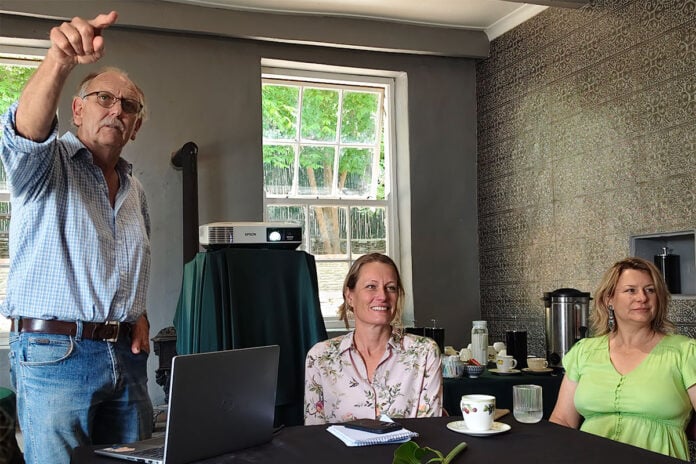
This practical approach shaped discussions at the Barrydale in Bloom Technical Agricultural Day, held on 6 November at the Karoo Art Hotel in Barrydale, Western Cape, where restoration ecologist Shelly Fuller and soil scientists Bennie Diedericks and Dr Pieter Raath explored how healthier soils, functioning ecosystems, and careful irrigation can help farmers get more crop from every drop.
Working with nature
For Fuller, regenerative farming need not be complicated or expensive. Many improvements start with resources already available on the farm.
She said farmers should look beyond individual crops to the landscape that supports them, including life beneath the soil, rivers, and mountain catchments.
Restoring ecological corridors and clearing invasive alien trees can help these landscapes function better. Managing water-hungry alien vegetation around rivers and in catchment areas can improve water availability while reducing the fuel that feeds destructive fires.
On the farm, protecting the soil helps make better use of that water. Cover crops and mulch can reduce evaporation, help water soak into the ground, and moderate temperatures around plants.
However, this approach must suit local conditions. Fuller explained that practices in Stellenbosch might need to be adapted for the drier Karoo, where competition for moisture requires particular care.
“It’s about using what’s around you, and what’s possible in your context,” she said.
Fuller encouraged farmers to experiment and share their experiences. Starting with manageable trials, and discussing their setbacks and successes, can help producers learn from one another before committing to wider changes.
Farming as part of a system
Diedericks expanded on the importance of context, explaining that farming depends on the relationships between ecology, communities, and the economy.
That means looking beyond the orchard, vineyard, or field fence. Farmers who share catchments and river systems also share responsibility for the natural resources on which their businesses depend.
Diedericks’s presentation explored increasing crop diversity, maintaining soil cover, keeping living roots in the soil, and integrating animals where appropriate.
Winter cover crops, for example, can produce material that remains on the soil surface during summer, limiting evaporation and helping water infiltrate the soil.
Diedericks takes a broad view of the animal component in regenerative farming, extending it beyond cattle and sheep to include chickens and bees.
He said that, depending on the species, animals can help manage vegetation, support pollination, and contribute to soil health, while providing income from meat, eggs, or honey. They can also attract tourists, creating further opportunities to diversify farm income.
Animals’ integration must suit local conditions, with grazing carefully managed to benefit the soil and crops.
Introducing cover crops also requires planning, particularly where water is limited. Establishing them may mean adjusting irrigation and other management practices.
For Diedericks, the task is identifying how different parts of the farm can support one another, then adapting management to make those relationships work.
Managing every drop
Raath brought the discussion to irrigation, starting with two questions: a) How much water is available? and b) How productively is the water being used?
He said farmers should know how much water they use to produce a kilogram of crop and how much income that kilogram generates. Tracking these figures can reveal opportunities for improvement and guide decisions when supplies come under pressure.
Putting that knowledge into practice requires an irrigation system designed for the farm’s different soil conditions and crop needs, and maintained to work as intended.
Leaking pipelines, blocked drippers, and faulty sprinklers can leave some trees short of water and others receiving too much. Extending irrigation times to compensate for dry patches can increase losses elsewhere without resolving the underlying problem.
Alongside maintenance, accurate scheduling is essential. Decisions about when to irrigate and how much water to apply should respond to soil moisture, weather conditions, and the tree’s stage of development. A fixed routine can miss these changing needs.
Monitoring technology can help farmers adjust their irrigation practices, but readings should still be checked against conditions in the field.
This is where the spade comes in. Raath said digging allows farmers to examine root distribution and observe whether water is reaching the active root zone, draining beyond it or leaving deeper layers waterlogged. These observations help determine whether irrigation schedules are meeting the crop’s needs.
When water shortages become severe, farmers may need to prioritise some orchard blocks over others. Raath advised assessing each block’s productivity and profitability to decide where the available water can deliver the greatest return.
Within those blocks, farmers can also manage water demand by adjusting crop loads and limiting excessive leafy growth, helping to prioritise water use for marketable crop production.
Across the presentations, the emphasis was on understanding the farm and responding to what is happening on the ground.