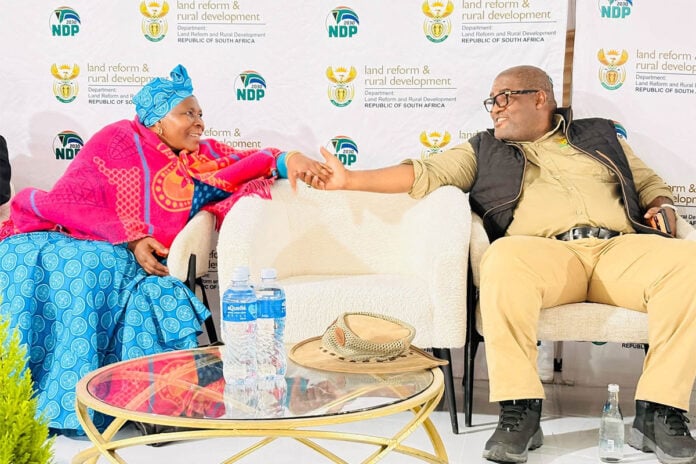
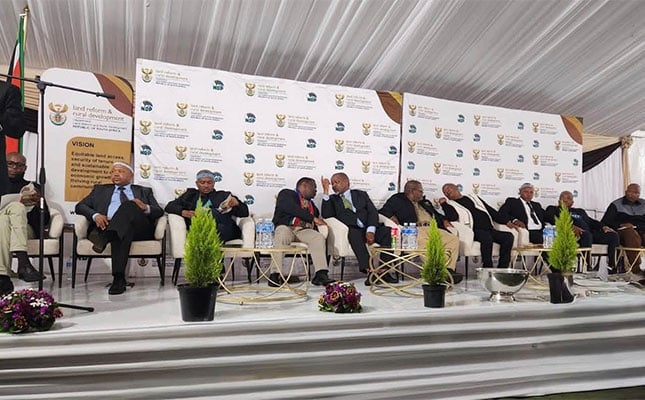
The Integrated Land Reform and Rural Development Support Programme (ILRRDSP), launched by Minister of Land Reform and Rural Development Mzwanele Nyhontso at Nywarha Village in the Eastern Cape on 26 October, seeks to combine financial assistance, technical expertise, infrastructure development, skills training, and market access into one support system.
Speaking at the launch, which was held under the theme ‘From Land Access to Sustainable Livelihoods: Empowering Rural Communities through Integrated Support’, Nyhontso said the Department of Land Reform and Rural Development (DLRRD) had allocated R1,2 billion to the programme for the current financial year, of which R500 million was contributed by Lank Bank. The funding would be distributed across all nine provinces, and the remaining R800 million would be allocated in the next financial year.
Individual provincial allocations range from R100 million to R170 million, based on their respective shares of landholdings.
Nyhontso said land reform had too often been treated as a property transaction, without providing beneficiaries with the resources to use their land productively.
“Returning land without comprehensive and restorative support for those who receive it is not justice, but it is an empty gesture. Land without the means to productively use it simply perpetuates the inequalities of the past,” he explained.
He added that historical dispossession had deprived African communities not only of their land but also their cattle, labour, cultural dignity, and economic opportunities.
One coordinated support system
Nyhontso said the ILRRDSP aims to address fragmented government support, which could leave farmers moving between different institutions to access funding and assistance, often without securing the support they need.
According to him, the DLRRD wants beneficiaries to enter one coordinated process and have a clear pathway to financial support, technical advice, infrastructure, and markets.
“The practice of sending a farmer from one institution to another will be a thing of the past,” he added.
Speaking to Farmer’s Weekly, DLRRD Director-General Bongikhaya Dayimani described the programme as a strategic intervention to provide integrated development support to land reform beneficiaries and rural communities.
He said it would combine financial and non-financial assistance to improve livelihoods, strengthen enterprises, increase the productive use of land and assets, and support infrastructure development and the sustainability of rural economies.
“The programme will cater to households, communal property associations, commonage farmers, co-operatives, and producer groups. Restitution communities will also have access to capital, expertise, and partnerships to develop reclaimed land. Women, young people, military veterans, and farmworkers are among the priority groups, with particular attention being given to investment in communal areas,” Dayimani explained.
Funding and infrastructure partnerships
Nyhontso said the DLRRD was also looking to strengthen partnerships with development finance institutions and commercial banks to expand funding options.
He said the Development Bank of Southern Africa (DBSA) will provide transactional advisory services, while engagements with the Industrial Development Corporation, other development finance institutions, and commercial banks are expected to support blended financing.
According to Nyhontso, R500 million of the R2 billion had already been committed through Land Bank for a blended finance scheme.
Nyhontso said support would extend beyond farming inputs such as tractors, seed, and irrigation infrastructure.
“The programme also identifies agriculture, tourism, and manufacturing as catalytic sectors that can create jobs, strengthen supply chains, and stimulate local economies. This could include community-owned tourism ventures, agro-processing facilities, and small factories close to sources of raw materials, as well as access roads, storage facilities, and digital connectivity. Agriculture is the foundation, but the ILRRDSP reaches far beyond farming,” he said.
Beyond funding
Wandile Sihlobo, presidential envoy on agriculture and land, welcomed the funding but stressed that successful land reform would require cooperation between government departments and the private sector.
“The work of the Department of Land Reform and Rural Development to support new land reform beneficiaries and rejuvenate the agricultural economy is critical for our long-term agenda of job creation and rural economic revival. The funding made available will go a long way, and more is needed,” he told Farmer’s Weekly.
Sihlobo added that joint efforts between the Department of Agriculture and agribusinesses would be essential.
“We also need intervention in other departments in addressing general constraints such as poor road networks, stock theft, and poor service delivery in municipalities, all of which are critical for supporting agricultural growth and market access for new-entrant farmers and existing commercial farmers,” he said.
Kgosi Thabo Seatlholo, chairperson of the National House of Traditional and Khoi-San Leaders, also welcomed the programme, emphasising the need for traditional leadership to work with government to make land available for productive development.
He said the initiative was a significant step towards advancing rural development, agricultural productivity, job creation, and economic inclusion.
“Communities need more than access to land, they require the resources, infrastructure, and institutional support to use it productively and sustainably. We must ensure that the necessary investment and support reach communities,” Seatlholo said at the launch.
The DLRRD issued its first call for expressions of interest and applications for development support in September this year, and applications are now closed.
Applications for the current production season, along with assessments of infrastructure needs, are now being evaluated.
Nyhontso said the DLRRD is committed to speeding up decisions, communicating outcomes, and ensuring approved beneficiaries receive support without unnecessary delays.