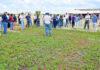
On the second day of Nampo Cape 2026, Bredasdorp Park was even busier than the first, and while stalls traded briskly and various machinery and animal handling demonstrations lured a steady stream of spectators, sector leaders were getting stuck into pressing matters.
Dr Jack Bloom, newly-appointed deputy minister of the Department of Water and Sanitation, is spending two full days at Nampo Cape, arriving at lunchtime on Wednesday and leaving late morning on Friday, ending his trip to the show with an address on enforcing the water economy.
On 10 September, he started the day with a meeting with Dr Theo de Jager, executive director of the Southern African Agri Initiative (SAAI), and Bennie van Zyl, general manager of TAU SA. He then attended a seminar for emerging farmers, addressing the group on the need to move away from centralised sewage management and the potential of processing sewage sludge and repurposing it as fertiliser, thereby reducing the country’s dependence on imported fertiliser and creating employment in rural areas.
De Jager told Farmer’s Weekly that this was the first time in decades that any minister or deputy minister of water affairs had attended a Nampo show, and said it was encouraging that Bloom was willing to meet with them even before the grounds opened.
“We spoke to him about the uncertainty among farmers amid threats that farmers’ water rights may be taken away, and the fact that farmers are getting fined hundreds of thousands of rand for developing water infrastructure. While licences for this infrastructure may not have been issued, the department has, in many places, still not yet verified the water rights in many parts of the country.”
From VUCA to BANI
Meanwhile, Absa AgriBusiness launched its AgriTrends Spring 2026 report, highlighting the growing complexity farmers faced in making production and business decisions. A key focus was the coming El Niño, which forecasts suggested could potentially be one of the most severe on record. However, the report noted that farmers were entering the drier cycle with high soil moisture levels, full dams and significant carry-over grain stocks.
The report also explored the shift from a VUCA (volatile, uncertain, complex, and ambiguous) world to a BANI environment (brittle, anxious, non-linear and incomprehensible) as geopolitical tensions, volatile markets and increasingly unpredictable weather created new risks for agriculture.
Invest in your land
Another highlight of Day 2 was the panel discussion hosted by Farmer’s Weekly with Dr Michael Southwood, a well-known independent agronomist and horticultural consultant, Dr Johan Strauss, a senior scientist at the Western Cape Department of Agriculture, and Daneel Rossouw, Nedbank’s head of agriculture relationships, which explored the risks associated with El Niño and ways in which farmers could improve resilience by investing in their soil by adopting conservation agriculture and managing their finances proactively.