

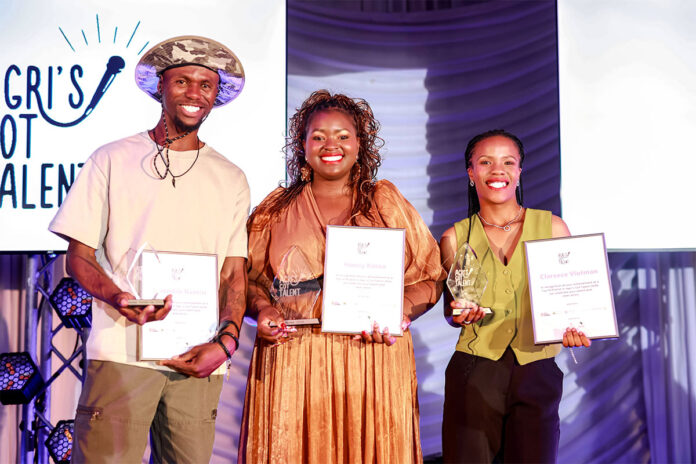
Speaking to Farmer’s Weekly, twenty-nine-year-old Katoo said talent existed in small rural communities, but remained unnoticed because residents had few opportunities to showcase it.
“There is so much talent in the community that I come from. However, it isn’t recognised because we come from a small place.
“Working for Endulini has helped us to be seen, because to enter the competition, you have to be working in agriculture,” she explained.
Now in its twelfth year, Agri’s Got Talent (AGT) gives workers in South Africa’s fruit and wine industries an opportunity to develop and showcase their musical talent through a week of coaching, personal development, and competition.
The initiative is supported by Hortgro, the Citrus Growers’ Association of Southern Africa, the South African Table Grape Industry, South Africa Wine, and the Western Cape Department of Agriculture.
Back-to-back titles
Katoo said Jantjies’s success had convinced her that someone from a small community such as Patensie could win the competition.
“The fact that [Jantjies] comes from a small place like Patensie and won [the competition] inspired me to enter. If she could do it, then I definitely thought I could do it. I decided to grab the opportunity, I entered, and I won!” she said.
Katoo performed the songs ‘And I Am Telling You I’m Not Going’ from the musical Dreamgirls and Beyoncé’s ‘Spirit’ during the final, earning near-perfect scores.
Clareece Vlotman of Wolfpack in Wolseley finished second, and Lwandile Nantsi from Laastedrif in Ceres placed third.
Previous winner sparked ‘ripple effect’
Thea van Zyl, project manager for AGT, said Patensie’s consecutive victories showed how one person’s achievement could encourage others around them to follow suit.
“When someone from a close-knit community does well, they plough back into it and encourage others to take part, and that’s exactly what the training week is about,” she explained.
“Jenedine Jantjies went home to a hero’s welcome last year, and that pride and encouragement helped pave the way for Honey. We see the same pattern elsewhere, which tells us the ripple effect is real,” Van Zyl added.
Katoo began singing at school, before completing an acting degree at AFDA. In 2021, she received a golden ticket on Idols, but her priorities changed when she became a mother.
She said the victory meant much to her young daughter, Zuri, and her mother.
“They also love music. We’re a musical family, and I hope Agri’s Got Talent will be my breakthrough into reaching my goals and dreams,” Katoo said.
She also hopes to obtain funding to complete a teaching diploma and teach children about music.
“My plan is to continue singing and performing. I’m grateful for the opportunity and the experience,” Katoo noted.
Training develops Agri workers
Van Zyl said improved self-confidence was the most visible change among finalists, but the effects of the competition go deeper.
“Finalists gain a sense of belonging, and many find peace with their own reality, along with hope for the future. They come to realise their value, in agriculture and in their communities,” she said.
Alongside voice coaching, finalists attended self-development workshops with a social worker. Van Zyl said they returned to their families and workplaces with new friendships and greater self-belief.
She pointed to Jason Baartman as an example of the programme’s longer-term impact.
Baartman, from Tulbagh in the Western Cape, entered as a rapper in 2017 and came second. He has since grown his agricultural career while developing his music and now performs at festivals, including Toyota Stellenbosch Woordfees and the KKNK.
“Jason shows that AGT isn’t about taking people out of agriculture, but about helping them grow and lead from within it, and then give back to lift the next group,” Van Zyl said.