
As weather extremes become more frequent and growing conditions become less predictable, the measure of a successful crop is not only yield under ideal conditions, but the focus is increasingly on how well a crop performs under adverse and changing conditions.
For producers, however, the objective remains the same: achieving the best possible performance from every hectare.
“Crop resilience is becoming increasingly important when talking about productivity,” Venessa Moodley, biostimulant lead at Omnia Nutriology, stresses in a recent news release.
She adds that decisions made early in the season can affect how effectively a crop responds when conditions change. While genetics, crop nutrition and sound agronomic practices remain fundamental, the focus is shifting to early adaption to environmental pressures before these limit growth and productivity.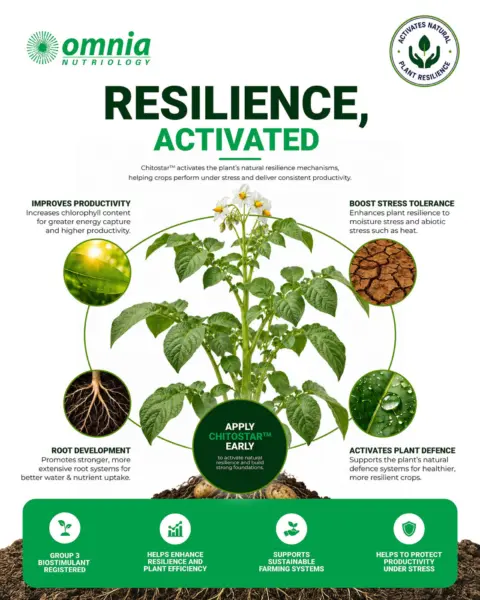
This means that producers need to think differently about crop performance and management.
“Yield will always be an important measure of success, but increasingly we also need to think about protecting yield potential,” says Moodley.
“The question is not only how a crop performs when conditions are favourable, but how effectively it can respond when drought, heat or other environmental pressures begin to affect growth.”
The importance of biostimulants
This is where biostimulants are becoming an increasingly important part of the crop management toolbox. As agriculture faces challenges from climate change, water scarcity, soil degradation, and pest pressure, improving crop resilience has become just as important as maximising yield. Biostimulants can play a significant role in helping crops withstand these stresses while maintaining productivity.
Unlike traditional nutrition products, biostimulants work by influencing the plant’s own physiological processes. They help stimulate natural responses that support crops as they prepare for abiotic stresses such as drought and heat, helping them maintain growth, recover more effectively, and make better use of available resources throughout the season.
When applied correctly, quality biostimulants have the ability to provide effective solutions to many of the challenges farmers are facing.
“Biostimulants play a key role in supporting nutrient uptake, nutrient-use efficiency, root development and overall plant health,” says Moodley.
“Alongside sound nutrition and agronomic practices, biostimulants help optimise crop performance and strengthen tolerance to environmental stress factors. Early application of the right biostimulant can help to prepare the plant before challenging conditions begin to affect growth.”
Omnia’s liquid biostimulant
The chitosan in Chitostar, Omnia’s liquid biostimulant, acts as an elicitor that helps to activate the plant’s natural defence responses. Elicitors are compounds that stimulate a plant’s defence mechanism and bind to plant cell receptors to trigger the production of protective secondary metabolites.
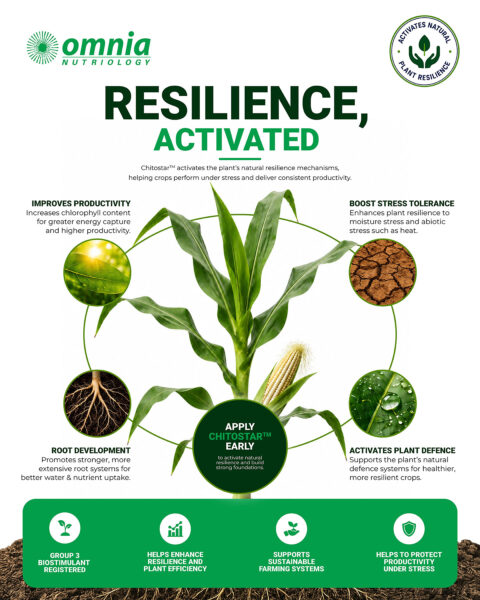
Once activated, these defence pathways help support stronger cell walls, stimulate defence-related enzymes, and enhance metabolic activity that enables the plant to continue functioning efficiently under challenging conditions.
“It essence, the defence pathways support improved chlorophyll production, stronger biomass accumulation and more consistent growth throughout the season,” Moodley explains.
Chitostar, registered as a biostimulant under the Fertilizers, Farm Feeds, Agricultural Remedies and Stock Remedies Act (No. 36 of 1947), complements existing crop nutrition programmes and integrate into standard fertiliser practices. In addition to its biostimulant activity, it supplies zinc, manganese and copper micronutrients that play an important role in enzyme function and plant metabolism.
“Research has demonstrated significant improvements in chlorophyll production and root and shoot biomass under both water-stressed and favourable conditions. Field evaluations across multiple crops have also shown improvements in plant performance that translated into measurable yield responses,” Moodley points out.
She stresses that no product can remove environmental risk altogether, but says that biostimulants are providing producers with additional tools to help crops withstand the challenges that inevitably occur during a growing season and support more consistent crop performance.
“Rather than waiting for stress to become visible and responding once plant performance has already been affected, producers now have the ability to support the plant’s ability to prepare for the season ahead.”
Biostimulants are becoming an important tool in climate-smart agriculture as they can help crops remain productive when conditions are less than ideal. In a future where weather extremes are expected to become more frequent, crop resilience is as valuable as yield itself.
For more information, visit nutriology.co.za.