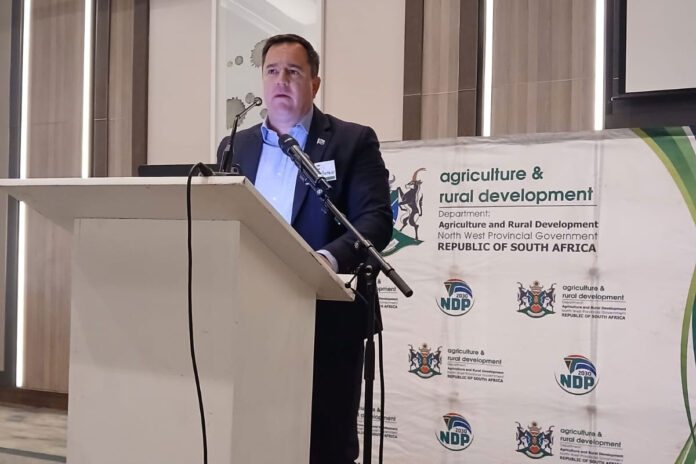
Addressing delegates under the theme ‘Pollinators for Food Security, Economic Growth and Rural Transformation’, Steenhuisen said healthy pollinator populations are fundamental to the productivity of many of South Africa’s most valuable horticultural industries.
“Pollination is a productive asset that supports the competitiveness of South African agriculture,” he said.
He noted that discussions about agricultural competitiveness often focus on water, transport infrastructure, market access, and biosecurity, arguing that pollination deserves equal recognition because it underpins the production of many export crops.
Managed honeybee colonies play a vital role in pollinating crops such as citrus, apples, pears, macadamias, avocados, and berries, contributing to improved fruit set, better-quality produce, and more consistent yields. Steenhuisen said these gains benefit the entire value chain, from producers and processors to retailers and exporters.
He added that South Africa has built a global reputation for producing high-quality agricultural products despite operating on a much smaller scale than many competing countries.
“Our competitive advantage depends on functioning logistics, reliable biosecurity systems, scientific innovation, investment, and strong relationships between government and industry.
“Increasingly, I believe it also depends on recognising productive assets that have not always received the attention they deserve. Pollination is one of those assets.”
Steenhuisen also highlighted the economic potential of the country’s beekeeping industry. Citing trade figures, he said South Africa exported approximately R11,9 million worth of natural honey during the first four months of 2026, around 35% more than the same period last year.
Botswana is the country’s largest export destination, while Lesotho, Eswatini, Mozambique, and Namibia are important regional markets.
However, South Africa remains a net importer of honey. In April alone, honey imports exceeded R18 million, compared with exports of about R3 million, with most imports coming from China due to its production scale and lower costs.
Steenhuisen said these figures demonstrate strong domestic and regional demand while highlighting opportunities to expand local production through healthier bee populations, improved forage resources, effective disease management, and increased commercial investment.
He also stressed the importance of maintaining consumer confidence through proper product standards.
“South African consumers should be able to purchase honey with confidence that it is authentic, accurately labelled, and compliant with applicable food standards,” he said, adding that honest producers should not be disadvantaged by fraudulent or adulterated products.
Steenhuisen said strengthening the pollination economy requires collaboration between government, industry, and researchers. He pointed to ongoing work by the Agricultural Research Council and universities on honeybee health and disease surveillance as examples of research that directly supports agricultural productivity.
In addition, he identified beekeeping as an accessible entry point into agriculture for young people, women, and rural entrepreneurs, provided they receive the appropriate technical support, mentorship, and market access.
Looking ahead, Steenhuisen said South Africa’s ambitions to expand agricultural exports and increase value addition will depend on investments made long before products reach processing plants or export terminals.
“When we recognise pollination as productive agricultural infrastructure, we also begin making different decisions about research, investment, and long-term planning.
“It is not simply about producing more honey. It is about strengthening the productive systems that allow South African agriculture to compete with the very best in the world.”
At the time of writing, John Steenhuisen had not yet been replaced by Willie Aucamp as minister of agriculture.